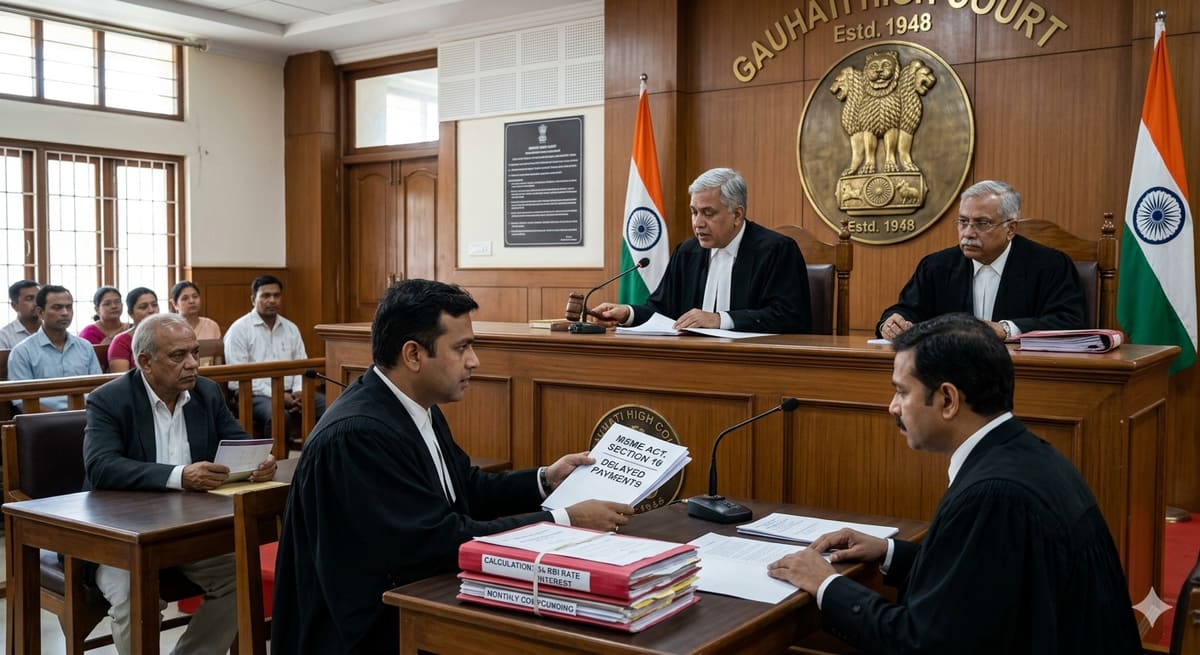
The Supreme Court has clarified that while borrowers are not entitled to a personal hearing before their loan accounts are classified as fraud under RBI guidelines, they are unequivocally entitled to full disclosure of forensic audit reports. This landmark ruling balances the need for swift regulatory action against the fundamental right to a fair hearing, setting a new benchmark for procedural fairness in banking fraud proceedings.
Background & Facts
The Dispute
The dispute centers on whether commercial banks, acting under Reserve Bank of India (RBI) directives, must provide borrowers with a personal oral hearing before classifying their loan accounts as "fraud." The borrowers argue that such classification triggers severe civil consequences - including blacklisting from institutional finance, disqualification under the Insolvency and Bankruptcy Code, and exposure to criminal proceedings - thereby necessitating a full opportunity to be heard. The banks and RBI contend that the process is administrative, not adjudicatory, and that written submissions, coupled with a reasoned order and disclosure of findings, satisfy the requirements of natural justice.
Key Facts
-
State Bank of India (SBI) v. Amit Iron Private Limited & Ors. (Civil Appeal arising out of SLP(C) Nos. 20618-20619/2025):
- Loan account of respondent No. 1 classified as Non-Performing Asset (NPA) on 20.08.2019 due to repayment defaults.
- Show cause notice issued on 27.12.2023 alleging fraudulent conduct under RBI Master Directions-2016.
- Replies submitted by respondents on 08.02.2024.
- Account classified as "fraud" on 13.03.2024 via a reasoned order.
- No personal hearing was granted.
- Writ petition filed before Calcutta High Court on 14.03.2024.
- Single Judge’s judgment dated 07.08.2024 directed personal hearing and disclosure of forensic audit reports.
- Division Bench dismissed SBI’s appeal on 12.03.2025, upholding the Single Judge’s directions.
-
Bank of India v. M/s Liliput Kidswear Limited (Civil Appeal arising out of SLP(C) Diary No. 55628/2025):
- Account classified as NPA on 27.03.2012.
- First forensic audit conducted; show cause notice issued on 18.08.2023.
- Second show cause notice issued on 03.01.2024 incorporating findings of a second forensic auditor.
- Replies filed on 04.02.2024.
- Account classified as "fraud" on 14.05.2025.
- No personal hearing provided.
- Writ petition filed before Delhi High Court.
- Single Judge’s judgment dated 06.06.2025 quashed the fraud classification and directed personal hearing and disclosure.
- Division Bench confirmed the order on 29.07.2025.
Procedural History
-
SBI v. Amit Iron Private Limited:
- 20.08.2019: Account classified as NPA.
- 27.12.2023: Show cause notice issued.
- 08.02.2024: Borrower’s reply submitted.
- 13.03.2024: Fraud classification order passed.
- 14.03.2024: Writ petition filed before Calcutta High Court.
- 07.08.2024: Single Judge allows petition, directs personal hearing and disclosure.
- 12.03.2025: Division Bench dismisses appeal, upholds Single Judge’s order.
- 20.06.2025: SLP filed before Supreme Court.
- 04.11.2025: RBI impleaded as respondent.
- 07.04.2026: Supreme Court judgment delivered.
-
Bank of India v. Liliput Kidswear Limited:
- 27.03.2012: Account classified as NPA.
- 18.08.2023: First show cause notice issued.
- 03.01.2024: Second show cause notice issued.
- 04.02.2024: Borrower’s reply submitted.
- 14.05.2025: Fraud classification order passed.
- 15.05.2025: Writ petition filed before Delhi High Court.
- 06.06.2025: Single Judge quashes order, directs personal hearing and disclosure.
- 29.07.2025: Division Bench confirms Single Judge’s order.
- 15.08.2025: SLP filed before Supreme Court.
- 04.11.2025: RBI impleaded.
- 07.04.2026: Supreme Court judgment delivered.
The Parties' Positions
-
Appellants (SBI and Bank of India): Argued that the classification of fraud is an internal administrative action, not a quasi-judicial proceeding. They contended that the issuance of a detailed show cause notice, consideration of written replies, and issuance of a reasoned order fully satisfy the principles of natural justice. They emphasized the volume of fraud cases (over 23,953 in FY 2024-25), the risk of asset dissipation, and the need for speed in reporting to law enforcement.
-
Respondents (Borrowers): Argued that fraud classification constitutes "civil death," severely impacting rights under Article 19(1)(g) and reputation. They relied on State Bank of India v. Rajesh Agarwal (2023) to assert that the Supreme Court had already mandated personal hearing as part of natural justice. They contended that the forensic audit report is central to the case and must be fully disclosed, not just its conclusions.
-
RBI (Impleaded Respondent): Supported the banks, asserting that its Master Directions-2024 were carefully crafted to incorporate natural justice without compromising operational efficiency. It emphasized that personal hearings would paralyze the system and undermine timely detection of fraud.
Relief Sought
The borrowers sought:
- A declaration that personal hearing is mandatory before fraud classification.
- A direction to furnish the complete forensic audit reports.
- Setting aside of the fraud classification orders dated 13.03.2024 and 14.05.2025.
- Costs.
The banks sought:
- Setting aside of the High Court directions requiring personal hearing.
- Clarification that only the conclusions of forensic reports need be disclosed.
- Upholding of the fraud classification orders.
The Legal Issue
The central questions are: (1) Does the principle of audi alteram partem under the RBI Master Directions require a personal oral hearing before classifying a borrower’s account as fraud? (2) Is the full forensic audit report, or merely its conclusions, required to be disclosed to the borrower to satisfy natural justice?
Arguments Presented
For the Appellant/Petitioner
The banks and RBI contended that Rajesh Agarwal (2023) did not mandate personal hearing. They argued that the phrase "reply and representation" in Rajesh Agarwal referred to written submissions, not oral hearings. They cited A.K. Kraipak v. Union of India, Union of India v. Jyoti Prakash Mitter, and Jah Developers to establish that natural justice is flexible and does not require oral hearings in administrative contexts. They emphasized the administrative nature of fraud classification, the scale of fraud (Rs. 36,014 crores in FY 2024-25), and the risk of asset dissipation if borrowers are given advance notice. They further argued that the Master Directions-2024, which codify notice, reply, and reasoned order, are a sufficient and balanced framework.
For the Respondent/State
The borrowers relied on Rajesh Agarwal (2023), particularly paragraphs 75, 81, and 98.6, to argue that the Supreme Court had implicitly recognized personal hearing as part of natural justice. They pointed to the use of the word "representation" alongside "reply" as evidence of a distinct oral opportunity. They cited T. Takano v. SEBI to argue that all material relevant to the decision must be disclosed, and that forensic audit reports are central, not peripheral, evidence. They contended that the consequences of fraud classification - blacklisting, insolvency disqualification, reputational harm - elevate the process to a quasi-judicial level requiring full procedural safeguards. They rejected the banks’ claims of impracticality, noting that personal hearings under wilful defaulter guidelines are already operational.
The Court's Analysis
The Court undertook a meticulous analysis of Rajesh Agarwal (2023), the RBI Master Directions-2016 and 2024, and the evolving jurisprudence on natural justice. It began by noting that the 2016 Directions were silent on natural justice, prompting the Court in Rajesh Agarwal to read in procedural safeguards. However, the Court held that the judgment did not mandate personal hearing.
"We are not persuaded to read the said phrases like a statute. Read in the context of the entire judgment, it is clear that what was contemplated was only a Show Cause Notice, a written representation in the form of a reply."
The Court emphasized that natural justice is not a rigid doctrine but a flexible principle shaped by context. It cited A.K. Kraipak, Union of India v. Jyoti Prakash Mitter, and Madhya Pradesh Industries to affirm that written representation suffices unless the nature of the proceeding demands otherwise. The Court rejected the borrowers’ reliance on Goldberg v. Kelly, noting that U.S. due process jurisprudence has been explicitly rejected in Indian law (A.K. Roy v. Union of India).
On the issue of forensic audit reports, the Court held that disclosure is mandatory. It relied on Rajesh Agarwal (para 95) and T. Takano v. SEBI to establish that any material relied upon in the decision-making process must be disclosed. The Court rejected the banks’ argument that disclosure would compromise criminal investigations:
"Once the criminal proceedings are launched, Investigating Authority will independently investigate and file a charge sheet/complaint of which the forensic audit report may be a part."
The Court recognized that third-party privacy or market stability may justify redaction, but imposed a two-step test: (1) the bank must prima facie establish that disclosure would harm third-party rights, and (2) the borrower may then demonstrate that the information is necessary to defend their case. The burden of proof shifts accordingly.
The Court also clarified that the Master Directions-2024, particularly Clause 2.1.1.1 - 2.1.1.4, correctly reflect the Rajesh Agarwal framework: detailed notice, 21-day reply period, consideration of submissions, and a reasoned order. The Court held that this framework strikes the right balance between procedural fairness and administrative efficiency.
The Verdict
The Supreme Court partially allowed both appeals. It set aside the High Court directions requiring personal hearing but upheld the directions mandating disclosure of forensic audit reports. The Fraud Identification Committees of both banks are directed to furnish the complete forensic audit reports to the borrowers. Borrowers must be given a reasonable opportunity to submit written representations on the reports. The banks may redact only those portions that impinge on third-party privacy or market stability, subject to the burden-shifting test outlined in T. Takano. Fresh orders on fraud classification must be passed after considering these representations. There will be no order as to costs.
What This Means For Similar Cases
Disclosure of Forensic Reports Is Mandatory, Not Optional
- Practitioners must now treat forensic audit reports as core evidence, not background material.
- Banks must disclose the full report unless they can prima facie justify non-disclosure on grounds of third-party privacy or market stability.
- Borrowers may challenge redactions by demonstrating how the withheld information is necessary to their defense.
- Digital disclosure is valid compliance; physical copies are not required.
Written Representation Suffices; Personal Hearing Is Not Required
- Banks need not schedule oral hearings for fraud classification proceedings.
- The issuance of a detailed show cause notice and consideration of written replies, followed by a reasoned order, satisfies audi alteram partem.
- Legal challenges based on denial of personal hearing will fail unless the proceeding involves deprivation of liberty or a statutory mandate for oral hearing.
- This applies to all RBI-regulated entities, including private banks, RRBs, and financial institutions.
Regulatory Frameworks Must Align with Natural Justice, Not Circumvent It
- The RBI’s Master Directions-2024 serve as a model for balancing speed and fairness.
- Courts will defer to regulatory frameworks that incorporate procedural safeguards, provided they are not arbitrary.
- Borrowers cannot claim parity with wilful defaulter procedures, as fraud involves criminal intent and distinct regulatory objectives.
- Any future RBI circulars must explicitly state whether personal hearing is required; silence will be interpreted as dispensable.
Procedural Compliance Is Non-Negotiable
- Failure to disclose forensic reports will invalidate fraud classification orders.
- Reasoned orders must reference the specific findings in the report and explain how the borrower’s representations were addressed.
- Courts may call for the original audit report to verify compliance with disclosure obligations.
- Delay in classification beyond the 180-day window under the Master Directions may be grounds for challenging the order’s validity.
The Doctrine of Merger and Precedent Control
- High Court judgments ordering personal hearing are overruled.
- The Supreme Court’s interpretation in Rajesh Agarwal is binding, and subsequent clarifications (or lack thereof) do not alter its holding.
- Banks cannot rely on inconsistent conduct in other cases to argue for a right to personal hearing.