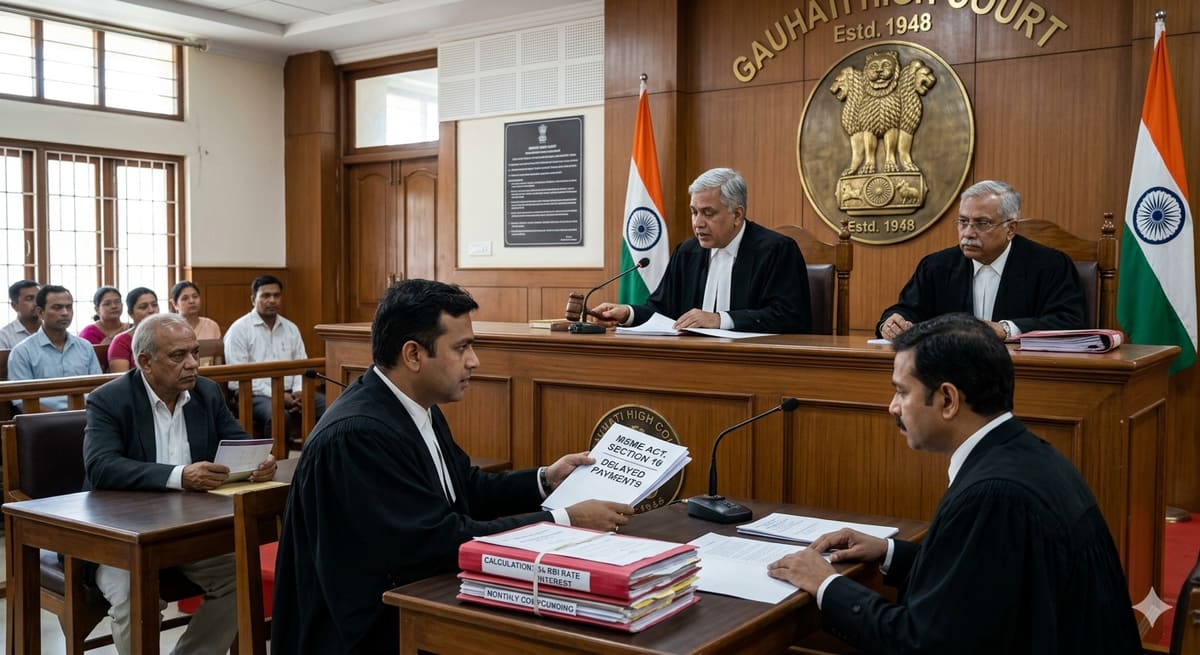
The Calcutta High Court has reaffirmed that procedural fairness under natural justice is non-negotiable when banks classify borrower accounts as fraud under RBI Master Directions. The judgment clarifies that withholding forensic audit materials before issuing show cause notices undermines the borrower’s right to a meaningful reply, regardless of the summary nature of the process.
Background & Facts
The Dispute
The petitioners, Hemant Kanoria and another, challenged show cause notices issued by Karnataka Bank Limited on 19th March 2024, directing them to explain why the accounts of SREI Infrastructure Finance Limited and SREI Equipment Finance Limited should not be declared "fraud" under the Reserve Bank of India Master Directions on Fraud Risk Management. The notices relied on a Forensic Audit Report (FAR) but did not include the report or its supporting documents.
Procedural History
- 19 March 2024: Show cause notices issued by Karnataka Bank.
- 1 April 2024: Petitioners received the notices.
- No reply filed: Petitioners did not submit a response to the notices.
- 10 February 2026: Writ petition filed before the Calcutta High Court.
- 14 January 2026: Hearing concluded.
Relief Sought
The petitioners sought quashing of the show cause notices on grounds of violation of natural justice, specifically the failure to provide access to the Forensic Audit Report and underlying documents necessary to formulate a meaningful reply.
The Legal Issue
The central question was whether natural justice requires a bank to serve the Forensic Audit Report and its supporting documents alongside a show cause notice under the RBI Master Directions, before declaring an account as "fraud".
Arguments Presented
For the Petitioner
The petitioners, led by Senior Advocates Ratnanko Banerjee and Jishnu Chowdhury, argued that the show cause notices were issued in violation of the principles of audi alteram partem. They relied on Hemant Kanoria v. Bank of India (W.P.A. 28329 of 2023) and Milind Patel v. Union Bank of India (2024 SCC Online Bom 745), both holding that access to material on which allegations are based is indispensable. They contended that without the FAR, the petitioners could not identify specific factual assertions to rebut, rendering any reply futile.
For the Respondent
The bank, represented by Dhruv Dewan, argued that the FAR had already been supplied prior to the issuance of the notices and that the petitioners’ failure to file a reply precluded their challenge. It invoked the Hemant Kanoria precedent to assert that the process under RBI Master Directions is summary in nature, and undue emphasis on technicalities would impede timely fraud detection. The bank maintained that the notices themselves enumerated the allegations sufficiently.
The Court's Analysis
The Court examined the balance between procedural rigor and the exigencies of financial regulation. It acknowledged the summary character of the RBI Master Directions but emphasized that summary procedures cannot override fundamental principles of natural justice. The Court relied on its own earlier decision in Hemant Kanoria v. Bank of India, which had laid down clear guidelines: a show cause notice must enumerate exact allegations, and if a Forensic Audit Report forms the basis of those allegations, it must be served with the notice.
"First, a show-cause notice is to be issued, enumerating the exact offences alleged against the borrower/Director. If any FAR or other document forms the basis of the show-cause, the same is to be served along with the show-cause notice."
The Court rejected the bank’s claim that the FAR had been previously supplied, noting that no evidence was placed on record to substantiate this assertion. Crucially, the Court held that the petitioners’ failure to file a reply did not cure the initial procedural defect. The right to be heard must be meaningful, not theoretical. A borrower cannot be expected to respond to allegations without knowing the evidentiary foundation. The Court distinguished between procedural delay and substantive denial of opportunity.
The Verdict
The petitioners’ writ petition was dismissed, not on the merits of the fraud allegations, but because they failed to exhaust the remedy of filing a reply to the show cause notice. However, the Court held that natural justice requires the Forensic Audit Report to be served with the show cause notice, and the bank’s failure to do so remains a procedural flaw. The petitioners retain the right to file a reply.
What This Means For Similar Cases
Forensic Audit Reports Must Be Supplied with Show Cause Notices
- Practitioners must insist that banks produce the FAR and all underlying documents when challenging fraud classifications.
- Banks that fail to serve the FAR alongside the notice risk having their classification set aside on grounds of procedural unfairness.
- A mere assertion that documents were "previously provided" is insufficient without documentary proof.
Failure to Reply Does Not Waive Procedural Rights
- Borrowers are not estopped from challenging procedural defects merely because they did not reply.
- Courts will not penalize a party for seeking judicial intervention when the initial notice is fundamentally defective.
- The proper course is to file a reply reserving rights to seek further documents, not to bypass the administrative process entirely.
Summary Procedures Have Limits
- The RBI’s emphasis on speed does not override constitutional principles of natural justice.
- Even in time-bound regulatory frameworks, the right to be heard must be substantive, not formal.
- Banks must document and prove service of all material relied upon, not merely assert it.