The Allahabad High Court has affirmed that compensation for railway accident deaths must be calculated based on the statutory rates in force at the time of the tribunal’s award, not at the time of the incident. This ruling clarifies the temporal application of revised compensation norms under the Railways Act and reinforces the principle that claimants are entitled to the benefit of legislative enhancements enacted during pendency of their claims.
Background & Facts
The Dispute
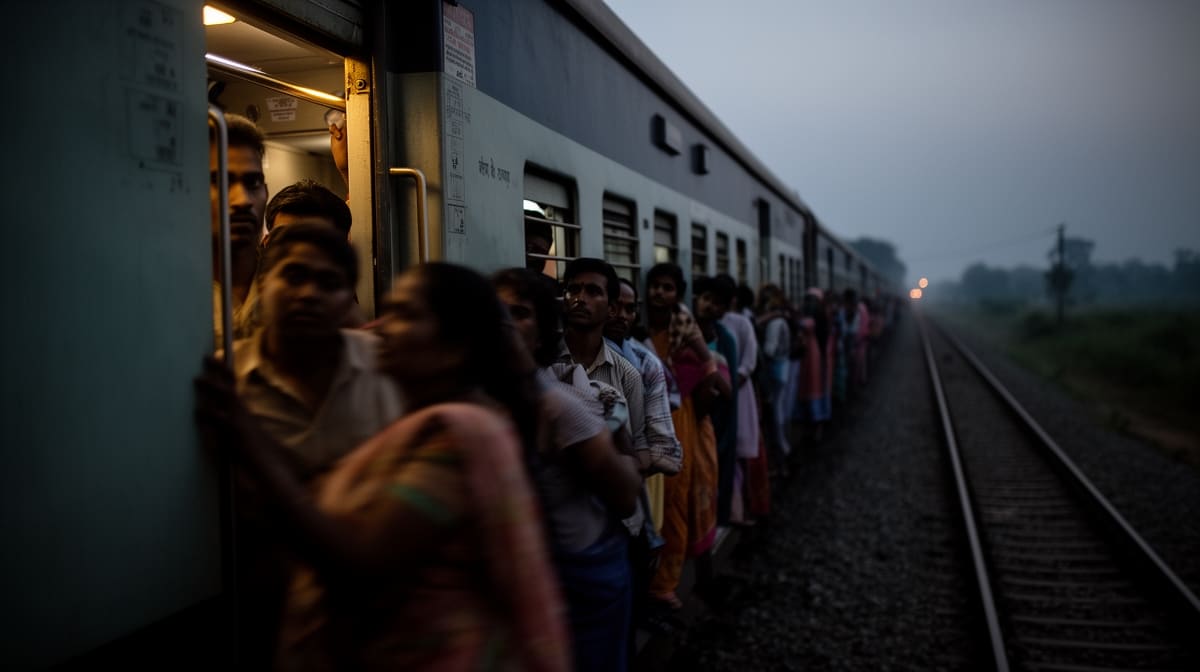
On 29.08.2008, Vijay Tiwari, a resident of Unnao, was traveling as a bonafide passenger on Train No. 2CSS (Balamau Passenger) from Unnao to Neemsaar. While standing near the door of the coach due to excessive crowd, he fell from the moving train at Balamau Junction and sustained fatal injuries, succumbing to them on the spot. His widow, Smt. Remi Tiwari, and two other dependents filed a claim petition before the Railway Claims Tribunal, Lucknow, under Section 123(c)(ii) of the Railways Act, 1989, seeking compensation for his death.
Key Facts
- The deceased held a valid second-class ticket for the journey on 29.08.2008
- The accident occurred at approximately 11:25 a.m. at Balamau Junction
- The claim petition was filed in 2008 seeking Rs. 6,00,000 as compensation
- At the time of the accident in 2008, the prescribed compensation under the Railways Act was Rs. 4,00,000
- The Union of India, through the Northern Railway, contested the claim on three grounds: (1) the deceased was not a bonafide passenger; (2) he was hit by another train (No. 4307); and (3) the compensation amount was excessive
- The Railway Protection Force (RPF) investigation report stated the deceased was traveling with his family and had fallen from the train
- The Station Master’s diary recorded the accident time as 11:25 a.m., while Train No. 4307 had passed the station at 10:25 a.m.
- The claimants submitted affidavits and railway tickets as evidence of passenger status
Procedural History
- 29.08.2008: Accident occurred at Balamau Junction
- 2008: Claim petition filed before Railway Claims Tribunal, Lucknow (Case No. O.A./II/U/995/2008)
- 22.12.2016: Union of India issued notification increasing compensation for accidental railway deaths from Rs. 4,00,000 to Rs. 8,00,000
- 01.01.2017: Revised compensation norms came into effect
- 27.01.2017: Railway Claims Tribunal awarded Rs. 8,00,000 compensation with interest, holding the deceased was a bonafide passenger and death resulted from fall from train under Section 123(c)(ii)
- 08.05.2026: First Appeal From Order No. 449 of 2017 heard and reserved
- 27.05.2026: High Court delivered judgment dismissing the appeal
The Parties' Positions
For the Appellant (Union of India)
- Argued that the deceased was not a bonafide passenger, as per RPF report suggesting he stepped off the train and was hit by Train No. 4307
- Contended that the compensation of Rs. 8,00,000 was illegal because the accident occurred in 2008, when the limit was Rs. 4,00,000
- Asserted that the claim petition did not mention the deceased was traveling with family, creating inconsistency with RPF report
- Claimed the Station Master’s records and certificate from Station Superintendent proved Train No. 4307 was the cause of death
- Argued that the Tribunal erred in relying on claimants’ testimony over official documents
For the Respondents (Claimants)
- Maintained that the deceased was a bonafide passenger holding a valid ticket
- Stated that the RPF report confirmed he fell from the train, not from stepping onto the track
- Highlighted that the Station Master admitted he was not present at the scene and his testimony was based on unverified documents
- Pointed out that Train No. 4307 passed at 10:25 a.m., while the accident occurred at 11:25 a.m., making it impossible for the deceased to have been hit by it
- Emphasized that the widow, a claimant, was not literate and could not have understood the inquest report
- Argued that the Tribunal correctly applied the revised compensation norms effective from 01.01.2017, as the award was passed on 27.01.2017
Relief Sought
The claimants sought compensation of Rs. 8,00,000 with 6% interest from the date of filing the claim petition (2008) until payment. The appellant sought dismissal of the claim or reduction of compensation to Rs. 4,00,000.
The Legal Issue
The central question was whether the compensation payable under Section 123(c)(ii) of the Railways Act, 1989 must be determined based on the rate in force at the time of the accident or at the time of the tribunal’s award, and whether the claimant’s status as a bonafide passenger can be negated by speculative inquest reports when direct evidence supports otherwise.
Arguments Presented
For the Appellant
The appellant relied on the RPF investigation report and the Station Superintendent’s certificate to argue that the deceased was not killed by falling from the train but by being struck by Train No. 4307. It contended that the claim petition’s silence on family travel created a contradiction. It further argued that the compensation amount must be governed by the statutory limit applicable at the time of the incident, citing State of U.P. v. Rameshwar and Railway Board v. K. S. Raghavan, asserting that retrospective application of enhanced compensation violates the principle of non-retroactivity. It claimed the Tribunal acted beyond its jurisdiction by awarding Rs. 8,00,000 when the law in 2008 capped it at Rs. 4,00,000.
For the Respondent
The respondents countered that the RPF report explicitly stated the deceased was traveling with family and fell from the train. They emphasized that the Station Master admitted he had no firsthand knowledge of the accident and that the certificate regarding Train No. 4307 was factually impossible given the one-hour time gap. They relied on Union of India v. Smt. Sushila Devi to argue that compensation under the Railways Act is a statutory obligation and must be awarded at the rate prevailing at the time of adjudication. They further noted that the Union itself had issued the notification enhancing compensation on 22.12.2016, effective from 01.01.2017, and the award was passed on 27.01.2017, making the higher amount legally valid.
The Court's Analysis
The Court undertook a meticulous review of the evidence and found no material inconsistency in the claimants’ case. The Tribunal’s finding that the deceased was a bonafide passenger was supported by the valid ticket, the RPF report, and the absence of any contradictory documentary evidence from the appellant.
"The Station Master himself admitted he was not present at the scene and his testimony was based on documents prepared after the fact, which he could not verify."
The Court rejected the appellant’s contention that the deceased was hit by Train No. 4307, noting the clear temporal discrepancy: the train passed at 10:25 a.m., while the accident occurred at 11:25 a.m. The Court held that the appellant failed to discharge its burden of proving an alternative cause of death.
Regarding compensation, the Court observed that the Railway Claims Tribunal is a statutory body empowered to award compensation under a remedial statute. The notification dated 22.12.2016, effective from 01.01.2017, was issued by the Union itself and applied to all pending claims. The Court held:
"Where a statutory compensation ceiling is enhanced during the pendency of a claim, and the award is rendered after the enhancement, the claimant is entitled to the benefit of the revised rate. To hold otherwise would defeat the very purpose of the enhancement and penalize the victim’s family for procedural delays."
The Court distinguished Rameshwar and K. S. Raghavan, noting those cases involved claims adjudicated before any enhancement, whereas here, the award was rendered after the revised rate came into force. The Court also dismissed the argument about the claim petition’s omission of family travel, noting that the RPF report corroborated the claimants’ version and that the widow’s illiteracy rendered her incapable of drafting a legally precise petition.
The Verdict
The appellant’s appeal was dismissed. The High Court upheld the Railway Claims Tribunal’s order dated 27.01.2017, confirming the compensation of Rs. 8,00,000 with 6% interest from the date of filing the claim petition (2008) until 31.12.2016 on Rs. 4,00,000, and from 01.01.2017 until payment on Rs. 8,00,000. The Union of India was directed to pay the full amount within eight weeks. The lower court records and a copy of this judgment were to be sent back to the Railway Claims Tribunal.
What This Means For Similar Cases
Compensation Must Reflect the Rate at Time of Award
- Practitioners must now argue that enhanced statutory compensation rates apply to all pending claims as of the date of the tribunal’s award, not the date of accident
- This applies to all claims under remedial statutes where the legislature has increased limits during litigation
- Failure to apply the revised rate constitutes a legal error and grounds for reversal on appeal
Documentary Evidence Must Be Verified, Not Assumed
- Official documents like station diaries or certificates must be authenticated by the person who prepared them or corroborated by independent evidence
- Testimony based on unverified documents, especially when the witness was not present at the scene, is insufficient to rebut direct evidence
- In railway accident claims, RPF reports and ticket records carry greater weight than speculative post-facto reports
Claimants’ Literacy and Emotional State Are Relevant to Evidence Evaluation
- Courts must account for the literacy level and emotional trauma of claimants when evaluating inconsistencies in affidavits or petitions
- Minor omissions or imprecise language in claim petitions cannot be used to discredit a claim where the overall evidence is consistent and credible
- The burden remains on the state to disprove the claimant’s version with concrete, verifiable evidence