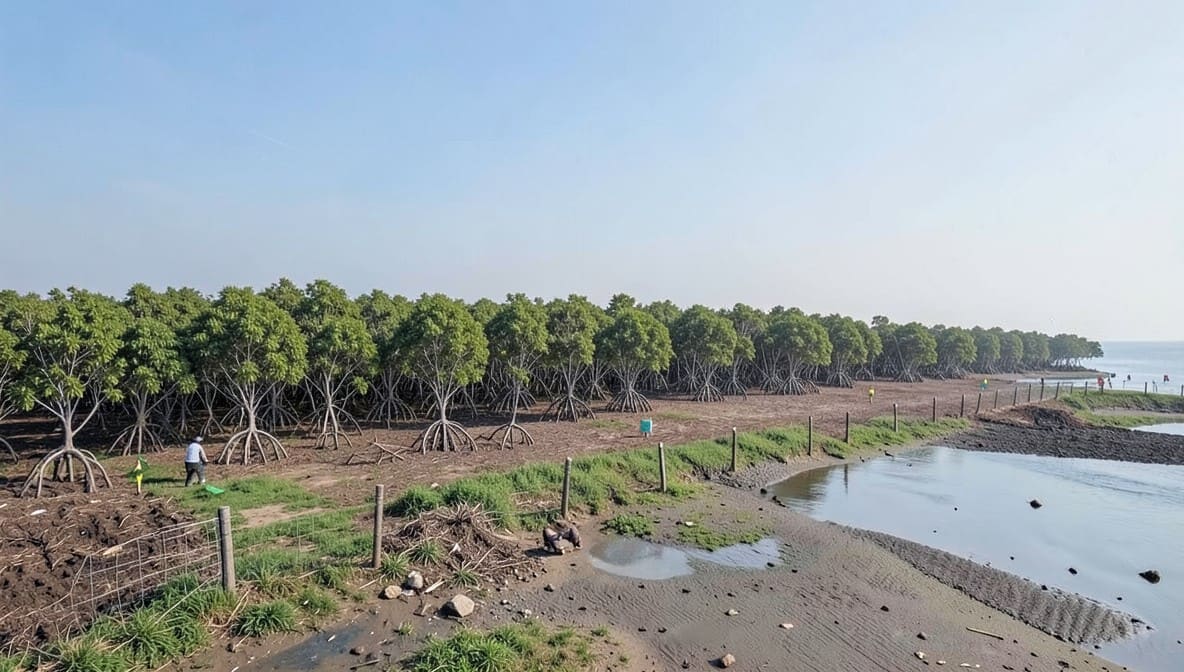
The National Green Tribunal’s dismissal of applications concerning alleged destruction of a natural water body and adjacent land underscores a critical doctrinal boundary: not all government-owned land qualifies as a public trust resource. The judgment clarifies that environmental protections under Article 21 and the Public Trust Doctrine apply only to lands formally recognized as forests, wetlands, or community resources - not merely to any uncultivated government land.
Background & Facts
The Dispute
The dispute arose from allegations that two ex-servicemen, P. Jagadeesh Babu and B. Venugopal Reddy, had illegally levelled and excavated a 10-acre tract of government land known as Muchala Kona Kunta, adjacent to the Dornakambala Reserve Forest. The applicant, S. Sivaiah Naidu, claimed the land served as a natural percolation tank feeding groundwater and irrigation for downstream farmers, and that its destruction violated ecological and public rights.
Procedural History
- December 2023: Letter petition filed by A. Gnana Sudha, triggering suo motu registration of O.A. No.193 of 2023.
- January 2024: O.A. No.11 of 2024 filed by S. Sivaiah Naidu, seeking restoration and action against assignees.
- August 2024: District Collector submitted reports from Revenue, Forest, and Irrigation Departments.
- December 2025: Judgment reserved after hearing both applications.
- February 2026: Applications dismissed after consolidation.
The Parties' Positions
- Applicant (S. Sivaiah Naidu): Argued the land was a vital ecological feature protected under the Public Trust Doctrine and Article 21.
- Respondents (Assignees & Government Authorities): Contended the land was unnotified government land, classified as a 'gap area', legally assignable under state policy to ex-servicemen.
Relief Sought
The applicant sought: (1) cessation of land levelling and excavation; (2) restoration of the percolation tank; (3) cancellation of assignment pattas; and (4) directions to enforce environmental safeguards.
The Legal Issue
The central question was whether government land classified as a 'gap area' and assigned to ex-servicemen under state policy automatically falls within the ambit of the Public Trust Doctrine and Article 21 protections, even in the absence of formal notification as forest or common property.
Arguments Presented
For the Petitioner
The applicant relied on T.N. Godavarman Thirumulkpad v. Union of India to assert that all natural resources, including ponds and hillocks, are held in trust by the state for public benefit. Citing Hincha Lal Tiwari v. Kamala Devi, they argued that such lands maintain ecological balance and are integral to the right to life under Article 21. They contended that the absence of formal forest notification does not negate the ecological function of the land.
For the Respondent
The state authorities, represented by Mr. K. Ravindranath, submitted that the land was never notified as forest under the Forest (Conservation) Act, 1980. Revenue records, satellite imagery, and field inspections confirmed the land was classified as 'gap area' - unclaimed government land eligible for assignment under G.O. Ms. No.743 of 1963 and G.O. Ms.250 of 2018. The Irrigation Department confirmed the percolation tank (Muchala Kona Kunta) was undisturbed and not a functional irrigation structure.
The Court's Analysis
The Tribunal conducted a rigorous review of documentary evidence, including revenue records, satellite maps, and departmental inspections. It emphasized that the Public Trust Doctrine does not extend to all uncultivated land but applies only to resources traditionally recognized as public assets - rivers, lakes, forests, and coastal areas - either by statutory notification or long-standing customary use.
"The land in question is not part of any notified forest area and it is only the Government land. There are also no trees existing in the land except that the same is covered by thorny bushes, grasses and light vegetation growth."
The Court noted that the Irrigation Department’s report conclusively established that the percolation tank was not disturbed, lacked sluices or weirs, and did not directly irrigate farmland. The Forest Department confirmed no forest cover existed on the land, and the Revenue Department verified lawful assignment under state policy for ex-servicemen.
The Tribunal distinguished Godavarman and Hincha Lal Tiwari by observing that those cases involved lands already recognized as ecological assets under statutory or customary frameworks. Here, the land was neither notified nor functionally integral to a recognized ecosystem. The Court held that mere adjacency to a reserve forest does not confer protected status.
The judgment reaffirmed that statutory classification trumps ecological speculation. Without formal notification or demonstrable public use as a common resource, the land remains subject to state discretion under land assignment policies.
The Verdict
The applicant’s applications were dismissed. The Court held that assignment of unnotified government land to ex-servicemen under state policy does not violate the Public Trust Doctrine or Article 21, provided no statutory forest or protected resource is disturbed. The percolation tank was found intact, and the land’s ecological function was deemed insufficient to override lawful assignment.
What This Means For Similar Cases
Assignment of Gap Areas Is Lawful Unless Notified
- Practitioners must verify whether contested land is formally notified as forest, wetland, or protected under state land use policy.
- Mere ecological utility or adjacency to a reserve forest is insufficient to challenge assignment.
- Revenue records and satellite imagery are decisive in establishing land classification.
Public Trust Doctrine Requires Formal Recognition
- The doctrine cannot be invoked based on subjective claims of ecological value.
- To succeed, petitioners must prove the resource was historically used by the public or statutorily protected.
- Environmental NGOs must now substantiate claims with official records, not just expert affidavits.
Procedural Compliance in Land Assignment Is Key
- Assignment pattas issued after public notice, committee approval, and compliance with G.O.s are presumptively valid.
- Challenges must target procedural lapses (e.g., failure to publish notices) rather than substantive ecological concerns.
- Authorities must maintain clear documentation of land classification to preempt litigation.