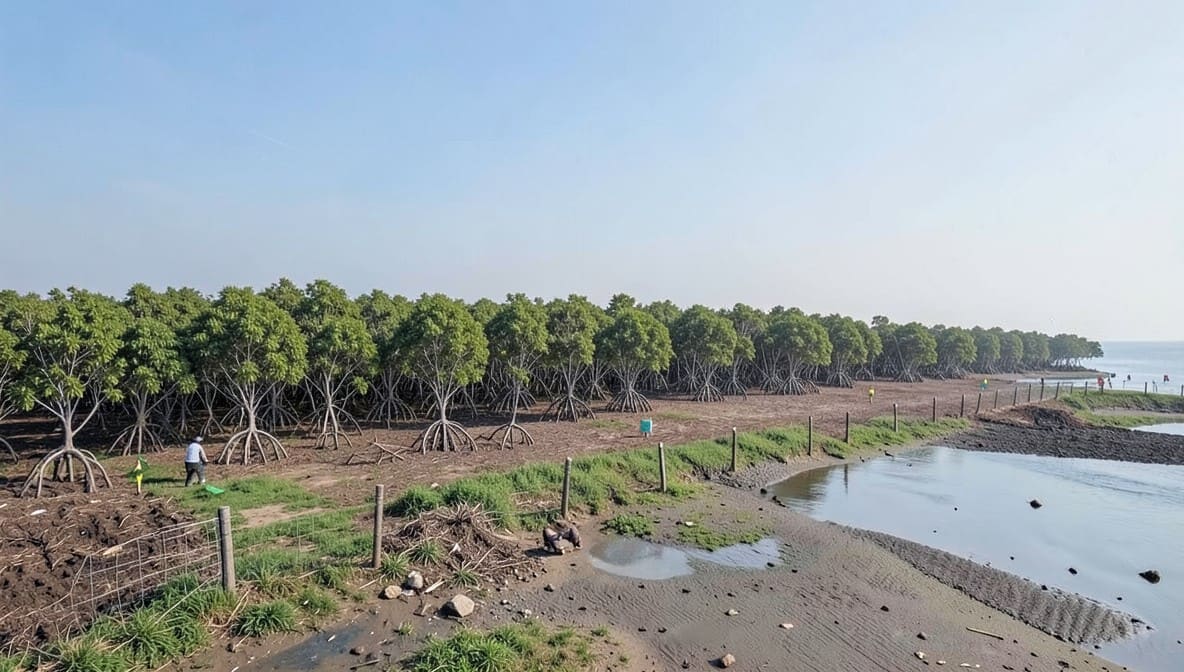
The National Green Tribunal has delivered a significant ruling affirming that pre-existing public roads, duly recorded in revenue records as non-agricultural pathways before the enactment of the Forest (Conservation) Act, 1980, are not subject to its prohibitions. The judgment clarifies that customary and prescriptive rights of passage, established through long-standing public use, prevail over subsequent forest notifications, even where the land is claimed as protected forest.
Background & Facts
The Dispute
The applicant, Mala Ram Gurjar, alleged that Respondents Nos. 8 to 17 - stone crusher and mining operators - had illegally encroached upon Reserved Forest land in Village Kishorepura, Sikar, Rajasthan, by constructing an unauthorized road for transporting minerals. The applicant claimed the road cut through Khasra Nos. 476, 477, and 698, which were part of a notified Protected Forest under the Indian Forest Act, 1927. Allegations included tree felling, environmental degradation, untimely blasting, and disruption of school operations.
Procedural History
- June 2025: Applicant filed the Original Application before the National Green Tribunal (NGT), Central Zone Bench, Bhopal.
- August 2025: NGT constituted a joint inspection committee comprising representatives from the Collector, Forest Department, and Rajasthan State Pollution Control Board.
- September 2025: Committee submitted a detailed report verifying land records, conducting GPS surveys, and confirming non-operational status of crushers due to trenches dug by the Forest Department.
- October 2025: Forest Department filed a compliance affidavit confirming no mining or tree felling occurred within notified forest boundaries.
- November 2025: Respondents submitted revenue records, voter lists from 1980, and evidence of Zila Parishad road reconstruction in 2002.
Relief Sought
The applicant sought: (a) constitution of a high-powered commission to verify forest encroachment; (b) penalization of erring officials; and (c) any other order deemed necessary in the interest of justice.
The Legal Issue
The central question was whether the use of a pre-1980 public road, recorded in revenue records as "Gair Mumkin Sadak" and used continuously by villagers for access, constitutes a "non-forest purpose" under Section 2 of the Forest (Conservation) Act, 1980, and whether such use can be prohibited despite the existence of prescriptive easementary rights under the Indian Easements Act, 1882.
Arguments Presented
For the Petitioner
The applicant argued that the road was a new, unauthorized construction facilitating illegal mining, violating Section 2 of the Forest (Conservation) Act, 1980, which prohibits non-forest use of forest land without Central Government approval. Reliance was placed on T.N. Godavarman Thirumulkpad v. Union of India to assert that any land recorded as forest in government records, irrespective of ownership, qualifies as forest land under the Act. The applicant contended that tree felling and blasting activities confirmed environmental harm, and that the Forest Department’s closure of the road was a legitimate enforcement action.
For the Respondent
The respondents countered that the road predated the 1980 Act and was recorded in revenue records as "Gair Mumkin Sadak" - a public, non-agricultural pathway. They relied on State of Bihar v. Banshi Ram Modi to argue that pre-existing rights of passage are not extinguished by subsequent forest notifications. Evidence included: (i) voter lists from 1980 proving existence of hamlets; (ii) Zila Parishad’s 2002 reconstruction of the road; (iii) continuous public use for over 60 years, maturing into a prescriptive easement under Sections 13 and 15 of the Indian Easements Act, 1882; and (iv) the absence of any registered forest offence or tree felling. They further argued that the matter was sub judice before the District Court and that the NGT lacked jurisdiction to adjudicate land demarcation disputes.
The Court's Analysis
The Tribunal undertook a meticulous review of statutory frameworks, judicial precedents, and documentary evidence. It emphasized that Section 2 of the Forest (Conservation) Act, 1980 prohibits only "new" diversion or clearing of forest land for non-forest purposes. The Court distinguished between new encroachments and pre-existing rights, citing T.N. Godavarman to affirm that while the Act applies universally to all forest land, it does not retroactively extinguish rights established before its enactment.
"The Forest Conservation Act, 1980 was enacted with a view to check further deforestation... the provisions made therein for the conservation of forests... must apply to all forests irrespective of the nature of ownership or classification thereof."
The Tribunal accepted the respondents’ evidence that the road existed prior to 1980, was recognized by the Zila Parishad in 2002, and was recorded in revenue records as a public pathway. It held that such a road, even if traversing land later notified as Protected Forest, does not constitute a "new" non-forest purpose under Section 2. The Court further recognized that Sections 13 and 15 of the Indian Easements Act, 1882 confer prescriptive rights where use has been continuous, open, and uninterrupted for 20 years - a threshold clearly met here.
The Tribunal also noted that the Forest Department itself had not registered any offence of tree felling or encroachment, and that the road’s use was not exclusive to mining vehicles but served the entire community, including the Gaushala and hamlets. The Court rejected the applicant’s claim that the road was created for mining, given the chronology: the road was reconstructed in 2002, while crushers began operations only between 2010 and 2024.
The Tribunal declined to interfere with the pending civil suit before the Additional District Judge on easement rights, and acknowledged that demarcation disputes between Revenue and Forest Departments must be resolved by competent authorities. It emphasized that the MoEF&CC’s pending diversion proposal (FP/RJ/ROAD/553556/2025) would determine the road’s future legal status.
The Verdict
The applicant’s petition was dismissed. The NGT held that the pre-existing public road, recorded as "Gair Mumkin Sadak" in revenue records and used continuously since before 1980, does not constitute a violation of the Forest (Conservation) Act, 1980. The respondents’ use of the road for access and transportation is protected by prescriptive easementary rights, and no environmental violation was substantiated.
What This Means For Similar Cases
Pre-1980 Roads Are Exempt from FC Act Restrictions
- Practitioners must verify revenue records and historical land use before alleging forest encroachment under the FC Act.
- A road recorded as "Gair Mumkin Sadak" or similar in pre-1980 Jamabandis is prima facie protected from FC Act enforcement.
- The burden shifts to the complainant to prove the road was constructed or widened after 1980.
Easement Rights Are Legally Enforceable Against Forest Notifications
- Continuous, open, and uninterrupted public use for 20+ years creates a prescriptive easement under Sections 13 and 15 of the Indian Easements Act, 1882.
- Forest Departments cannot unilaterally block such roads without judicial intervention.
- Gram Sabhas and local communities may invoke these rights to resist arbitrary forest closures.
Demarcation Disputes Must Be Resolved by Revenue Authorities
-
Conflicts between Forest and Revenue Departments over land classification are civil disputes, not environmental violations.
-
NGT and other environmental tribunals lack jurisdiction to adjudicate boundary demarcations.
-
Parties must pursue remedies under the Rajasthan Land Revenue Act, 1956, or civil courts.
-
Practitioners should file applications for joint survey by Revenue and Forest officials to resolve ambiguity.
-
Environmental petitions must be grounded in specific, verifiable violations - not speculative claims.
-
Any attempt to use environmental litigation to settle personal or political disputes will be viewed with skepticism.