The Bombay High Court has reaffirmed the stringent requirements of O.S. Rule 986, holding that failure to remove office objections within the prescribed timeline will result in automatic rejection of petitions. This judgment underscores the non-negotiable nature of procedural compliance in civil litigation, particularly in matters of filing and registration of petitions.
Background & Facts
The Procedural Deficiencies
The cases before the court involved multiple writ petitions and interim applications that had been filed but remained unregistered due to pending office objections. The key facts include:
- Petitions were filed between 2024 and 2025 but faced office objections
- The Prothonotary and Senior Master issued notices granting "last chances" for compliance
- Several petitioners failed to appear or comply with directions
- The objections related to procedural deficiencies under O.S. Rule 986 of the Bombay High Court Original Side Rules
The Court's Directions
The court passed uniform orders in all listed matters:
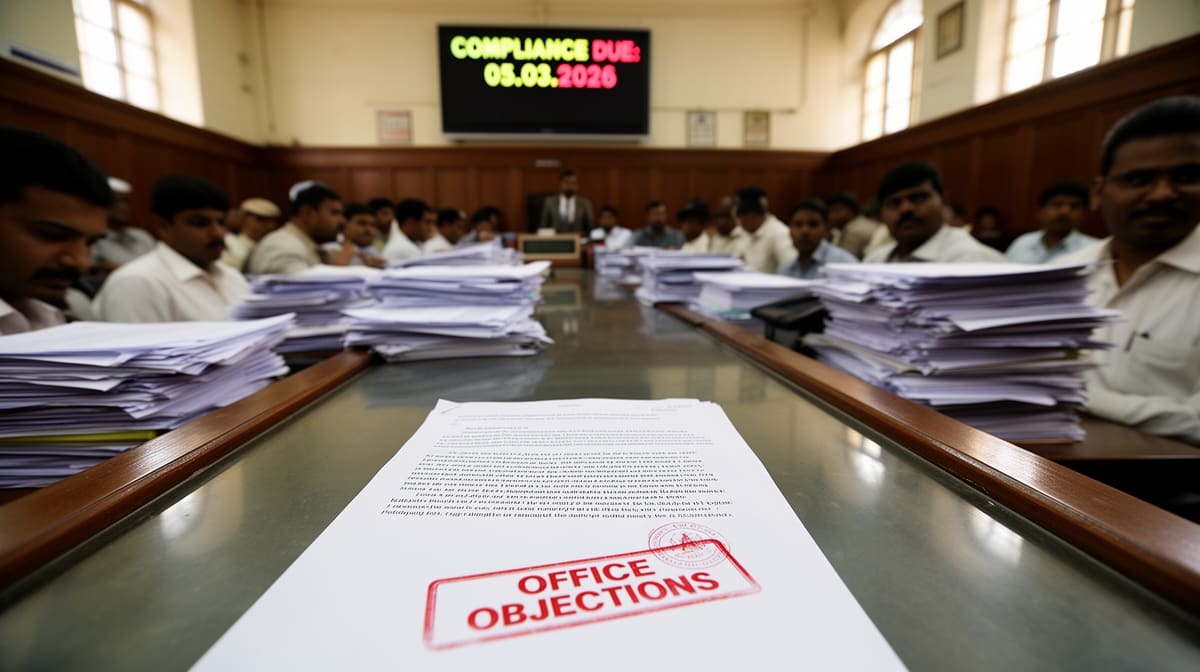
- Granted a final opportunity to remove objections by 5 March 2026
- Directed that petitions would stand rejected for non-compliance
- Applied the same standard to both writ petitions and interim applications
- Noted absence of petitioners in several matters
The Legal Issue
The central question was whether the court could reject petitions for non-compliance with O.S. Rule 986 without further hearing, and whether such rejection constitutes a final disposal of the matter.
The Court's Analysis
The court's analysis focused on three key aspects:
-
Statutory Interpretation: The court examined O.S. Rule 986, which empowers the Prothonotary to reject defective petitions. The rule states:
"If any party fails to comply with the office objections within the time specified, the petition or application shall stand rejected."
-
Procedural Rigor: The judgment emphasized that procedural rules exist to ensure orderly administration of justice. The court noted:
"Procedural compliance is not a mere formality but a fundamental requirement for access to justice. The court cannot be expected to entertain defective petitions indefinitely."
-
Judicial Discretion: While granting a "last chance," the court balanced procedural rigor with fairness. The direction for automatic rejection upon non-compliance demonstrates that such discretion is not unlimited.
The Verdict
The court upheld the strict application of O.S. Rule 986, directing that:
- All listed petitions and applications would stand rejected if office objections were not removed by 5 March 2026
- The rejection would be automatic, without further hearing
- The orders applied uniformly to both writ petitions and interim applications
What This Means For Similar Cases
Procedural Compliance Is Non-Negotiable
Practitioners must now:
- Treat office objections as urgent matters requiring immediate attention
- Ensure all procedural requirements are met before filing
- Monitor compliance deadlines strictly, as extensions are not guaranteed
The Limits of Judicial Discretion
- Courts may grant "last chances" but will enforce automatic consequences for non-compliance
- The judgment signals that procedural defaults will not be excused on grounds of oversight or delay
- Practitioners cannot assume leniency in matters of procedural compliance
Best Practices For Filing
- Pre-Filing Checklist: Verify all documents comply with O.S. Rule 986 requirements before submission
- Deadline Tracking: Implement systems to track and comply with office objection deadlines
- Appearance Protocol: Ensure representation even for procedural hearings to avoid adverse orders in absence