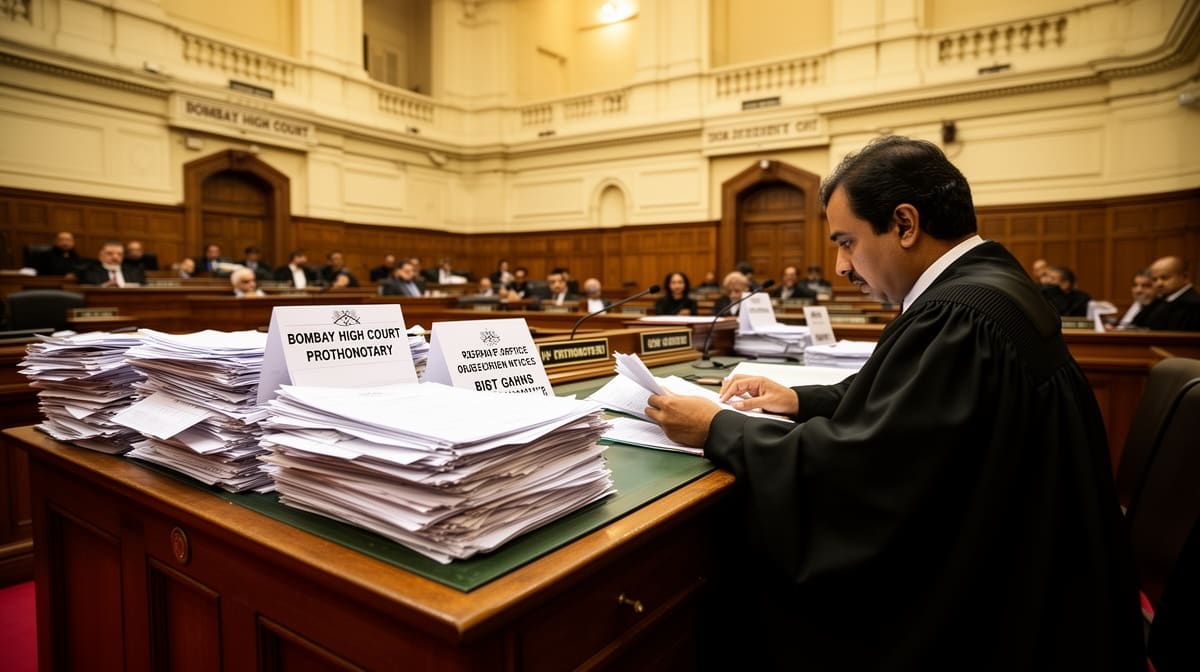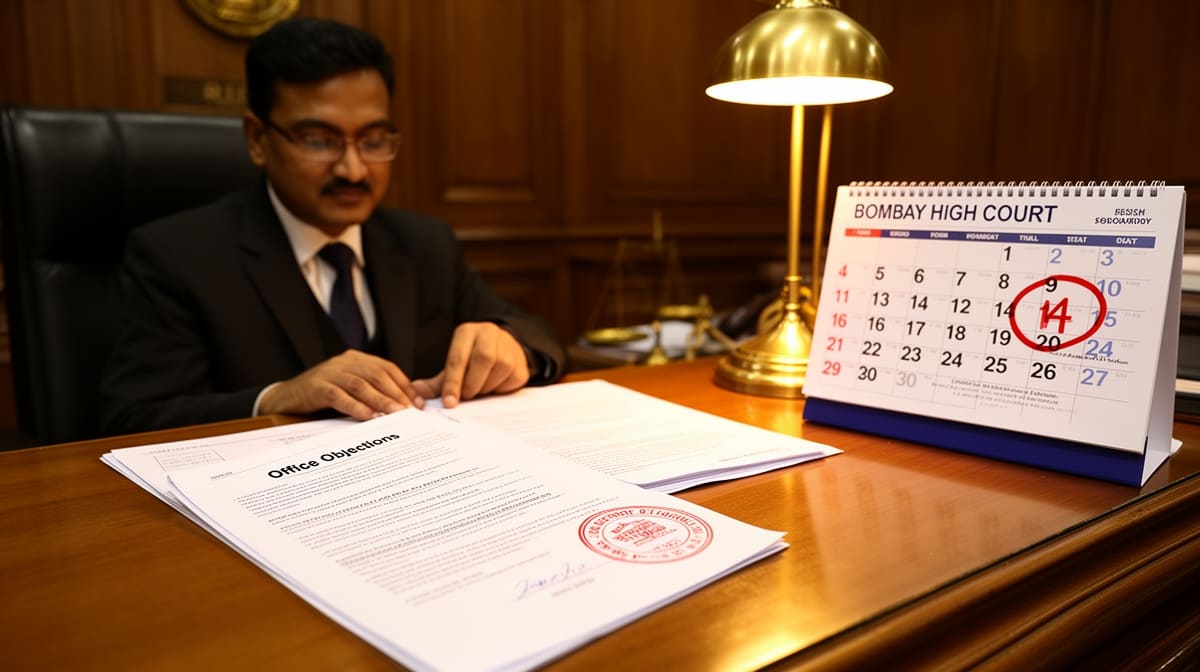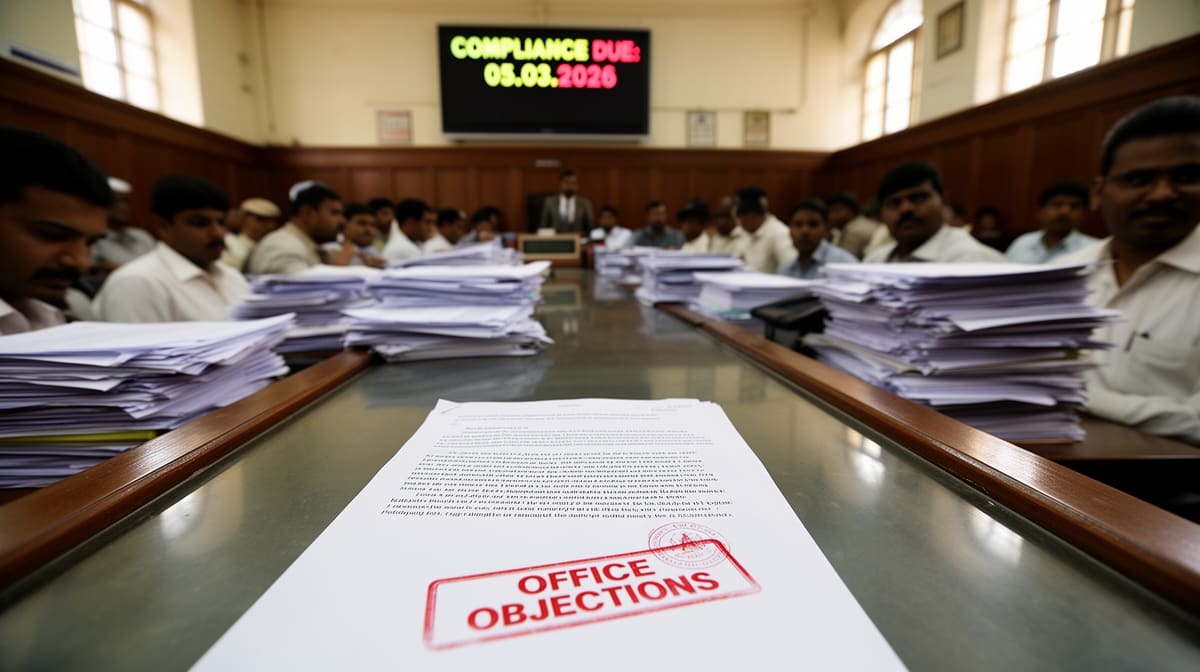
The Bombay High Court has issued a firm directive reinforcing that non-compliance with office objections under Order XX Rule 986 of the Code of Civil Procedure results in automatic rejection of petitions and applications, regardless of merits. This ruling underscores the judiciary’s zero-tolerance stance on procedural defaults, setting a critical precedent for litigants and practitioners navigating court filings.
Background & Facts
The Dispute
The matter involves multiple pending petitions and interim applications across various case numbers before the Bombay High Court, all of which were flagged for non-compliance with procedural requirements set by the Prothonotary and Senior Master. These objections typically relate to incomplete documentation, improper formatting, missing affidavits, or failure to serve notices as mandated by court rules.
Procedural History
The court issued a series of notices across multiple case numbers, granting petitioners a final opportunity to rectify deficiencies:
- 47 WPL/27610/2024: Petitioner directed to file compliance praecipe by 05.03.2026
- 48 WPL/27637/2024: No appearance; petition subject to rejection
- 50 WPL/27649/2024: Petition and associated I.A. to be rectified by 05.03.2026
- 59 WPL/27917/2024: Petitioners given final chance to cure defects
- 61 WPL/27992/2024: Same directive issued; failure to comply will result in rejection
All notices uniformly cited O.S. Rule 986 as the basis for rejection if compliance was not achieved by the deadline.
Relief Sought
The petitioners sought registration and numbering of their petitions and applications despite procedural lapses. No substantive legal relief was claimed beyond the procedural regularization of filings.
The Legal Issue
The central question was whether O.S. Rule 986 permits courts to reject petitions and applications outright for failure to cure office objections within a stipulated time, even in the absence of a formal order of dismissal.
Arguments Presented
For the Petitioner
Petitioners, where represented, argued that rejection at this stage would violate principles of natural justice and the right to be heard. They contended that procedural defects are curable and should not result in absolute denial of access to justice, especially where the underlying claims are substantial. Reliance was placed on State of Haryana v. Bhagwan Das for the proposition that courts should prefer adjudication on merits over technical dismissal.
For the Respondent/State
The Additional Government Pleader for the State supported the Prothonotary’s directive, asserting that O.S. Rule 986 is a mandatory procedural safeguard designed to ensure efficiency and discipline in court administration. The State emphasized that repeated non-compliance undermines judicial credibility and that the final notice constituted adequate opportunity.
The Court's Analysis
The court examined the nature and purpose of O.S. Rule 986, which empowers the Prothonotary to identify and notify parties of procedural irregularities in filings. The court held that such rules are not mere formalities but essential mechanisms to maintain orderly litigation.
"The court’s registry is not a filing depot; it is the first gatekeeper of judicial process. When parties are given a clear, unambiguous final opportunity to comply, and they fail to do so, the consequence must be automatic rejection. To permit otherwise would invite deliberate delay and procedural arbitrariness."
The court distinguished State of Haryana v. Bhagwan Das by noting that case involved substantive adjudication on merits after full hearing, whereas here, no hearing had occurred due to non-filing. The court further held that the notices issued were not ex parte orders but procedural advisories with clear consequences, thus satisfying the requirements of audi alteram partem.
The court also affirmed that the Prothonotary’s role under O.S. Rule 986 is administrative, not adjudicatory, and that rejection under this rule does not amount to a final order on merits but a procedural default.
The Verdict
The court upheld the Prothonotary’s directive. It held that failure to comply with office objections under O.S. Rule 986 by the stipulated date results in automatic rejection of petitions and applications, without prejudice to the right to file a fresh petition in compliance with all procedural requirements.
What This Means For Similar Cases
Procedural Compliance Is Non-Negotiable
- Practitioners must treat office objections as binding deadlines, not advisory notes
- Any petition or application flagged for defects must be rectified within the stipulated time, regardless of perceived merit
- Late filings or partial compliance will not be tolerated
Automatic Rejection Is Lawful and Precedented
- Rejection under O.S. Rule 986 is not a substantive dismissal but a procedural consequence
- Courts are not required to provide further notice or hearing after a final compliance window has expired
- This mechanism is consistent with the Supreme Court’s emphasis on case management in S.P. Chengalvaraya Naidu v. Jagannath
Fresh Filing Remains Permissible
- Rejection under this rule does not bar a fresh petition if all defects are cured
- Practitioners must ensure complete compliance with formatting, annexures, and service requirements before re-filing
- A new case number will be assigned; the old file will be archived as rejected