The Andhra Pradesh High Court has reaffirmed a foundational constitutional principle: police authorities cannot act as arbiters in purely civil disputes, even when pressured by private parties. This judgment delivers a clear directive against extrajudicial coercion, reinforcing the separation between criminal law enforcement and private civil rights.
Background & Facts
The Dispute
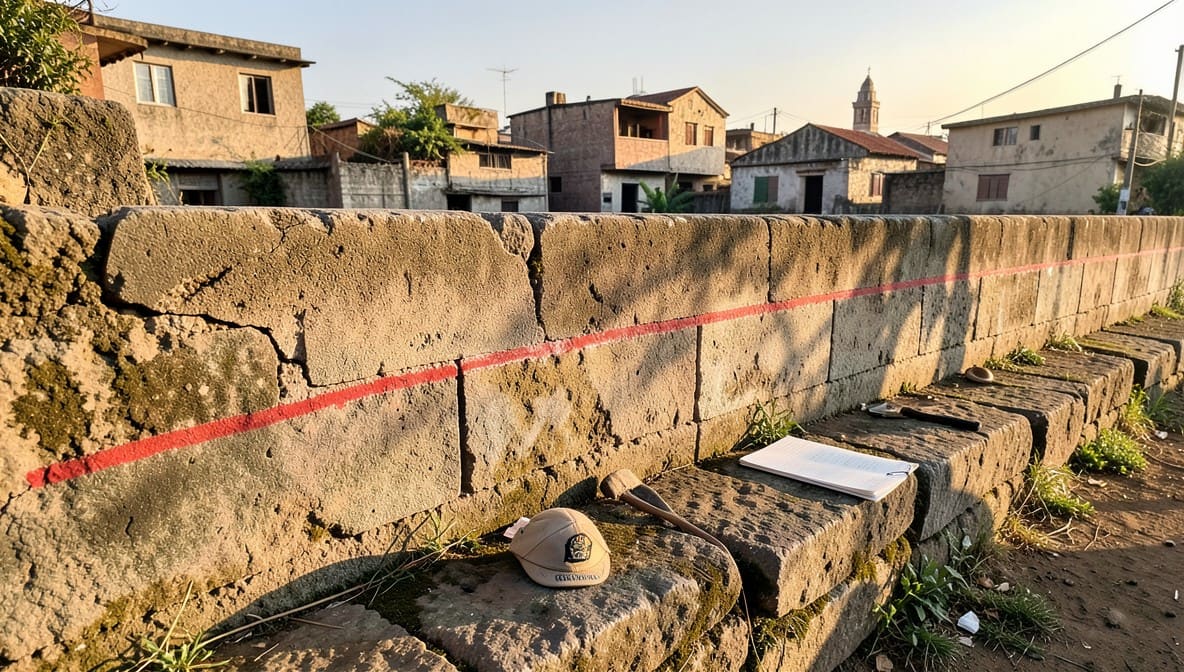
The dispute arose over a boundary wall between the petitioners’ property and that of the respondents, who are neighbors in Muppalla Village, Ipur Mandal, Palnadu District. The petitioners, Jasti Srinivasa Rao and Jasti Naga Jyothi, constructed a southern boundary wall on their property bearing Door No. 2-74, Sy. No. 409/A2. The respondents, Gurram Nagaratnam, Gurram Bucha Rao, Gurram Harsha, and Gopu Veeranjaneyulu, alleged that the wall encroached upon their land, triggering a civil property dispute.
Key Facts
- The boundary wall was constructed by the petitioners in early 2026.
- On 11.03.2026, Respondent No. 5 (Gurram Nagaratnam) filed a report with the Ipur Police Station alleging encroachment and damage to her property.
- On 12.03.2026, the boundary wall was demolished by the respondents, allegedly with the presence and tacit support of police personnel from Ipur Police Station.
- The petitioners were summoned to the Ipur Police Station on 12.03.2026, confined for several hours, and coerced into agreeing to remove the wall.
- Police officials allegedly threatened to file false criminal cases against the petitioners if they reconstructed the wall.
- The petitioners had not filed any criminal complaint; the matter was purely civil in nature.
- The police did not record any formal statement, conduct a site inspection, or issue a notice under any statutory provision before summoning the petitioners.
Procedural History
- 11.03.2026: Respondent No. 5 filed a report at Ipur Police Station.
- 12.03.2026: Petitioners summoned and confined at police station; boundary wall demolished with police presence.
- 12.03.2026: Petitioners threatened with false criminal prosecution if wall is rebuilt.
- 15.03.2026: Petitioners filed a legal notice to the Superintendent of Police, Palnadu District.
- 22.03.2026: Writ Petition No. 7787/2026 filed before the Andhra Pradesh High Court.
- 23.03.2026: Hearing before Dr. Justice Y. Lakshmana Rao.
The Parties' Positions
Petitioners: Argued that the police acted beyond their statutory authority by intervening in a civil dispute, coercing them into surrendering property rights, aiding unlawful demolition, and threatening criminal prosecution without any basis. They contended this violated Article 21 (right to life and liberty) and Article 14 (right to equality) of the Constitution.
Respondents (State and Police): Submitted that the police acted only to conduct a preliminary inquiry after a report was filed. They claimed no coercion occurred, no formal action was taken, and the police merely advised both parties to resolve the matter amicably. They further stated that a History Sheet (No. 64) had been opened against the petitioners under the authority of the Vinukonda Police Station, later transferred to Ipur Police Station for periodic review.
Relief Sought
The petitioners sought:
- A writ of mandamus declaring the police actions illegal, arbitrary, and unconstitutional.
- A direction to the police not to interfere in the civil dispute.
- A direction to the State to initiate departmental action against erring police officials.
- A prohibition against threatening to file false criminal cases.
The Legal Issue
The central question was whether police authorities may summon, confine, and coerce private parties in a purely civil boundary dispute, and whether threatening to file false criminal cases to influence civil rights constitutes a violation of constitutional guarantees under Article 21.
Arguments Presented
For the Petitioner
Learned counsel for the petitioners relied on Arnesh Kumar v. State of Bihar and D.K. Basu v. State of West Bengal to argue that police cannot act as civil enforcers. He emphasized that the absence of any cognizable offense under the IPC rendered the police intervention unlawful. He contended that confinement at the police station without a formal complaint or arrest warrant violated Section 41 CrPC and Article 22. The threat of false criminal prosecution, he argued, amounted to intimidation and coercion, which the courts have consistently held to be unconstitutional.
For the Respondent
The Assistant Government Pleader submitted that the police acted in a purely advisory capacity, conducting a preliminary inquiry under Section 157 CrPC. He claimed the History Sheet was maintained for law and order purposes and was not used to intimidate. He argued that no formal action was taken and no arrest occurred, thus no legal violation occurred.
The Court's Analysis
The Court rejected the State’s submission that the police merely conducted a "preliminary inquiry." It noted that the petitioners were summoned, confined, and coerced into agreeing to remove a structure on their own land - actions that go far beyond the scope of an inquiry. The Court observed that no cognizable offense was disclosed in the report filed by Respondent No. 5, and therefore, Section 154 CrPC did not trigger any duty to investigate.
"The police are not civil courts, nor are they private arbitrators. Their role is to enforce criminal law, not to resolve disputes over property boundaries at the behest of one party."
The Court further held that the threat to file false criminal cases constituted an abuse of power and a violation of Article 21. It cited State of U.P. v. Sanjay Kumar to affirm that threats of criminal prosecution to extract civil concessions are per se illegal. The Court also dismissed the relevance of the History Sheet, noting that its existence does not justify coercive conduct in a civil matter.
The Court emphasized that even if the boundary dispute was contentious, the remedy lay in civil proceedings - not police coercion. The police’s role, if any, was limited to maintaining peace and recording complaints - not enforcing outcomes.
The Verdict
The petition succeeded. The Court directed the Respondent Police not to interfere in the civil boundary dispute between the petitioners and the unofficial respondents without following due process of law. The Court declared the police actions on 12.03.2026 - including summoning, confinement, aiding demolition, and threatening criminal prosecution - illegal and unconstitutional. The State was directed to initiate departmental action against the erring officials. There shall be no order as to costs.
What This Means For Similar Cases
Police Cannot Act as Civil Enforcers
- Practitioners must immediately challenge any police intervention in civil disputes over property, boundaries, or family matters where no cognizable offense is registered.
- Any summons to a police station in such contexts must be contested as unlawful detention under Section 41 CrPC and Article 21.
Threats of False Criminal Cases Are Unlawful
- Threats to file false FIRs to pressure parties in civil matters are now explicitly declared unconstitutional.
- Such conduct can form the basis for a writ petition under Article 226, even if no physical arrest occurred.
- Departmental action against officers making such threats is mandatory under this judgment.
History Sheets Cannot Justify Coercion
- The existence of a History Sheet does not empower police to intimidate or coerce individuals.
- History Sheets are administrative tools for surveillance, not instruments of punishment or civil enforcement.
- Any use of History Sheets to pressure parties in civil disputes is now legally untenable.