The Andhra Pradesh High Court has reaffirmed a foundational principle of Indian administrative law: police authorities cannot act as arbiters in private civil disputes over land, absent a clear criminal complaint or statutory mandate. This judgment underscores the constitutional boundaries between criminal jurisdiction and civil remedies, offering critical guidance to practitioners handling property-related litigation.
Background & Facts
The Dispute
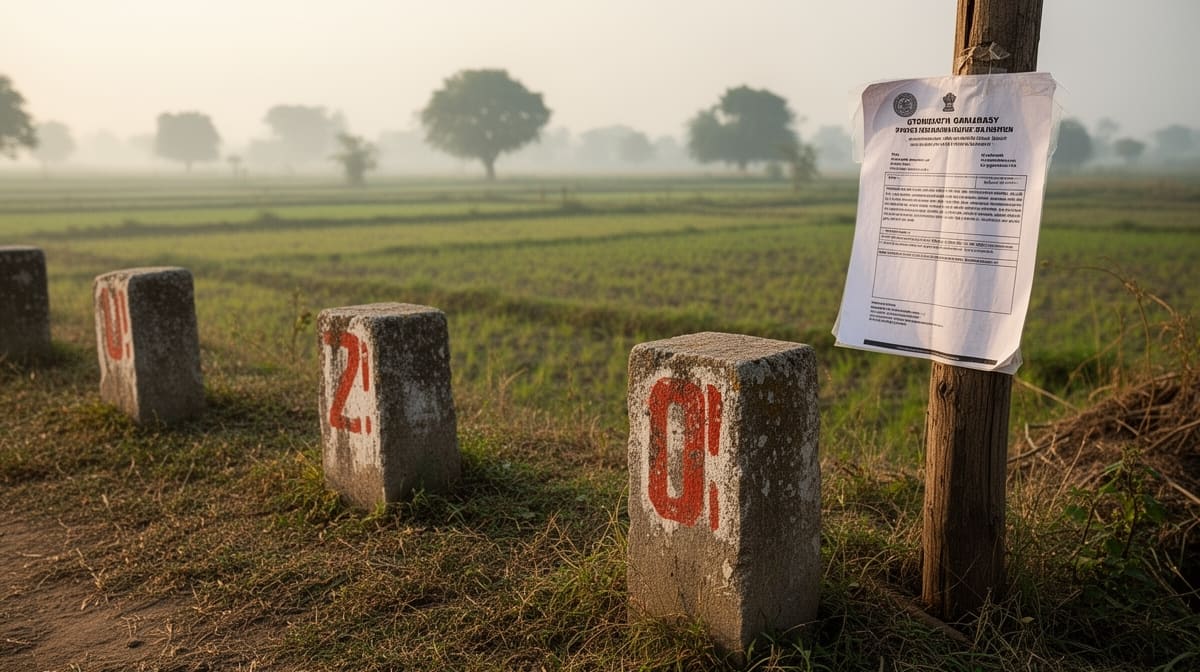
The petitioners, three brothers - Anjinappagari Hanumantaraya, Anjinappagari Nagaraju, and Anjinappagari Shasi Kumar - are co-heirs to agricultural land measuring 0.46 cents in Survey Number 242-3.D, located in Hemavathi Village, Amarapuram Mandal, Sri Satya Sai District. The respondents, Ramappa, Shantamma, and Ur Anjinappa, are neighboring landowners who claim adverse possession or a prior oral agreement over the same parcel. The dispute is purely civil in nature, involving title, possession, and boundary demarcation, with no allegation of violence, trespass, or criminal mischief.
Key Facts
- The land in dispute is registered in the name of the petitioners’ deceased father, Anjanappa, under the revenue records
- The petitioners have held physical possession since 2015, following their father’s death
- Respondents Nos. 4 to 6 claim possession based on alleged long-term cultivation and oral agreement dating back to the 1990s
- No FIR has been registered by the police in relation to this dispute
- No charge sheet or criminal complaint has been filed before any court
- The petitioners filed a civil suit for declaration of title and injunction on 10.01.2026 before the Civil Court at Amarapuram
- On 12.03.2026, Respondent No. 4 filed a written representation with the Amarapuram Police Station alleging trespass and illegal occupation
Procedural History
- 10.01.2026: Civil suit filed by petitioners before the Civil Judge (Senior Division), Amarapuram (Suit No. 12/2026)
- 12.03.2026: Respondent No. 4 submitted a written complaint to the Amarapuram Police Station
- 15.03.2026: Station House Officer (3rd Respondent) summoned both parties for a "preliminary enquiry"
- 18.03.2026: Police reportedly visited the site and verbally advised both parties to "settle the matter"
- 20.03.2026: Petitioners filed this writ petition alleging illegal police interference
- 23.03.2026: Hearing before the High Court
The Parties' Positions
Petitioners: Argued that the police action constituted unlawful interference in a pending civil matter, violating their right to property under Article 300A, right to equality under Article 14, and right to life and personal liberty under Article 21. They contended that police presence and summons created an atmosphere of coercion, undermining the civil judicial process.
Respondents (State): Submitted that the police did not interfere but merely conducted a preliminary inquiry upon receipt of a complaint, and advised both parties to approach the Civil Court. They claimed no coercive action was taken and no order of possession was passed.
Relief Sought
The petitioners sought a writ of mandamus directing the 3rd Respondent (Amarapuram SHO) to cease all interference in the civil dispute, declare the police action illegal, and restrain any future intervention without due process of law.
The Legal Issue
The central question was whether the police can summon parties and conduct a preliminary inquiry in a purely civil land dispute, absent any cognizable offence, and whether such action violates constitutional guarantees under Articles 14, 21, and 300A.
Arguments Presented
For the Petitioner
Learned counsel relied on State of U.P. v. Krishna Kumar and S. R. Batra v. Tarun Bedi to argue that police have no jurisdiction to adjudicate civil title disputes. He emphasized that the Supreme Court in Arnesh Kumar v. State of Bihar had cautioned against police overreach in civil matters, and that Article 300A mandates state action to be lawful and non-arbitrary. He contended that even a non-coercive summons in a civil dispute creates a chilling effect and undermines the civil court’s exclusive domain.
For the Respondent
The Assistant Government Pleader submitted that the police acted only as facilitators, not adjudicators, and that their role was limited to recording a complaint and advising parties to approach the Civil Court. He cited K. S. Puttaswamy v. Union of India to argue that minimal procedural engagement does not amount to interference, provided no arrest, seizure, or direction on possession was issued.
The Court's Analysis
The Court examined the distinction between criminal investigation and civil adjudication, noting that land disputes over title, possession, or boundary are quintessentially civil matters governed by the Transfer of Property Act, 1882, and the Specific Relief Act, 1963. The Court observed that the police, under Section 154 CrPC, may register an FIR only if a cognizable offence is disclosed, such as criminal trespass under Section 441 IPC or mischief under Section 425 IPC. No such offence was alleged or established here.
"The role of the police is not to resolve title disputes, nor to act as a substitute for civil courts. Even a preliminary enquiry in such matters, if it results in pressure or perceived authority being exercised, amounts to an unlawful encroachment on judicial domain."
The Court held that summoning parties for a "preliminary enquiry" in a civil land dispute, even without arrest or seizure, creates an impression of state coercion and violates the principle of separation of powers. It further noted that Article 300A requires that deprivation of property must be by authority of law, and police action without statutory backing cannot constitute such authority.
The Court distinguished S. R. Batra by emphasizing that even non-coercive police involvement in civil disputes erodes public confidence in the civil justice system and invites forum shopping. It also referenced K. S. Puttaswamy to affirm that any state action, however minor, must be proportionate and lawful.
The Verdict
The writ petition was disposed of with the direction that the 3rd Respondent, the Station House Officer, Amarapuram Police Station, shall not interfere in the civil dispute between the petitioners and respondents Nos. 4 to 6 concerning land in Sy. No. 242-3.D, Hemavathi Village, without following due process of law. There shall be no order as to costs. All pending miscellaneous petitions are closed.
What This Means For Similar Cases
Police Must Stay Out of Civil Land Disputes
- Practitioners may now cite this judgment to seek immediate injunctions against police interference in pending civil suits over land
- Any police summons, site visit, or "advice" in a civil title dispute can be challenged as ultra vires
- A mere complaint from a party does not empower police to initiate inquiry in civil matters
Due Process Is Non-Negotiable
- Before any police action in property disputes, there must be a registered FIR for a cognizable offence
- Civil courts remain the exclusive forum for adjudicating title, possession, and boundary disputes
- Police reports or statements in civil suits are inadmissible unless part of a valid criminal investigation
Constitutional Safeguards Are Active, Not Theoretical
- Article 300A is enforceable against arbitrary state action, even when no physical seizure occurs
- Article 14 is violated when police treat civil litigants unequally by selectively engaging with one party
- Article 21 protects the right to peaceful enjoyment of property from state overreach