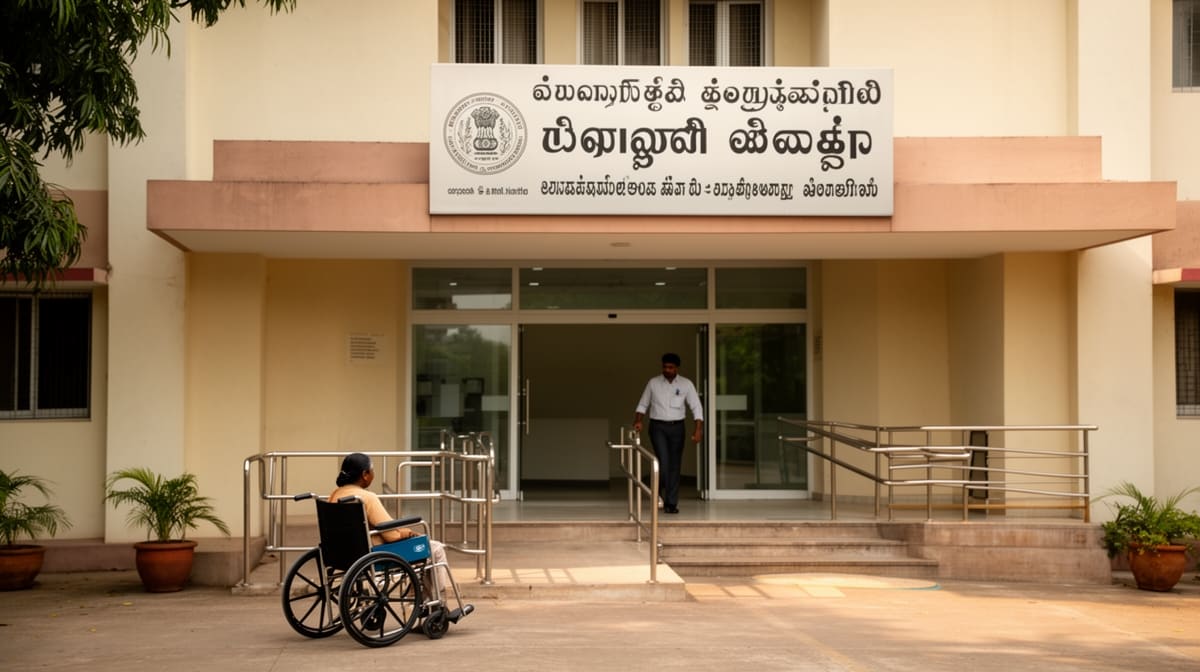
The Allahabad High Court has reinforced that administrative decisions on transfers must account for disability and equitable treatment under established policies, rejecting mere procedural deference to authorities. This judgment clarifies that when a public servant with a certified disability invokes a policy framework, the state cannot evade substantive consideration by invoking bureaucratic discretion.
Background & Facts
The Dispute
The petitioner, Ganga Prasad Pandey, is a government employee currently posted in District Raebareli, Uttar Pradesh. He suffers from a 50 percent locomotor disability, as certified and submitted as Annexure No. 4. He seeks transfer to the Office of the Chief Medical Officer, District Hospital, Barabanki, citing medical necessity and the availability of better treatment facilities in Barabanki. He contends that his request is consistent with the Transfer Policy dated 05.05.2026 for the year 2026-27, particularly Paragraph 5(iv), which mandates sympathetic consideration for employees with disabilities.
Key Facts
- The petitioner holds a valid disability certificate certifying 50 percent locomotor disability
- He was posted in District Raebareli prior to two other officers, Sri Prasiddha Narayan Tripathi and Sri Mahesh Gautam, who were posted in 2021
- Both Sri Prasiddha Narayan Tripathi and Sri Mahesh Gautam were subsequently transferred to places of their choice
- The petitioner, despite being posted earlier and having a certified disability, has not been granted similar consideration
- He submitted a formal request for transfer, referenced as Annexure No. 1, which remains unaddressed
- The transfer request is made under the provisions of the Transfer Policy dated 05.05.2026
Procedural History
- The petitioner filed Writ Petition No. 6068 of 2026 before the Allahabad High Court, Lucknow Bench
- The petition was heard on 12.06.2026
- No prior formal order or written response from the competent authority to the petitioner’s representation was placed on record
- The State did not contest the factual assertions regarding disability or the existence of the Transfer Policy
The Parties' Positions
For the Petitioner
The petitioner argued that:
- His disability qualifies him for preferential consideration under Paragraph 5(iv) of the Transfer Policy
- The transfer of two other officers posted after him to their preferred locations establishes a clear pattern of differential treatment
- Denial of his request without reasoned justification amounts to arbitrary and discriminatory administrative action
- The State has a duty to accommodate disability under both policy and constitutional principles of equality
For the Respondent
The Chief Standing Counsel for the State did not dispute the petitioner’s factual claims or the applicability of the Transfer Policy. She stated that she had no objection if the competent authority decided the matter in accordance with law.
Relief Sought
The petitioner sought a writ of mandamus directing Respondent No. 3 (the competent authority) to:
- Consider his transfer request sympathetically under the Transfer Policy dated 05.05.2026
- Transfer him from District Raebareli to the Office of the Chief Medical Officer, Barabanki
- Take into account his disability and the parity with two other officers who received favorable transfers
The Legal Issue
The central question was whether an administrative authority may defer or ignore a transfer request grounded in a statutory policy and a certified disability, merely on the ground that no formal order has been passed, without providing any reasoned justification.
Arguments Presented
For the Petitioner
The petitioner relied on Paragraph 5(iv) of the Transfer Policy dated 05.05.2026, which explicitly requires sympathetic consideration for employees with disabilities. He cited the principle of non-arbitrariness under Article 14 of the Constitution and the precedent in State of U.P. v. Raj Kumar where the Court held that policy frameworks bind administrative discretion. He further argued that the transfer of two officers posted after him created a legitimate expectation of equal treatment, and that failure to explain the differential treatment amounted to discrimination.
For the Respondent
The State did not contest the petitioner’s factual claims or the applicability of the policy. The Chief Standing Counsel conceded that the matter should be decided by the competent authority in accordance with law, effectively abandoning any substantive opposition to the petitioner’s claim.
The Court's Analysis
The Court observed that the petitioner’s request was not speculative or unsubstantiated. He had provided documentary proof of disability and invoked a specific policy provision meant to protect employees in his condition. The Court noted that the State did not dispute the existence of the policy or the fact that two similarly situated officers had been transferred.
"The petitioner has not merely sought a transfer; he has invoked a policy designed to accommodate disability and has pointed to a clear pattern of differential treatment. Administrative silence in such circumstances cannot be equated with lawful decision-making."
The Court emphasized that while transfer decisions are inherently discretionary, discretion must be exercised reasonably and in accordance with stated policy. The absence of a reasoned order, particularly when a disability and a policy framework are involved, renders the inaction arbitrary. The Court further held that the parity argument, though not determinative, must be addressed in any reasoned decision.
The Court declined to issue a direct mandamus, recognizing that the competent authority must retain the power to weigh competing administrative needs. However, it held that the petitioner’s request must be adjudicated with due regard to the policy and his disability.
The Verdict
The writ petition was disposed of with liberty granted to the petitioner to submit a fresh representation before Respondent No. 3 within one week. The competent authority was directed to consider the representation and issue a reasoned and speaking order within three weeks thereafter, taking into account: (1) the petitioner’s 50 percent locomotor disability, (2) Paragraph 5(iv) of the Transfer Policy dated 05.05.2026, and (3) the claim of parity with Sri Prasiddha Narayan Tripathi and Sri Mahesh Gautam. No monetary relief was granted.
What This Means For Similar Cases
Disability Must Trigger Policy-Based Consideration
- Practitioners must now insist that administrative authorities explicitly reference applicable disability policies when rejecting transfer or posting requests
- Blanket denials without citing policy provisions or explaining why they do not apply are vulnerable to judicial review
- Disability certificates, when submitted, shift the burden to the authority to justify non-accommodation
Parity Arguments Are Legally Relevant, Not Merely Equitable
- When two or more officers in similar positions receive favorable treatment, the failure to explain differential outcomes constitutes a potential violation of Article 14
- Even if parity is not a legal right, its absence without justification renders administrative action arbitrary
- Petitioners should document and cite specific instances of comparable transfers to strengthen claims
Administrative Silence Is Not a Decision
- Authorities cannot evade responsibility by failing to act or issue orders
- Courts will not accept "pending decision" as a defense when a policy framework and factual basis exist
- Reasoned orders are mandatory when constitutional rights or policy guarantees are invoked