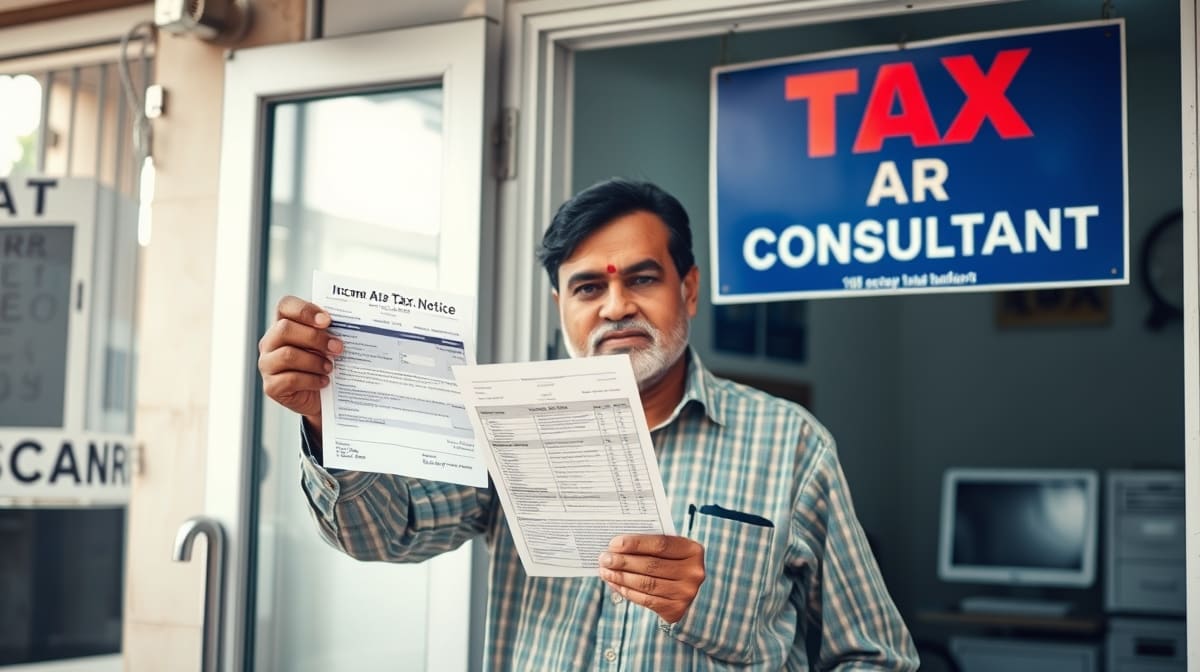
The Income Tax Appellate Tribunal, Mumbai, has clarified that an individual assessee facing a massive tax addition of over Rs.9 crores cannot be presumed to have deliberately delayed filing an appeal when no notice was received from either the Assessing Officer or the appointed Chartered Accountant. This ruling reinforces the principle that procedural fairness must account for the practical realities faced by non-corporate taxpayers.
Background & Facts
The Dispute
The appellant, Samsher Hasankhan Dalwai, a resident individual, filed his return of income for A.Y. 2020-21 on 07.01.2021, declaring income of Rs.6,02,620. The return was selected for scrutiny. The Assessing Officer subsequently completed the assessment by adding Rs.9,02,21,100 under Section 56(2)(x) of the Income Tax Act, 1961, based on the difference between the declared sale consideration and the stamp duty value of a property.
Key Facts
- The appellant engaged a Chartered Accountant to handle all tax matters
- No intimation was received from the CA regarding the finalization of the assessment
- No communication - neither physical nor electronic - was received from the Income Tax Department regarding the completion of assessment
- The appellant only became aware of the assessment when contacted by the Department regarding a demand notice and penalty order under Section 270A
- The total tax demand, including interest and penalty, amounted to a substantial sum for an individual assessee
Procedural History
- 07.01.2021: Assessee filed return of income
- Undated (prior to 05.01.2026): Assessment completed by Assessing Officer adding Rs.9,02,21,100
- Undated (after assessment): Penalty order issued under Section 270A
- 05.01.2026: First Appellate Authority (CIT(A)) dismissed the appeal in limine for delay of 140 days
- 16.03.2026: Appeal filed before ITAT Mumbai (ITA No.162/Mum/2026)
- 30.03.2026: Hearing conducted
- 08.04.2026: ITAT Mumbai pronounced order
Relief Sought
The appellant sought condonation of delay of 140 days in filing the appeal before the First Appellate Authority and a direction to adjudicate the appeal on merits.
The Legal Issue
The central question was whether Section 249 of the Income Tax Act permits condonation of delay in filing an appeal where the assessee, an individual, had no notice of the assessment completion from either the department or his appointed representative.
Arguments Presented
For the Appellant
The appellant’s counsel, Shri Sucheck Anchaliya, argued that the delay of 140 days was not due to laches or negligence but due to complete lack of communication. The appellant had entrusted all matters to a Chartered Accountant who failed to inform him of the assessment outcome. No intimation was sent by the department via email or post. Given the magnitude of the addition - over Rs.9 crores - it was implausible that the appellant would have ignored the matter. Reliance was placed on the principle of natural justice and the doctrine of audi alteram partem.
For the Respondent
The Revenue, represented by Shri Swapnil Choudhari (Sr. AR), contended that the appellant bore the responsibility to monitor the status of his assessment. The fact that a Chartered Accountant was engaged did not absolve the assessee of his statutory duty to follow up. The delay was inordinate and no sufficient cause was shown. The First Appellate Authority was justified in dismissing the appeal in limine.
The Court's Analysis
The Tribunal examined the nature of the delay, the magnitude of the addition, and the absence of any communication from either the department or the CA. It noted that the appellant was not a corporate entity with dedicated tax compliance teams but an individual facing a liability exceeding Rs.9 crores. Such a sum, the Tribunal observed, would naturally prompt immediate action by any reasonable person.
"It is unbelievable that an individual assessee fastened with such huge addition and demand would take the matter casually and deliberately try to defer the steps to be taken for contesting the addition."
The Tribunal further held that a delay of 140 days, while technically beyond the statutory period, was not inordinate in the context of total non-communication. The absence of any intimation from the department or the CA created a factual vacuum that could not be attributed to the assessee’s negligence. The Tribunal emphasized that Section 249 must be interpreted in a manner that upholds substantive justice, particularly where the taxpayer is not a sophisticated entity.
The Tribunal rejected the notion that mere engagement of a CA shifts the entire burden of vigilance to the assessee. It held that the CA’s failure to communicate does not equate to the assessee’s failure to act, especially when the department itself remained silent.
The Verdict
The appeal was allowed for statistical purposes. The Tribunal directed the First Appellate Authority to condone the delay of 140 days and adjudicate the appeal on merits. The appellant was granted a reasonable opportunity to be heard. No monetary relief was granted at this stage, as the matter was remanded for fresh adjudication.
What This Means For Similar Cases
Non-Communication Justifies Condonation of Delay
- Practitioners must now argue that absence of notice from both the department and the CA constitutes sufficient cause under Section 249
- The burden shifts to the Revenue to prove actual negligence or mala fide intent when delay is under 150 days and the addition exceeds Rs.5 crores
- Taxpayers should retain proof of engagement with CAs and document all attempts to follow up
Individual Assessees Are Entitled to Greater Procedural Leniency
- Tribunals must recognize the asymmetry in resources between individual taxpayers and the department
- Large additions (Rs.5 crore+) trigger a higher duty on the department to issue formal intimation
- Relying solely on the CA’s conduct as a proxy for the assessee’s negligence is legally unsound
CA’s Failure Is Not Assessee’s Fault
- Engagement of a professional does not extinguish the assessee’s right to be informed
- Courts must distinguish between professional negligence and personal negligence
- Assessees should be permitted to file affidavits detailing their reliance on CAs and lack of departmental communication