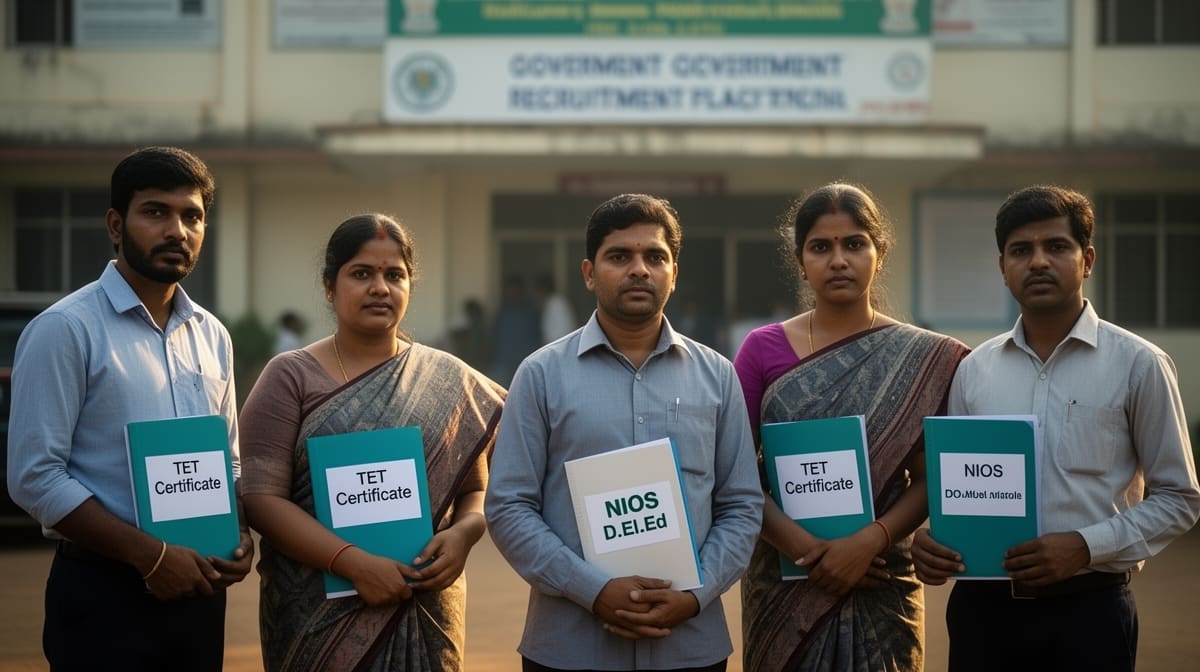
The Tripura High Court has recognized an 18-month Diploma in Elementary Education (D.El.Ed) completed through the National Institute of Open Schooling (NIOS) as equivalent to the mandatory two-year D.El.Ed for eligibility in teacher recruitment, affirming that procedural barriers cannot override substantive qualification when grounded in Supreme Court precedent.
Background & Facts
The Dispute
The petitioners, four individuals from different districts of Tripura, completed an 18-month D.El.Ed program through NIOS and successfully qualified for the Teacher Eligibility Test (TET). However, they were denied participation in the document verification process for Under Graduate Teacher (Classes I-V) and Graduate Teacher (Classes VI-VIII) posts because their D.El.Ed certificate did not reflect a two-year duration, as stipulated in the recruitment notification dated 02.03.2026.
Procedural History
- The petitioners applied for the teaching posts under the notification issued by the Teachers Recruitment Board, Tripura (TRBT).
- They were informed that their TET certificates would not be accepted due to the absence of a two-year D.El.Ed degree.
- The petitioners filed a writ petition before the Tripura High Court seeking interim relief to allow them to participate in document verification.
- An interim application (IA No. 01 of 2026) was filed seeking direction to the TRBT to permit their participation pending final disposal of the writ petition.
- Notice was not served on respondents 2 through 7, including NIOS and the National Council for Teacher Education.
Relief Sought
The petitioners sought interim relief to be allowed to participate in the document verification process scheduled between 07.03.2026 and 12.03.2026, despite lacking the conventional two-year D.El.Ed certificate, on the ground that their 18-month NIOS course had been judicially recognized as equivalent.
The Legal Issue
The central question was whether petitioners who completed an 18-month D.El.Ed course through NIOS and qualified for TET could be denied participation in document verification solely on the technical ground of course duration, in light of the Supreme Court’s recognition of such courses as equivalent.
Arguments Presented
For the Petitioner
Mr. Arijit Bhowmik, Advocate for the petitioners, relied on the Supreme Court judgments in Viswanath & Ors. v. State of Uttarakhand (2025) 6 SCC 808 and Koushik Das & Ors. v. State of West Bengal (2025) 5 SCC 413, which explicitly recognized the 18-month D.El.Ed course through NIOS as a valid and equivalent qualification for TET eligibility. He argued that denying participation in document verification would cause irreparable prejudice, as the verification window was imminent and the petitioners had fulfilled all substantive criteria.
For the Respondent
The Additional Government Advocate, Mr. Dipankar Sarma, did not contest the legal validity of the Supreme Court’s recognition of the 18-month course. However, he opposed interim relief on the ground that no final adjudication had been made and that granting such relief would pre-empt the court’s final decision on the writ petition.
The Court's Analysis
The Court acknowledged that the petitioners had not merely claimed equivalence but had already completed the course, passed the TET, and were otherwise eligible under the recruitment rules. It emphasized that the Supreme Court’s rulings in Viswanath and Koushik Das were not mere observations but binding precedents establishing a one-time window for recognition of NIOS’s 18-month D.El.Ed.
"The Hon’ble Supreme Court has already accredited the 18-month D.El.Ed course through NIOS as equivalent to the two-year course. To deny participation at this stage would be to impose a technical barrier contrary to substantive justice."
The Court held that interim relief was warranted not to decide the final merit of the petition, but to preserve the status quo and prevent irreparable harm. It noted that the petitioners had acted in good faith, complied with all requirements, and were being excluded only due to an administrative rigidity that contradicted higher judicial authority. The Court further observed that allowing participation in document verification would not prejudice the respondents, as the final eligibility determination would still be subject to the outcome of the writ petition.
The Verdict
The petitioners won. The Tripura High Court directed the Teachers Recruitment Board, Tripura, to allow the petitioners to participate in the document verification process for the teaching posts, despite the absence of a two-year D.El.Ed certificate, subject to the final outcome of the writ petition. The Court affirmed that substantive qualification recognized by the Supreme Court cannot be negated by procedural technicalities.
What This Means For Similar Cases
Equivalence Recognized Over Form
- Practitioners must now argue that equivalence of qualifications, once judicially recognized, overrides rigid eligibility criteria in recruitment.
- Where higher courts have declared a course equivalent, authorities cannot impose additional documentary conditions that contradict such recognition.
- This applies equally to other state-level teacher recruitment processes where NIOS or distance education qualifications are involved.
Interim Relief for Prejudice Avoidance
-
Courts will grant interim relief when denial of participation would cause irreversible prejudice, even if the final merits are pending.
-
The burden shifts to the state to demonstrate why interim access would cause harm, not to the petitioner to prove final entitlement.
-
Recruitment timelines cannot be used as a shield to exclude qualified candidates who meet substantive criteria.
-
Practitioners should file IA applications immediately upon receipt of exclusion notices, citing Viswanath and Koushik Das as binding precedent.
-
Always attach certified copies of TET qualification and course completion certificates to substantiate claims of equivalence.