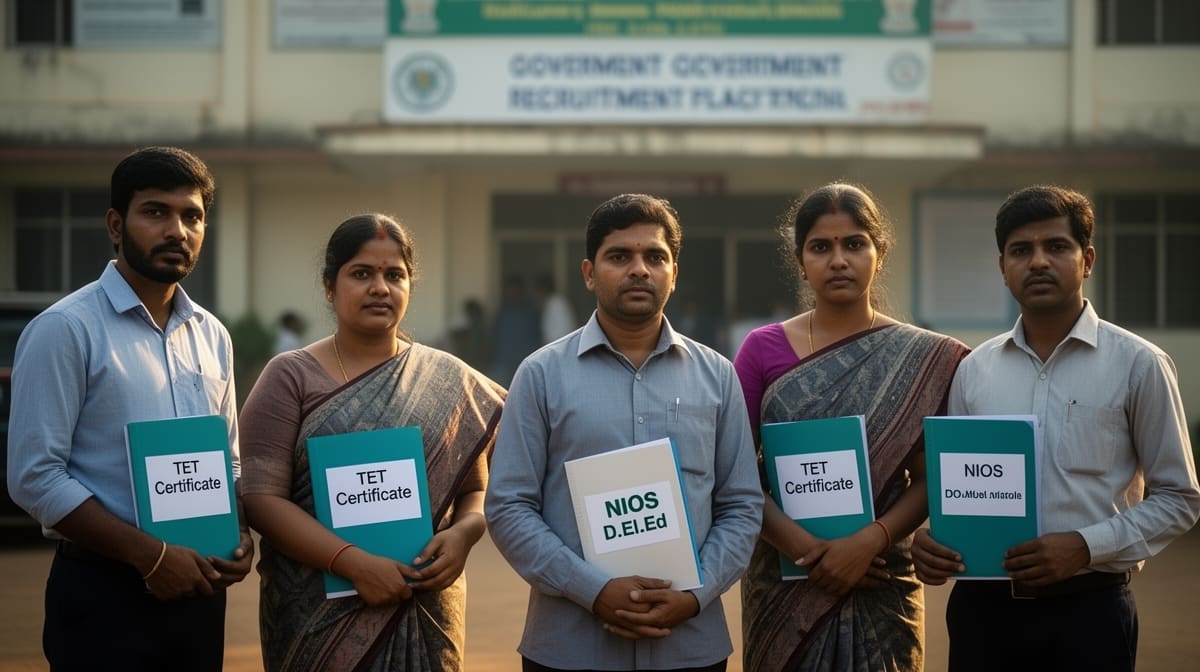
The Allahabad High Court has affirmed that the Teacher Eligibility Test (TET) is a mandatory qualification for appointment as an Assistant Teacher teaching classes VI to VIII, rendering state rules that omit this requirement ultravires the Right of Children to Free and Compulsory Education Act, 2009. This judgment resolves a critical conflict between statutory mandates under the National Council for Teacher Education and state-level recruitment rules, with immediate implications for teacher appointments across Uttar Pradesh.
Background & Facts
The Dispute
The petitioners challenged Rule 8 of the Uttar Pradesh Subordinate Educational (Trained Graduate Grade) Service Rules, 1983, as amended by the 6th Amendment dated 30.01.2025. They contended that the rule fails to incorporate the Teacher Eligibility Test (TET) as a mandatory qualification for appointment as Assistant Teacher for classes VI to VIII, despite a binding notification issued by the National Council for Teacher Education (NCTE) on 23.08.2010 under Section 23 of the Right of Children to Free and Compulsory Education Act, 2009 (RTE Act). The petitioners further challenged the recruitment advertisement dated 28.07.2025 issued by the Uttar Pradesh Public Service Commission, which did not specify TET as a requirement.
Key Facts
- The RTE Act, 2009, was enacted on 04.04.2009 and came into force on 01.04.2010.
- Section 23 of the RTE Act empowers the NCTE to prescribe minimum qualifications for teacher appointment.
- On 31.03.2010, the Government of India notified the NCTE as the academic authority under Section 23(1) of the RTE Act, published in the Gazette of India on 05.04.2010.
- On 23.08.2010, NCTE issued a notification mandating that all persons appointed as teachers for classes VI to VIII must possess a valid TET pass certificate, in addition to other academic qualifications.
- On 12.11.2014, NCTE issued a subsequent notification extending the TET requirement to teachers for classes IX and X.
- Rule 8 of the UP Subordinate Educational Service Rules, 1983, was amended in 2016 to require a Bachelor’s degree and B.Ed., and again in 2025 to clarify "graduation degree," but never incorporated TET for classes VI-VIII.
- The Additional Director of Education, in a supplementary counter-affidavit dated 09.12.2025, admitted that there are 904 institutions in Uttar Pradesh where students from classes VI to XII are taught.
- The recruitment advertisement dated 28.07.2025 did not specify the class levels for which teachers were being recruited.
- The respondents admitted that no recruitment has yet been conducted under the 2010 NCTE notification for classes VI-VIII.
Procedural History
- 23.08.2010: NCTE issues notification mandating TET for teachers of classes VI-VIII.
- 12.11.2014: NCTE extends TET requirement to classes IX-X.
- 2016: Rule 8 amended to require B.Ed. and graduation, but TET omitted.
- 30.01.2025: Sixth amendment to Rule 8 introduces "graduation degree" clarification, still omits TET.
- 28.07.2025: UP Public Service Commission issues recruitment advertisement for Trained Graduate Teachers without mentioning TET or class levels.
- 2025: Writ Petitions filed before the Allahabad High Court.
- 02.04.2026: Judgment delivered.
The Parties' Positions
Petitioners: Argued that Rule 8, by omitting TET for classes VI-VIII, directly contradicts the NCTE’s 2010 notification and is therefore ultravires Section 23 of the RTE Act. They emphasized that the existence of 904 institutions teaching classes VI-XII implies that unqualified teachers are currently instructing children in violation of statutory norms.
Respondents (State and NCTE): Contended that Rule 8 was amended in 2016 and 2025 to align with NCTE’s 2014 notification for classes IX-X, and that no recruitment for classes VI-VIII has occurred under the current rules. They relied on a 2017 coordinate Bench order that had previously dismissed a similar petition on the ground that the advertisement in question was for classes IX-X only.
Relief Sought
The petitioners sought:
- Declaration that Rule 8, as amended, is ultravires the RTE Act and NCTE notification dated 23.08.2010.
- Quashing of the recruitment advertisement dated 28.07.2025.
- Direction to amend Rule 8 to include TET (pass) as a mandatory qualification for appointment to teach classes VI-VIII.
- Direction to the Commission to issue a corrigendum clarifying that the 28.07.2025 advertisement pertains only to classes IX-X.
The Legal Issue
The central question was whether Rule 8 of the Uttar Pradesh Subordinate Educational (Trained Graduate Grade) Service Rules, 1983, by omitting the Teacher Eligibility Test (TET) as a mandatory qualification for appointment to teach classes VI to VIII, is ultravires Section 23 of the Right of Children to Free and Compulsory Education Act, 2009, in light of the NCTE’s binding notification dated 23.08.2010.
Arguments Presented
For the Petitioner
Ms. Taniya Pandey and Mr. Sanjay Kumar Yadav argued that the NCTE’s 2010 notification, issued under Section 23 of the RTE Act, is a statutory mandate that supersedes any inconsistent state rule. They cited the Supreme Court’s holding in National Council for Teacher Education v. K. S. S. S. R. College of Education that NCTE norms are mandatory and non-negotiable. They emphasized that the State’s admission of 904 institutions teaching classes VI-XII proves the existence of vacancies where unqualified teachers are currently employed, violating the RTE Act’s spirit and statutory framework. The omission of TET in Rule 8 was not a mere oversight but a deliberate defiance of central law.
For the Respondent
Mr. Kartikeya Saran, Additional Advocate General, contended that Rule 8 was amended in 2016 and 2025 to comply with the NCTE’s 2014 notification for classes IX-X, and that the State had no intention of recruiting for classes VI-VIII under the current rules. He relied on the 2017 coordinate Bench order, where the Court had accepted the State’s representation that a prior advertisement was for classes IX-X only. He argued that since no recruitment for classes VI-VIII had taken place, there was no immediate violation, and any amendment could be made prospectively.
The Court's Analysis
The Court rejected the State’s argument that the absence of recruitment negated the illegality of Rule 8. It held that the existence of 904 institutions teaching classes VI-XII, coupled with the State’s failure to demonstrate that TET-qualified teachers are currently employed in those institutions, created a prima facie case of statutory violation. The Court emphasized that the RTE Act is a social welfare legislation designed to ensure minimum standards in education, and that the NCTE’s notification under Section 23 is not advisory but mandatory.
"The State cannot evade its statutory obligation under the RTE Act by claiming non-implementation. The omission of TET in Rule 8 for classes VI-VIII is not a procedural lapse but a substantive violation of central law."
The Court distinguished the 2017 order relied upon by the State, noting that it pertained to a different advertisement and did not address the validity of Rule 8 itself. It held that the 2025 amendment to Rule 8, while clarifying academic qualifications, did not cure the fundamental defect of omitting TET. The Court further noted that the recruitment advertisement dated 28.07.2025 was ambiguous as to the class levels involved, creating potential for misuse and non-compliance.
The Court concluded that the State’s failure to amend Rule 8 to include TET for classes VI-VIII rendered the rule inconsistent with the RTE Act and therefore ultra vires. The Court rejected the notion that compliance could be deferred until recruitment was initiated, holding that the rule itself must conform to the law at all times.
The Verdict
The writ petitions are allowed. The Court declares Rule 8 of the Uttar Pradesh Subordinate Educational (Trained Graduate Grade) Service Rules, 1983, as amended, ultravires Section 23 of the RTE Act, 2009, insofar as it omits the TET (pass) as a mandatory qualification for appointment to teach classes VI to VIII. The Court directs the State to amend Rule 8 within eight weeks to include TET (pass) as an essential eligibility criterion for such appointments. The Uttar Pradesh Public Service Commission shall issue a corrigendum to the recruitment advertisement dated 28.07.2025, clarifying that it pertains exclusively to recruitment for classes IX and X. The State shall ensure that all future recruitment for classes VI-VIII strictly complies with the NCTE’s 2010 notification.
What This Means For Similar Cases
TET Is Non-Negotiable for Classes VI-VIII
- Practitioners must now treat TET (pass) as a mandatory, non-waivable qualification for any appointment to teach classes VI-VIII in any state, regardless of local rules.
- Any state rule or advertisement omitting TET for these classes is immediately vulnerable to challenge under the RTE Act.
State Rules Cannot Override Central Educational Norms
- The judgment reinforces that NCTE notifications under Section 23 of the RTE Act have the force of statutory law and override inconsistent state service rules.
- Courts will not permit states to delay compliance on grounds of administrative convenience or non-implementation.
Ambiguous Recruitment Advertisements Are Invalid
-
Recruitment notices must clearly specify the class levels for which teachers are being appointed.
-
Failure to do so invites legal challenges and may result in quashing, even if the underlying rule is later amended.
-
Practitioners representing petitioners should immediately challenge any state recruitment for classes VI-VIII that does not explicitly require TET.
-
State education departments must review all service rules and advertisements to ensure alignment with NCTE norms.
-
Legal advisors to public commissions must now verify that every advertisement references the applicable NCTE notification and class-specific requirements.