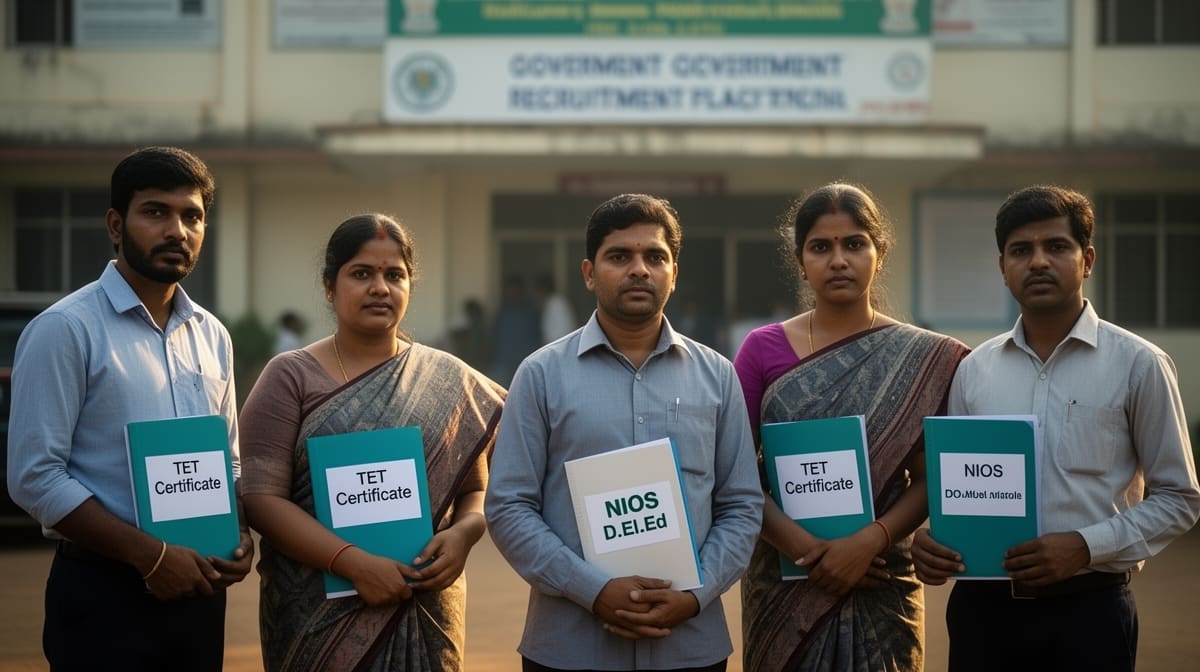
The Tripura High Court has affirmed that candidates who completed an 18-month D.El.Ed. program through the National Institute of Open Schooling (NIOS) are entitled to apply for teaching positions despite the absence of a TET certificate, recognizing a one-time window established by the Supreme Court. This ruling prevents the arbitrary exclusion of qualified candidates due to procedural technicalities, reinforcing equitable access to public employment.
Background & Facts
The Dispute
The petitioners, 16 individuals who successfully cleared the Tripura Teachers Eligibility Test (TRBT-TET), were denied TET certificates by the Teachers Recruitment Board, Tripura (TRBT), on the ground that their D.El.Ed. degrees were obtained through NIOS in a duration of 18 months, which allegedly did not meet the prescribed three-year norm. The TRBT contended that the NIOS program was not completed before 31.03.2019, rendering it ineligible under prior guidelines.
Procedural History
- The petitioners filed a writ petition before the Tripura High Court seeking direction to issue TET certificates.
- Simultaneously, they filed an interlocutory application (IA) seeking interim relief to participate in the TRBT’s 21.02.2026 recruitment notification for Graduate and Under Graduate Teachers.
- The TRBT resisted the IA, arguing that the main petition was still pending adjudication and no interim direction could be issued.
- The petitioners submitted that copies of the IA had been served on the State’s Senior Government Advocate at the time of filing.
Relief Sought
The petitioners sought immediate permission to apply for the teaching posts advertised on 21.02.2026, despite not possessing TET certificates at that stage, pending final disposal of their writ petition. They argued that delay would irreparably deprive them of employment opportunities.
The Legal Issue
The central question was whether candidates who completed an 18-month D.El.Ed. course through NIOS, and whose eligibility was recognized by the Supreme Court in Viswanath & Ors. v. State of Uttarakhand and Koushik Das & Ors. v. State of West Bengal, could be denied the opportunity to apply for teaching posts solely on the ground that their TET certificates had not yet been issued.
Arguments Presented
For the Petitioner
Learned counsel Mr. Arijit Bhauumik relied on the Supreme Court judgments in Viswanath & Ors. v. State of Uttarakhand (2025) 6 SCC 808 and Koushik Das & Ors. v. State of West Bengal (2025) 5 SCC 413, which explicitly recognized the 18-month NIOS D.El.Ed. program as valid under a one-time window. He argued that denying application rights based on pending certificate issuance violated the principle of substantive justice and amounted to procedural arbitrariness under Article 14 of the Constitution.
For the Respondent
The Senior Government Advocate, Mr. Pradyumna Gautam, contended that since the main writ petition was still pending, no interim relief could be granted. He emphasized that the TRBT was bound by its own rules and could not issue certificates without formal validation, even if the Supreme Court had recognized the course. He argued that interim orders must not prejudge the merits of the pending case.
The Court's Analysis
The Court acknowledged the binding precedent set by the Supreme Court in Viswanath and Koushik Das, which created a one-time window for recognition of the 18-month NIOS D.El.Ed. program. The Court observed that the petitioners had not merely completed the course but had also cleared the TET examination, thereby demonstrating their competence. The refusal to permit them to apply for advertised posts, pending certificate issuance, was found to be disproportionate and contrary to the spirit of the Supreme Court’s directive.
"It is the admitted position that the Hon’ble Supreme Court of India... accredited 18 (eighteen) months D.El.Ed. course as an one time window through NIOS. The present petitioners have undergone the said D.El.Ed. course through NIOS."
The Court rejected the argument that interim relief could not be granted merely because the main petition was pending. It held that where a clear legal right exists under a binding precedent, and denial of interim relief would cause irreparable harm to livelihood, equity demands immediate relief. The Court emphasized that procedural compliance cannot override substantive rights established by higher courts.
The Verdict
The petitioners succeeded. The Tripura High Court directed the TRBT to permit the petitioners to apply for the teaching posts under the 21.02.2026 notification without possession of TET certificates, subject to the final outcome of their writ petition. The Court affirmed that the Supreme Court’s recognition of the NIOS D.El.Ed. program creates a legally enforceable entitlement.
What This Means For Similar Cases
NIOS D.El.Ed. Qualifies for TET Applications
- Practitioners representing candidates with NIOS D.El.Ed. degrees must cite Viswanath and Koushik Das to assert eligibility for TET and teaching recruitments.
- State recruitment boards cannot impose additional conditions beyond those specified in Supreme Court orders.
- Denial of application rights based on pending certificate issuance is legally unsustainable.
Interim Relief Is Warranted When Supreme Court Precedent Exists
- Courts must grant interim relief when a binding precedent establishes a clear legal right, even if the main petition is pending.
- The doctrine of substantive justice overrides rigid procedural timelines when livelihood is at stake.
- Recruitment notifications must be interpreted in light of constitutional and Supreme Court directives, not internal administrative rules.
Certificate Issuance Cannot Be a Gatekeeper to Employment
- TET certificates are administrative formalities; eligibility is determined by qualification and examination performance.
- Petitioners who have cleared TET and hold recognized degrees must be allowed to compete for posts pending certificate issuance.
- Delay in certificate issuance by authorities cannot be used to disqualify otherwise eligible candidates.