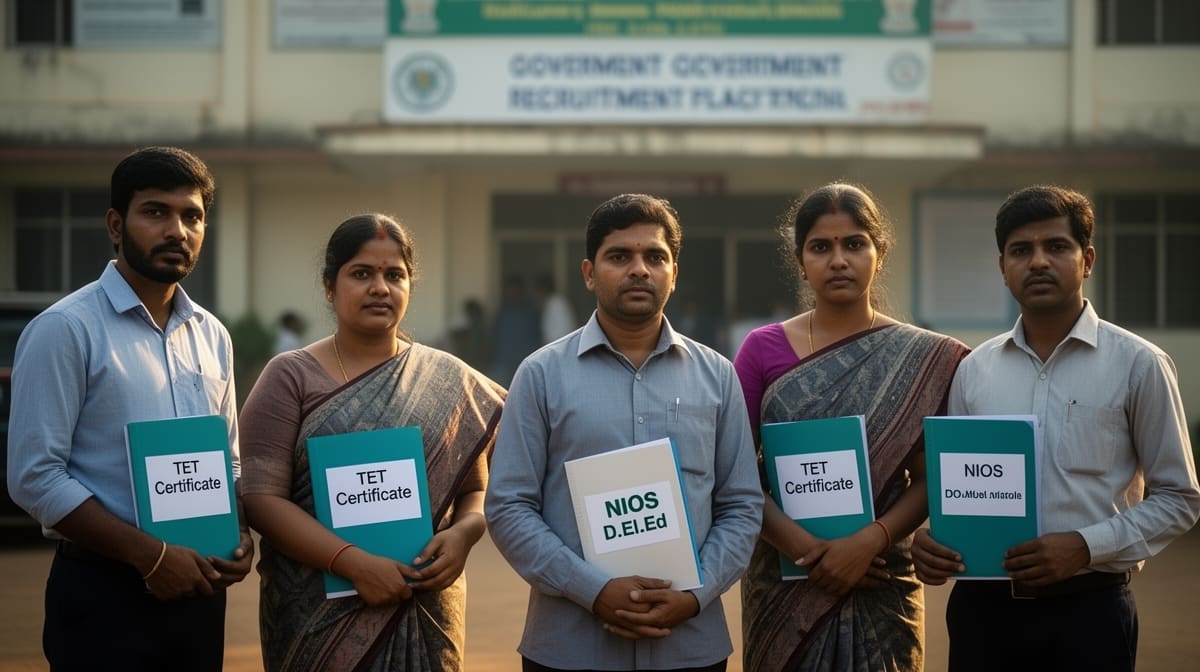
The Tripura High Court affirmed that an 18-month Diploma in Elementary Education (D.El.Ed) completed through the National Institute of Open Schooling satisfies the eligibility requirements for the Teachers Eligibility Test (TET) 2024, thereby directing the authorities to issue the TET certificate and consider the petitioner for appointment.
Background & Facts
The Dispute
The petitioner, Sri Abhijit Chakraborty, a resident of North Kachuchhara, Dhalai district, completed an 18-month D.El.Ed programme conducted by the National Institute of Open Schooling (NIOS) in open-distance learning mode. He applied for the TET Paper-I as per the advertisement dated 21.02.2026, qualified the examination, but was barred from the document-verification process on the ground that he did not possess the "required" two-year D.El.Ed qualification.
Key Facts
- Course duration: 03 Oct 2017 to 31 Mar 2019 (18 months) conducted by NIOS.
- Advertisement for UG Teacher posts: issued on 21 Feb 2026 by the Teachers Recruitment Board (TRBT).
- TET Paper-I qualification: petitioner cleared the exam prior to the advertisement.
- Document verification date: 23 Jul 2025; petitioner’s attendance sheet shows absence.
- Prospectus cum Instruction for T-TET 2024: required a minimum of two-year D.El.Ed qualification and physical presence at verification.
- Supreme Court judgment (Viswanath) dated 10 Dec 2024: recognised the 18-month diploma for in-service untrained teachers.
- NCTE recognition order: dated 22 Sep 2017, acknowledging the NIOS D.El.Ed programme.
- Parliamentary amendment: Section 23(2) of the Right of Children to Free and Compulsory Education (RTE) Act, 2009, extended the training period to 31 Mar 2019.
Procedural History
- 20 Aug 2026: Writ petition (WP(C) No. 210 of 2026) heard before Justice Biswajit Palit.
- 25 Aug 2026: Judgment and order delivered.
- The petition sought (i) declaration that clause 1(A) and 1(B) of the prospectus are illegal, (ii) issuance of a writ of certiorari to set aside the rejection of candidature, (iii) recognition of the 18-month D.El.Ed as valid, (iv) direction to issue the TET certificate, and (v) appointment as Under-Graduate Teacher.
- The respondents filed a counter-affidavit denying the petitioner's eligibility, citing non-appearance on 23 Jul 2025 and the prospectus requirement of a two-year diploma.
Parties' Positions
- Petitioner: Argues that the 18-month D.El.Ed is a valid qualification under the Viswanath judgment, NCTE order, and the amended Section 23(2) of the RTE Act; contends that his non-appearance was due to being denied entry to the verification venue.
- Respondents: Maintain that the prospectus expressly requires a two-year D.El.Ed and physical presence; assert that the petitioner’s absence on the verification date justifies disqualification.
Relief Sought
- Quash clause 1(A) and 1(B) of the prospectus.
- Issue a writ of certiorari to set aside the rejection of the petitioner's candidature.
- Recognise the 18-month D.El.Ed as a valid qualification.
- Direct the TRBT to issue the TET certificate and include the petitioner in the selection list.
- Order appointment as Under-Graduate Teacher.
- Any other order deemed fit.
The Legal Issue
Whether an 18-month Diploma in Elementary Education completed through NIOS, as recognised by the National Council for Teacher Education (NCTE) and the amendment to Section 23(2) of the Right of Children to Free and Compulsory Education Act, 2009, satisfies the eligibility criteria stipulated in the prospectus for T-TET 2024, and whether the respondents can lawfully disqualify the petitioner for non-appearance at document verification.
Arguments Presented
For the Petitioner
- Relied on Viswanath v. Union of India (Supreme Court, 10 Dec 2024) which held that the 18-month diploma is a valid qualification for in-service teachers.
- Cited the NCTE recognition order dated 22 Sep 2017 and the parliamentary amendment to Section 23(2) of the RTE Act, 2009, extending the training period to 31 Mar 2019.
- Submitted that the prospectus requirement of a two-year diploma is inconsistent with the higher judicial pronouncements and statutory amendments.
- Emphasised that the petitioner’s absence on 23 Jul 2025 was a consequence of being denied entry, not a voluntary default.
For the Respondent
- Asserted that the prospectus and Notice No.F.4 (1-11)/COE/TRBT/2020/478 dated 26 Jun 2025 expressly mandate physical presence and a two-year D.El.Ed qualification.
- Pointed to the attendance sheet showing the petitioner’s absence, arguing that the disqualification was procedurally correct.
- Maintained that the statutory framework permits the authority to set minimum qualification standards, and the prospectus is a valid regulatory instrument.
The Court's Analysis
The Court began by examining the statutory hierarchy. It noted that the RTE Act, 2009, as amended, expressly permits an 18-month D.El.Ed programme for in-service teachers, a position reinforced by the Supreme Court’s Viswanath ruling. The Court observed that the NCTE, the competent academic authority, had recognised the NIOS programme and that the Ministry of Human Resource Development had communicated the same to the State.
"The amendment to Section 23(2) of the RTE Act extended the period for such training to 31 March 2019 and the NCTE has acknowledged the D.El.Ed course through NIOS as valid for in-service teachers."
The Court held that the prospectus, being a subordinate regulatory document, cannot override a statutory amendment or a superior judicial pronouncement. It distinguished the respondents’ reliance on the prospectus from the higher authority of the Viswanath judgment and the statutory amendment, stating that the latter constitute the governing law.
Further, the Court scrutinised the attendance record. It accepted the petitioner’s contention that the verification venue barred candidates lacking the 18-month diploma, thereby rendering the absence involuntary. The Court emphasized the principle of audi alteram partem and held that denying entry to the petitioner amounted to a denial of natural justice.
The Court also referred to its own earlier decisions (WP(C) No. 603 of 2025, WP(C) No. 27 of 2026, WP(C) No. 159 of 2026) which consistently upheld the validity of the 18-month diploma and directed the authorities to include such candidates in the selection process.
In light of these authorities, the Court concluded that the respondents were bound to treat the petitioner’s 18-month D.El.Ed as a valid qualification, to include his name in the final selection list, and to issue the requisite TET certificate.
The Verdict
The petition was allowed in its entirety. The Court directed the Teachers Recruitment Board to (i) include the petitioner’s name in the recommended list dated 03 Apr 2025 for both Graduate and Under-Graduate Teacher posts within six weeks of the judgment, (ii) issue the T-TET 2024 certificate within six weeks, (iii) arrange a fresh document-verification session within one month, and (iv) recommend the petitioner for appointment within three months, subject to verification of his past service as of 10 Aug 2017.
What This Means For Similar Cases
Eligibility of 18-Month D.El.Ed Courses
- The amendment to Section 23(2) of the RTE Act, 2009 and the Viswanath judgment now constitute the controlling standard for eligibility, superseding any prospectus that demands a two-year diploma.
- Candidates holding an 18-month D.El.Ed from NIOS can rely on this precedent to challenge disqualification in recruitment processes.
Procedural Fairness in Document Verification
- Authorities must ensure physical access to verification venues for all eligible candidates; denial of entry amounts to a breach of natural justice.
- Attendance records alone cannot be used to disqualify a candidate if the absence is attributable to the authority’s own procedural lapse.
Impact on Recruitment Authorities
- Recruitment bodies must align their eligibility criteria with statutory amendments and higher-court pronouncements.
- Any future prospectus or instruction that conflicts with the recognized 18-month diploma will be vulnerable to judicial scrutiny and likely struck down.