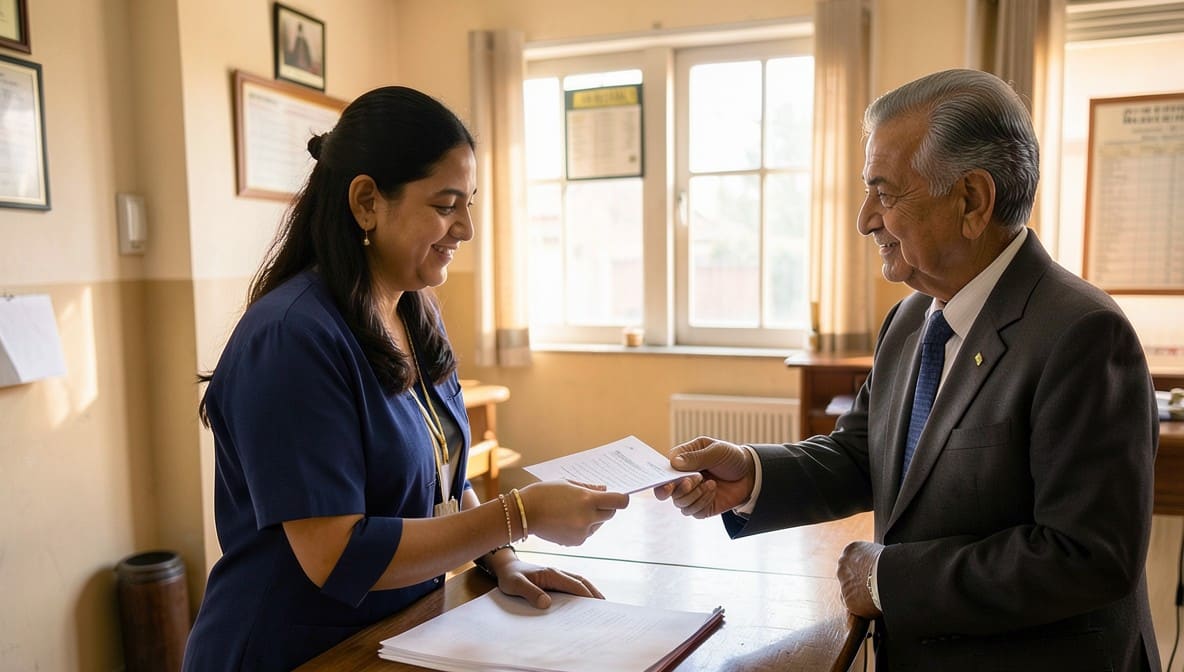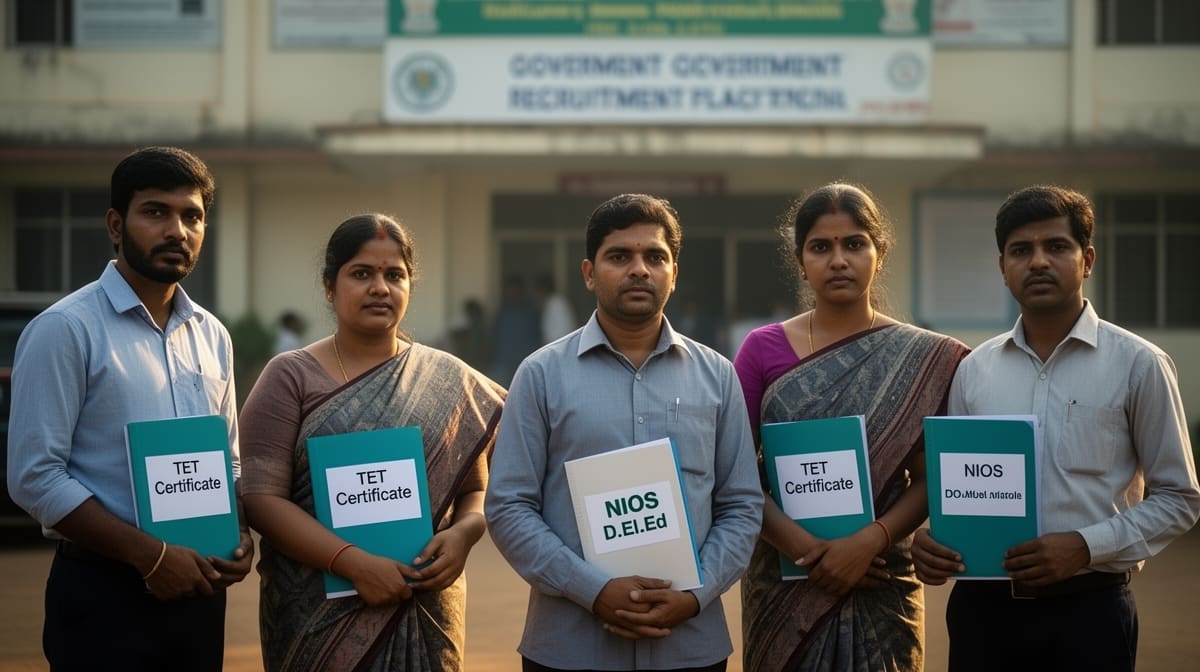
The Bombay High Court has reaffirmed that procedural fairness is non-negotiable in public employment appointments, particularly in the education sector where statutory compliance is complex and evolving. The Court set aside a rejection order that denied appointment without affording the petitioner an opportunity to address alleged deficiencies, emphasizing that administrative decisions must be reasoned, transparent, and fair.
Background & Facts
The Dispute
The petitioner, Shri Nagnath s/o Sambhaji Dhulekar, applied for appointment as a Shikshan Sewak and subsequently as an Assistant Teacher in a school managed by Respondent Nos. 5 and 6. He holds qualifications of M.A., D.Ed., and B.Ed. in English/Geography and belongs to the Nomadic Tribe category. A vacancy arose for teaching English and Geography to Classes 9 and 10. Respondent No. 6 published advertisements for the post on 24.04.2019 and 25.04.2019 in the newspapers "Ajanta Express" and "Mahasagar". After a competitive interview process, Respondent No. 5 passed a resolution on 07.06.2019 to appoint the petitioner from the open category, as the roaster available on 15.02.2019 indicated eligibility. The appointment order was issued on 10.06.2019, and the petitioner assumed charge on that date.
Key Facts
- The petitioner was appointed to teach Classes 9 and 10 from 10.06.2019
- Respondent No. 6 submitted a proposal to Respondent No. 3 (Directorate of School Education) on 07.11.2019 seeking approval for the appointment
- The proposal remained pending for 1 year, 1 month, and 8 days
- On 14.12.2020, Respondent No. 3 rejected the proposal solely on the ground that the appointment was not processed through the Pavitra Portal
- The petitioner filed Writ Petition No. 13419/2021 challenging this rejection
- On 13.08.2024, the Bombay High Court partly allowed the petition, directing Respondent No. 3 to reconsider the proposal without rejecting it on the Pavitra Portal ground alone
- On 24.03.2025, Respondent No. 3 again rejected the proposal, this time on six distinct grounds, including lack of TET qualification and non-compliance with Pavitra Portal
- No opportunity was given to the petitioner or the managing institution to explain, submit documents, or rectify alleged deficiencies before the second rejection
Procedural History
- 07.06.2019: Appointment resolution passed by Respondent No. 5
- 10.06.2019: Petitioner took charge as Shikshan Sewak
- 07.11.2019: Proposal submitted to Respondent No. 3 for approval
- 14.12.2020: First rejection on Pavitra Portal ground
- 13.08.2024: High Court sets aside first rejection and directs fresh consideration
- 24.03.2025: Second rejection on six grounds, without hearing
- 10.04.2026: Present writ petition decided by Division Bench
The Parties' Positions
Petitioner: Argued that the second rejection was arbitrary, violative of natural justice, and contrary to the earlier direction of the Court. He contended that TET qualification is not mandatory for teaching Classes 9 and 10 under the Right to Education Act, 2009, and that the Pavitra Portal requirement was already addressed by the Court’s prior order. He relied on Jayshree d/o Anil Kadam and Dnyan Vikas Mandal to support that newspaper publication is directory and that procedural compliance must be contextual.
Respondent State: Relied on Anjuman Ishaat-e-Taleem Trust v. State of Maharashtra (2025 LiveLaw SC 861) to assert that TET qualification is mandatory for all teaching positions. Also cited State of Maharashtra v. Shaikh Jaweria Khadarsab (SLP Diary No. 10549/2025) to argue that Pavitra Portal is mandatory and that no selection was possible through it in 2017, implying the petitioner’s appointment was inherently flawed.
Relief Sought
The petitioner sought quashing of the impugned order dated 24.03.2025, direction to approve his appointment with effect from 10.06.2019, and payment of arrears with interest. He also sought compliance with the earlier Court direction to reconsider without relying on the Pavitra Portal ground.
The Legal Issue
Whether an administrative authority may reject a teacher’s appointment proposal on multiple grounds without affording the candidate or the managing institution an opportunity to explain, rectify, or submit supporting documents, particularly after a prior judicial direction to reconsider the matter fairly.
Arguments Presented
For the Petitioner
The petitioner’s counsel argued that the second rejection violated the principles of natural justice under Article 14 and 21 of the Constitution. He emphasized that the Court’s earlier order explicitly prohibited rejection on the Pavitra Portal ground, yet Respondent No. 3 resurrected the same issue under six new grounds without a hearing. He cited Jayshree d/o Anil Kadam to show that technicalities like portal compliance cannot override substantive eligibility, and Dnyan Vikas Mandal to argue that publication in two newspapers is directory, not mandatory. He contended that TET qualification under the RTE Act applies only to elementary education (Classes 1 - 8), not secondary (Classes 9 - 10), and that the petitioner’s appointment was lawful.
For the Respondent/State
The Additional Government Pleader relied on Anjuman Ishaat-e-Taleem Trust to assert that TET is mandatory for all teaching posts, including secondary level, and that the petitioner’s failure to clear TET renders his appointment invalid. He cited the Supreme Court’s observation in SLP Diary No. 10549/2025 that no selections were made through Pavitra Portal in 2017, implying systemic non-compliance. He argued that the State has a duty to ensure statutory compliance and that the petitioner’s appointment was procedurally defective from inception.
The Court's Analysis
The Court observed that while statutory compliance, including TET qualification and use of the Pavitra Portal, is important, procedural fairness cannot be sacrificed in the name of technicalities. The Court noted that the earlier order dated 13.08.2024 had specifically directed Respondent No. 3 to reconsider the proposal without rejecting it on the Pavitra Portal ground. Yet, the impugned order dated 24.03.2025 not only ignored this direction but introduced six new grounds for rejection without any opportunity for the petitioner or the school to respond.
"One more chance is required to be given to the Petitioner as well as the Respondent/management and the school to clear the defects, if any. If still they fail, then Respondent No. 3 would be at liberty to pass appropriate order."
The Court held that the State cannot act as both judge and party in such matters. The petitioner’s qualifications, appointment resolution, and actual service since 2019 were not disputed. The alleged deficiencies - whether in TET, portal compliance, or documentation - were matters that could be clarified through a hearing. The Court distinguished Anjuman Ishaat-e-Taleem Trust by noting that the Supreme Court’s ruling did not preclude procedural fairness in reconsideration. The Court further held that the State’s reliance on the 2017 Pavitra Portal data was irrelevant to an appointment made in 2019, and that the burden of proving non-compliance lay with the authority, not the candidate.
The Court emphasized that administrative decisions affecting livelihood must be reasoned, and that the right to be heard is not a formality but a constitutional imperative.
The Verdict
The petition was partly allowed. The impugned order dated 24.03.2025 is quashed and set aside. Respondent Nos. 5 and 6 shall submit a fresh proposal to Respondent No. 3 within 15 days, addressing all six grounds of rejection. Upon receipt, Respondent No. 3 shall afford the petitioner and the managing institution an opportunity to present their case and documents. A final decision shall be rendered within 8 weeks thereafter. No costs are awarded.
What This Means For Similar Cases
Procedural Fairness Trumps Technical Non-Compliance
- Practitioners must insist on a hearing before any rejection of teacher appointments, even if statutory norms appear unmet
- Administrative authorities cannot rely on prior rejections or generic policy documents to deny service without individualized assessment
- The burden of proving non-compliance rests on the State, not the candidate
TET Qualification Is Not Automatically Mandatory for Secondary Level
- The Right to Education Act mandates TET for Classes 1 - 8; its applicability to Classes 9 - 10 remains legally contested
- Authorities must cite specific statutory provisions when denying appointments on TET grounds
- Judicial precedents like Anjuman Ishaat-e-Taleem Trust do not override the right to be heard on factual disputes
Pavitra Portal Is a Process, Not a Barrier
- Portal compliance cannot be used as a blanket disqualification without considering alternative evidence of eligibility
- Past non-functionality of the portal (e.g., in 2017) does not invalidate appointments made later
- Courts will intervene where portal compliance is used as a pretext to avoid substantive review