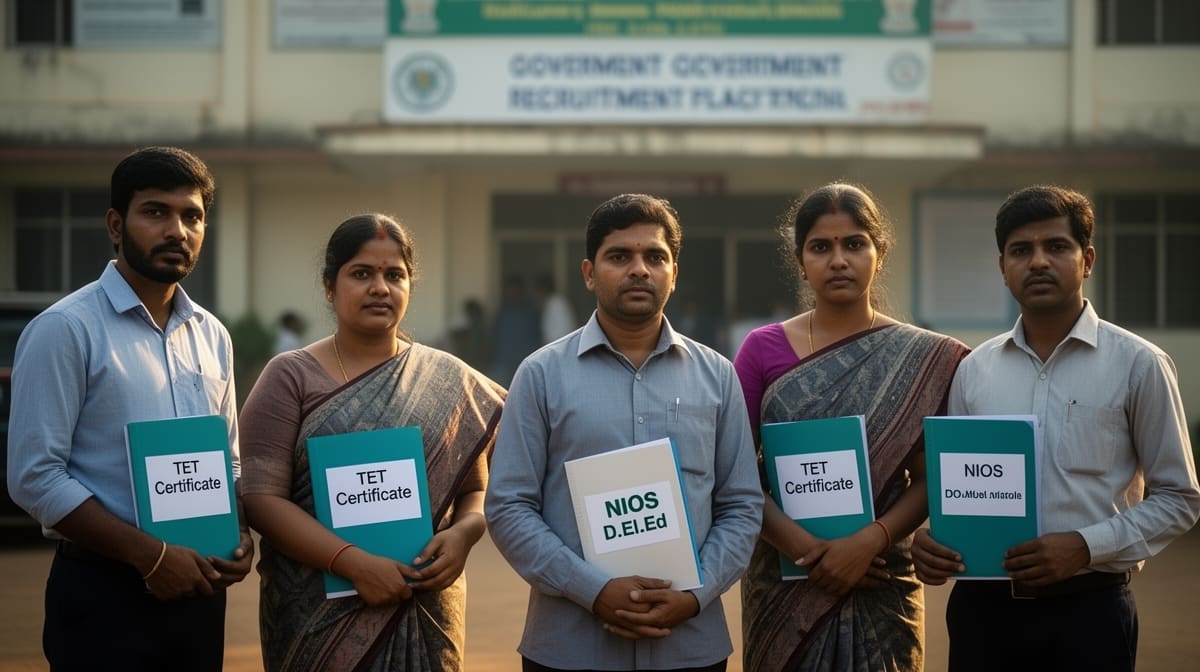
The Supreme Court has clarified that the State Eligibility Test (SET) for appointment as a Higher Secondary School Teacher must be in the concerned subject, regardless of whether the statutory rule explicitly states so. This decision resolves a long-standing ambiguity in Kerala’s teacher appointment framework and reinforces the principle that statutory interpretation must align with legislative purpose and administrative context.
Background & Facts
The Dispute
The dispute centers on whether a candidate appointed as a Higher Secondary School Teacher (HSST) in Economics can qualify under the Kerala Education Rules if their State Eligibility Test (SET) was passed in a different subject - Malayalam - despite holding postgraduate degrees in Economics. The appellant, Zubair P., was appointed as HSST (Economics) in July 2021, but his appointment was rejected because he lacked SET in Economics. The competing candidate, Respondent No. 4, possessed SET in Economics and challenged the appointment.
Procedural History
- 15.07.2021: Appellant appointed as HSST (Economics) by school management
- 18.06.2022: Competent authority rejected appointment citing non-compliance with Rule 6.2(24)(iii) of Kerala Education Rules
- 14.05.2024: Single Judge of Kerala High Court dismissed appellant’s writ petition and allowed Respondent No. 4’s petition, directing consideration of her appointment
- 18.07.2024: Division Bench of Kerala High Court affirmed the Single Judge’s order
- 2024 - 2025: Appellant filed Special Leave Petitions (SLPs) before the Supreme Court
Relief Sought
The appellant sought quashing of the rejection order and direction for approval of his appointment with effect from 15.07.2021. Respondent No. 4 sought declaration of her superior eligibility and direction for her appointment to the same post.
The Legal Issue
The central question was whether Rule 6.2(24)(iii) of Chapter XXXII of the Kerala Education Rules requires the State Eligibility Test (SET) to be passed in the concerned subject for appointment as a Higher Secondary School Teacher, even when the rule does not expressly state "in the concerned subject."
Arguments Presented
For the Appellant
The appellant, through senior counsel Nikhil Goel, argued that Rule 6.2(24)(iii) mandates only a "pass in the State Eligibility Test" without specifying the subject. The deliberate omission of subject-specific language, they contended, indicates legislative intent to treat SET as a general teaching aptitude test. They relied on Manager, MPVHS School v. Girija (2003) to argue that executive circulars cannot override statutory rules and that a long-standing administrative practice across Kerala supports subject-neutral SET acceptance. They further emphasized that Rule 10(4) exempts teachers with ten years of service from SET entirely, regardless of subject, reinforcing that SET is not subject-specific.
For the Respondent
Respondent No. 4, through counsel Anne Mathew, argued that the purpose of SET is to ensure subject-specific competence at the Higher Secondary level, as evidenced by the SET prospectus requiring Paper II to test postgraduate-level subject expertise. They relied on Union of India v. Pushpa Rani and Kunjunjamma v. State of Kerala to assert that government clarifications (G.O. dated 18.01.2021) are valid interpretations within the rule-making authority’s competence. They distinguished Girija as concerning High School Assistants under Chapter XXXI, not HSSTs under Chapter XXXII, and argued that allowing SET in unrelated subjects would undermine academic standards.
The Court's Analysis
The Court undertook a purposive and contextual interpretation of Rule 6.2(24)(iii), rejecting a narrow textual reading. It emphasized that statutory provisions must be read as a whole, in light of their object and scheme, citing Reserve Bank of India v. Peerless General Finance and Investment Co. Ltd. (1987). The Court observed that while the rule does not explicitly state "in the concerned subject," the scheme of the SET examination - as detailed in the July 2021 prospectus - requires candidates to choose a subject of specialization for Paper II, which tests postgraduate-level subject knowledge.
"Thus, it is not in dispute that SET is conducted subject-wise and it includes a paper testing postgraduate-level subject expertise, therefore, a candidate cannot qualify in SET without choosing a specific subject of specialisation."
The Court held that interpreting SET as subject-neutral would defeat the very purpose of introducing the test - to ensure pedagogical and subject-specific competence at the Higher Secondary level. It distinguished Girija (2003), which dealt with B.Ed. qualifications for High School Assistants under Chapter XXXI, noting that HSSTs under Chapter XXXII are a distinct cadre with higher academic expectations. The Court also rejected the appellant’s claim under Rule 10(4), as he had only 9 years, 10 months, and 14 days of qualifying service, falling short of the mandatory ten-year threshold.
The Verdict
The appellant’s appeals were dismissed. The Court held that SET qualification for HSST appointment must be in the concerned subject, even if the rule does not expressly state so, because the statutory context and examination scheme compel such an interpretation. The High Court’s order upholding Respondent No. 4’s eligibility was affirmed, and the authorities were directed to consider her appointment with effect from 01.06.2021, subject to verification of her eligibility.
What This Means For Similar Cases
SET Subject Specificity Is Mandatory
- Practitioners must now treat SET as a subject-specific qualification for HSST appointments under Kerala Education Rules
- Applications based on SET in unrelated subjects will be legally untenable, even if the candidate holds postgraduate degrees in the teaching subject
- Administrative authorities must verify SET subject alignment before approving appointments
Executive Clarifications Are Valid Interpretations
- Government orders interpreting statutory rules to require subject-specific SET are not ultra vires, provided they align with the rule’s purpose
- Challenges to such clarifications must be filed at the earliest opportunity; failure to challenge them in lower courts may bar reliance on them in higher forums
Distinction Between Cadres Is Critical
- Rules governing High School Assistants (Chapter XXXI) cannot be conflated with those for Higher Secondary Teachers (Chapter XXXII)
- Precedents from lower teaching cadres do not bind HSST appointment cases, as the latter involve higher academic standards
- Legal arguments must be tailored to the specific chapter and cadre under which the appointment is made