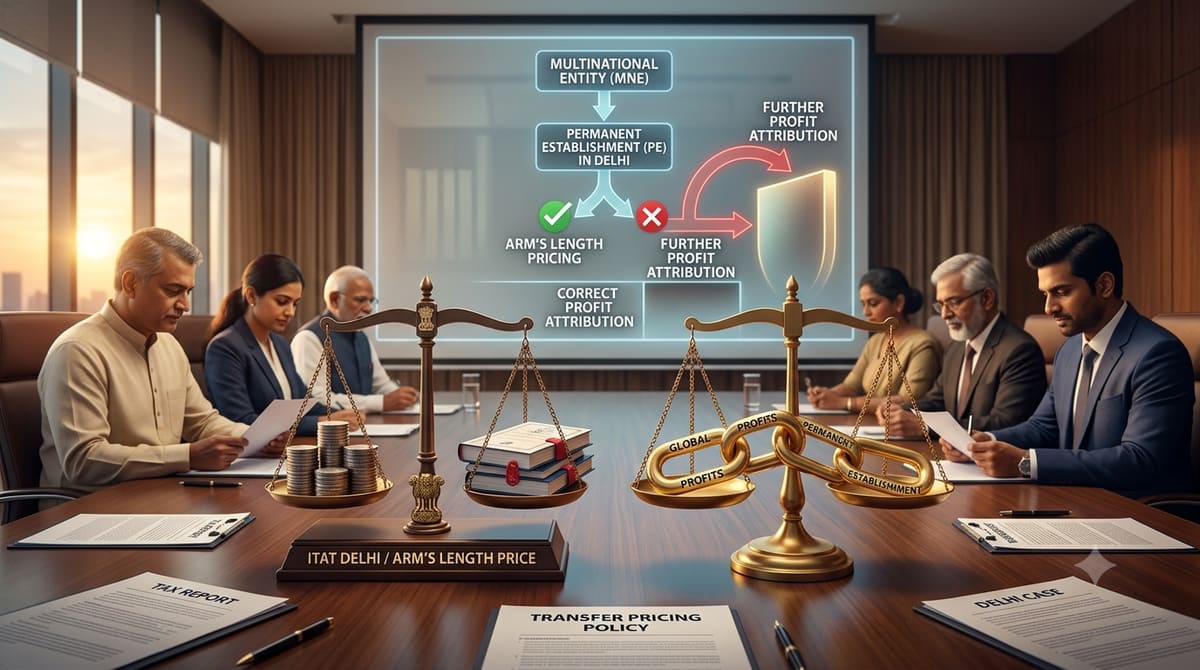
The Income Tax Appellate Tribunal, Ahmedabad, has delivered a significant ruling clarifying the limits of transfer pricing adjustments in cases involving intra-group services. The Tribunal held that revenue authorities cannot arbitrarily reduce the arm's length price to nil without applying any prescribed method or substantiating the absence of actual economic benefit. This decision reinforces the principle that commercial decisions of multinational enterprises must be respected unless clearly shown to violate the arm’s length standard.
Background & Facts
The Dispute
The appellant, Styrenix Performance Materials Ltd. (formerly INEOS Styrolution India Limited), is an Indian subsidiary of the INEOS Styrolution Group, a global multinational engaged in the production of engineering thermoplastics. The company filed its return of income for Assessment Year 2021-22 on 24.02.2022, declaring a total income of Rs. 3,65,38,69,610. The case was selected for scrutiny assessment, and a reference was made under Section 92CA of the Income-tax Act, 1961, to the Transfer Pricing Officer (TPO) for determining the arm’s length price (ALP) of international transactions with associated enterprises (AEs).
Key Facts
- The appellant paid aggregate amounts to two AEs: INEOS Styrolution Group GmbH, Germany (GHO services) and INEOS Styrolution APAC Pte. Ltd., Singapore (RHO services).
- The payments were for three categories of intra-group services:
- GHO non-IT services: Rs. 7,11,17,906
- GHO IT services: Rs. 43,19,415
- RHO services: Rs. 9,56,76,320
- Total proposed adjustment: Rs. 17,11,13,551
- The appellant benchmarked these services using the Transactional Net Margin Method (TNMM), treating the overseas service providers as the tested party.
- The appellant submitted detailed documentation including service agreements, emails, cost allocation keys, operational reports, and a Benefit Test Analysis.
- The TPO rejected the benchmarking and determined the ALP of all services (except GTO under GHO) at Nil, citing lack of proof of actual benefit and characterizing services as "shareholder activities" or "duplicative."
- The DRP acknowledged the identical nature of the issue in prior years but upheld the adjustment to "keep the issue alive" for further appeal.
Procedural History
- 24.02.2022: Return of income filed for A.Y. 2021-22
- 2022-2023: Transfer pricing proceedings initiated by TPO
- 29.09.2024: DRP order sustaining transfer pricing adjustment of Rs. 17,11,13,551
- 10.10.2024: Final assessment order passed by Assessing Officer incorporating DRP findings
- 15.03.2025: Appeal filed before ITAT Ahmedabad (ITA No. 2178/Ahd/2024)
- 06.05.2026: Hearing conducted
- 26.05.2026: Judgment pronounced
The Parties' Positions
For the Appellant
- Argued that the services rendered were genuine, documented, and essential for business operations.
- Submitted that the TNMM benchmarking was robust and complied with Rule 10D and Section 92D.
- Contended that the TPO and DRP failed to apply any prescribed method under Section 92C and Rule 10B.
- Highlighted that the same issue was decided in its favor for A.Y. 2017-18 and 2018-19 by ITAT and subsequently affirmed by the Gujarat High Court.
- Asserted that the DRP’s decision to sustain the adjustment merely to preserve the Revenue’s appeal rights was legally impermissible.
For the Respondent
- Maintained that the services were either shareholder activities or lacked demonstrable economic benefit.
- Argued that the appellant failed to prove the actual rendition of services with specificity.
- Relied on the DRP’s observation that the documentation was generalized and insufficient to establish commercial expediency.
- Did not contest the binding nature of prior decisions but defended the adjustment as a procedural safeguard.
Relief Sought
The appellant sought:
- Quashing of the transfer pricing adjustment of Rs. 17,11,13,551
- Deletion of additions under Section 92C
- Cancellation of penalty proceedings under Section 270A
- Rectification of TDS/TCS credit errors and interest levied under Sections 234A and 234C
Grounds 1 and 2 (regarding time limits under Section 153) were not pressed.
The Legal Issue
Can the Transfer Pricing Officer determine the arm’s length price of intra-group services at Nil under Section 92C without applying any prescribed method, merely on the ground that the services may constitute shareholder activities or lack sufficient benefit?
Arguments Presented
For the Appellant
The appellant relied on Section 92C and Rule 10B, which mandate that ALP must be determined using one of the prescribed methods - including TNMM - and not arbitrarily set at Nil. It cited ITA No. 58/Ahd/2022 and ITA No. 330/Ahd/2022 (its own prior cases), where ITAT had held that once the taxpayer demonstrates receipt of services with supporting documentation, the burden shifts to the Revenue to rebut with cogent evidence. The appellant emphasized that Rule 10AB requires consideration of uncontrolled transactions, which the TPO failed to search for. It further relied on the Gujarat High Court’s judgment dated 05.03.2024, which affirmed that the TPO cannot act as a "businessman in an armchair" and substitute commercial judgment for legal compliance.
For the Respondent
The Revenue contended that the services were not independently chargeable because they were either duplicative or related to stewardship functions of the parent company. It argued that the appellant’s documentation was too generic and did not prove direct benefit to the Indian entity. However, it did not dispute the binding nature of the prior ITAT and High Court decisions, nor did it present any new evidence to rebut the appellant’s submissions.
The Court's Analysis
The Tribunal conducted a meticulous review of the record and found that the DRP itself had acknowledged the identical nature of the issue in earlier assessment years. The DRP had sustained the adjustment not on substantive grounds but to preserve the Revenue’s right to appeal - a practice the Tribunal found legally untenable.
"The DRP itself accepted that the issue stood covered by the earlier orders of the Tribunal and sustained the addition merely for the purpose of keeping the issue alive in further appeal."
The Tribunal emphasized that Section 92C and Rule 10B do not permit the Revenue to determine ALP at Nil without applying any method. The TPO’s approach of presuming no service was rendered, based on subjective opinion of commercial expediency, was held to be contrary to statutory mandate.
"Once the assessee demonstrates actual receipt of services and business nexus, the TPO cannot determine the arm's length price of the services at Nil merely because in his opinion the assessee did not derive sufficient benefit or because an independent enterprise may not have paid for such services."
The Tribunal further noted that the Gujarat High Court had explicitly held that the TPO must search for comparable uncontrolled transactions before concluding that ALP is Nil. The absence of such an inquiry rendered the adjustment invalid.
The Tribunal also rejected the notion that incidental shareholder benefit negates the existence of a chargeable service. It held that the presence of some stewardship elements does not invalidate the entire transaction if core business services are demonstrably rendered.
The Verdict
The appeal was partly allowed. The ITAT set aside the transfer pricing adjustment of Rs. 17,11,13,551 made under Section 92C for A.Y. 2021-22 and directed the Assessing Officer to delete the entire addition. The Tribunal upheld the deletion of the adjustment in line with the binding precedents of its Coordinate Bench and the Gujarat High Court. The remaining grounds relating to penalty, TDS/TCS credits, and interest were not adjudicated as they were contingent on the transfer pricing adjustment. The order was pronounced on 26.05.2026.
What This Means For Similar Cases
Transfer Pricing Adjustments Cannot Be Based on Presumptions
- Practitioners must now insist that TPOs apply one of the prescribed methods under Section 92C before proposing any adjustment.
- A mere assertion that services are "shareholder activities" is insufficient - the Revenue must provide specific evidence of non-benefit or duplication.
- Generic emails or policy documents are not inherently invalid; context and business nexus matter.
Binding Precedents Bind the Revenue Even in Subsequent Years
- The Revenue cannot sustain an identical adjustment in later years merely to preserve its right to appeal.
- Once a tribunal or high court has ruled on identical facts and documentation, the Revenue is estopped from re-litigating the same issue without new evidence.
- Taxpayers should cite prior favorable orders in their submissions and demand application of res judicata principles.
Documentation Must Be Systematic, Not Just Extensive
- Maintain clear, dated, and entity-specific records linking services to business outcomes.
- Use allocation keys, service logs, and internal approvals to demonstrate actual receipt.
- Avoid over-reliance on group-wide templates; tailor documentation to the Indian entity’s operational reality.