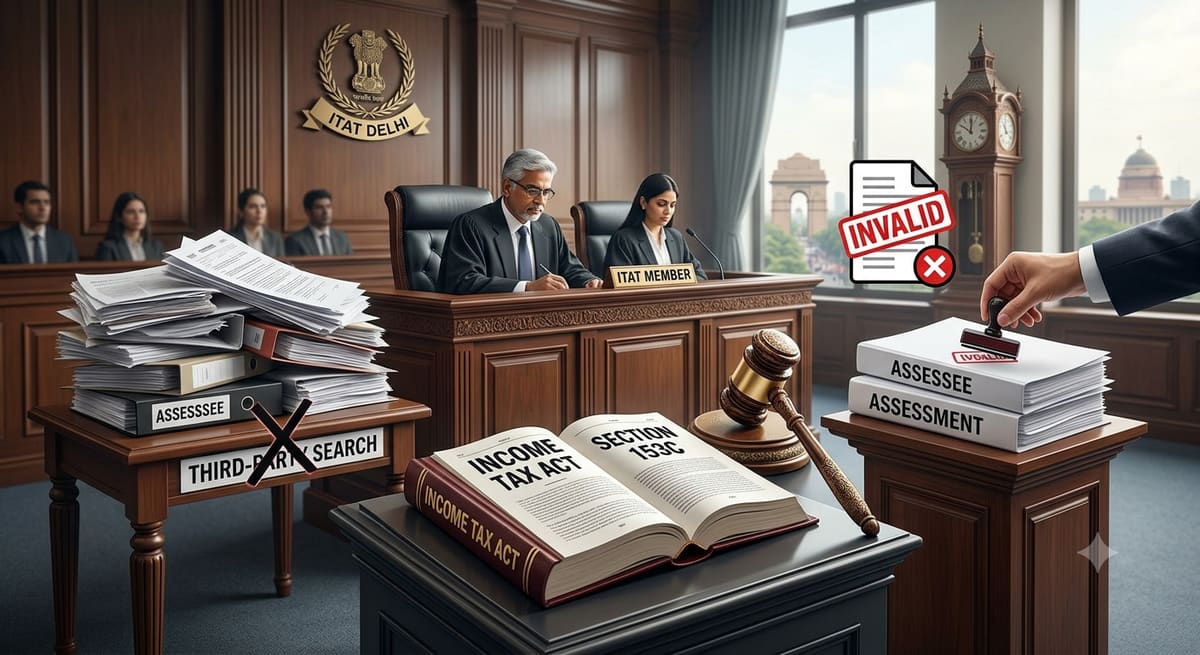
The Income Tax Appellate Tribunal, Mumbai, has delivered a decisive ruling reinforcing that revenue authorities cannot sustain tax additions under Section 153C of the Income Tax Act based exclusively on uncorroborated third-party statements or electronic data seized from unrelated entities. This judgment clarifies the non-negotiable requirements of corroboration, confrontation, and natural justice in assessment proceedings arising from search operations.
Background & Facts
The Dispute
The dispute arose from a search and seizure operation conducted under Section 132 of the Income Tax Act, 1961, at the premises of M/s Rubberwala Housing and Infrastructure Ltd (RHIL). During the search, authorities recovered a pendrive from the residence of Shri Imran Ansari, a key employee of RHIL, containing Excel sheets detailing cash transactions for the "Platinum Mall" project. Statements from RHIL’s promoter and employee alleged that purchasers, including the assessee, had paid "on-money" in cash over and above the registered sale consideration. The Assessing Officer (AO) used this third-party material to initiate proceedings under Section 153C and made additions of ₹2,00,000, ₹6,70,750, and ₹4,01,625 for assessment years 2017-18, 2018-19, and 2019-20 respectively, treating these amounts as unexplained investments under Section 69.
Procedural History
- March 2021: Search conducted at RHIL premises and employee residences.
- March 2024: AO passed assessment order under Section 153C, making additions based on pendrive data and third-party statements.
- October 2025: Commissioner of Income-tax (Appeals) confirmed the additions.
- February 2026: Appeals heard before ITAT Mumbai.
- March 2026: Tribunal delivered consolidated order allowing the appeals.
Relief Sought
The assessee sought deletion of the additions, arguing that no incriminating material pertaining to him was seized, no opportunity for cross-examination was granted, and the reliance on third-party data without corroboration violated principles of natural justice and statutory requirements under Section 69.
The Legal Issue
The central question was whether Section 153C permits the Assessing Officer to make additions against a third-party purchaser solely on the basis of uncorroborated statements and electronic data seized from a builder’s employee, without confronting the assessee with the material or affording him an opportunity to cross-examine the deponents.
Arguments Presented
For the Petitioner
The assessee’s counsel contended that: (1) no document or seized material named the assessee; (2) the pendrive data was recovered from a third party and not authenticated; (3) the assessee had paid the full consideration through banking channels; (4) the AO failed to provide copies of the statements or the pendrive data; and (5) the denial of cross-examination violated the principles of natural justice as affirmed in Andaman Timber Industries v. CCE and CIT v. Odeon Builders. Reliance was placed on Pravin Khetaram Purohit v. DCIT and Heena Dashrath Jhanglani v. ITO, where identical facts led to deletion of additions.
For the Respondent
The Departmental Representative relied on the AO’s order and the CIT(A)’s confirmation, arguing that the Excel sheets and statements from RHIL’s employees constituted incriminating material sufficient to trigger Section 153C proceedings. No independent legal arguments were advanced to rebut the procedural violations alleged by the assessee.
The Court's Analysis
The Tribunal conducted a meticulous review of the evidence and procedural record. It emphasized that Section 69 places the initial burden on the Revenue to establish that an investment was made before shifting the burden to the assessee to explain its source. Here, the Revenue failed to establish even the prima facie existence of the alleged cash payment by the assessee.
"No independent material or evidence has been brought on record by the Assessing Officer to establish that the assessee had in fact paid any on-money in cash."
The Court noted that the pendrive data, though recovered from a third party, contained no explicit reference to the assessee. The mere presence of a phone number allegedly linked to the assessee was insufficient to establish ownership or payment without corroborative evidence such as bank trails, receipts, or diary entries in the assessee’s possession.
The Tribunal further held that the failure to provide the assessee with copies of the statements or the pendrive data, and the refusal to allow cross-examination of Shri Imran Ansari and Shri Tabresh Shaikh, constituted a fundamental breach of natural justice. Citing Andaman Timber Industries v. CCE and CIT v. Odeon Builders, the Court observed:
"Failure to give the assessee the opportunity to cross-examine witnesses, whose statements are relied upon, results in breach of principles of Natural Justice. It is a serious flaw which renders the order a nullity."
The Tribunal also relied on its own Coordinate Bench’s decision in Pravin Khetaram Purohit v. DCIT, which had addressed identical facts and held that third-party data alone cannot sustain an addition. The Court found no distinguishing features in the present case to justify a different outcome.
The Verdict
The assessee won. The Tribunal held that additions under Section 69 cannot be sustained under Section 153C where the Revenue relies solely on uncorroborated third-party statements and electronic data without confronting the assessee or providing an opportunity for cross-examination. The additions of ₹2,00,000, ₹6,70,750, and ₹4,01,625 were deleted.
What This Means For Similar Cases
Third-Party Data Alone Is Not Conclusive
- Practitioners must challenge any addition based on seized electronic data from unrelated entities unless the Revenue proves direct linkage to the assessee.
- Mere coincidence of phone numbers or names in builder’s Excel sheets is insufficient without corroborative evidence like bank statements, signed acknowledgments, or cash trail documentation.
Cross-Examination Is Mandatory
- Any reliance on statements recorded under Section 132(4) against an assessee triggers an absolute right to cross-examine the deponent.
- Failure to grant this right, even if requested, renders the assessment order void ab initio under Andaman Timber Industries.
- Practitioners should formally request cross-examination in writing and preserve such requests in the record.
Burden of Proof Remains With the Revenue
- The Revenue must first establish a prima facie case of unexplained investment under Section 69 before shifting the burden.
- In cases involving cash payments alleged by builders, the assessee’s denial coupled with proof of banking channel payments creates a strong defense.
- Practitioners should always demand production of all adverse material and file applications under Section 133A or Rule 46A of the Income Tax Rules to compel disclosure.