The Rajasthan High Court has reaffirmed that procedural fairness is non-negotiable in tax adjudication. In a decisive ruling, the Court set aside an appellate order passed without any notice or hearing to the taxpayer, emphasizing that even in revenue matters, the principles of natural justice cannot be overridden by administrative convenience.
Background & Facts
The Dispute
The petitioner, M/s. Acme Solar Holdings Limited, a solar energy company based in Barmer, Rajasthan, was subjected to a GST assessment by the Additional Commissioner, CGST, Jodhpur. The Assessing Officer passed a reasoned order dated 26.07.2024 in favor of the petitioner, rejecting the department’s demand. Aggrieved by this outcome, the Revenue Department filed an appeal before the Appellate Authority under Section 107 of the CGST Act, 2017.
Key Facts
- The original assessment order dated 26.07.2024 was favorable to the petitioner and contained detailed reasoning.
- The Revenue filed an appeal against this order, but no notice of the appeal was served upon the petitioner.
- No communication regarding the filing, hearing, or pendency of the appeal was sent to the petitioner.
- No order from the Appellate Authority was uploaded on the GSTN portal, as mandated under Rule 109 of the CGST Rules, 2017.
- No record exists of any service of notice, whether actual or deemed, upon the petitioner.
- No judicial satisfaction was recorded by the Appellate Authority regarding the mode or sufficiency of service.
- The Appellate Authority passed an order dated 18.12.2025, setting aside the petitioner’s favorable assessment order without any participation or representation from the petitioner.
Procedural History
- 26.07.2024: Additional Commissioner, CGST, Jodhpur, passes order in favor of petitioner.
- Between 26.07.2024 and 18.12.2025: Revenue files appeal; no notice issued; no proceedings uploaded; no hearing granted.
- 18.12.2025: Appellate Authority passes impugned order setting aside the original assessment.
- 05.01.2026: Writ Petition No. 6148/2026 filed before the Rajasthan High Court.
- 19.03.2026: Hearing before Division Bench; respondents accept notice; court raises procedural concerns.
- 19.03.2026: Court delivers order setting aside impugned order and remanding the matter.
Relief Sought
The petitioner sought quashing of the Appellate Authority’s order dated 18.12.2025, on the grounds of violation of natural justice, and a direction for a fresh hearing with proper notice and opportunity of hearing.
The Legal Issue
The central question was whether an appellate order under the CGST Act can be sustained when the appellant has been denied notice, hearing, and any opportunity to participate, and when no procedural compliance with statutory upload requirements has been demonstrated.
Arguments Presented
For the Petitioner
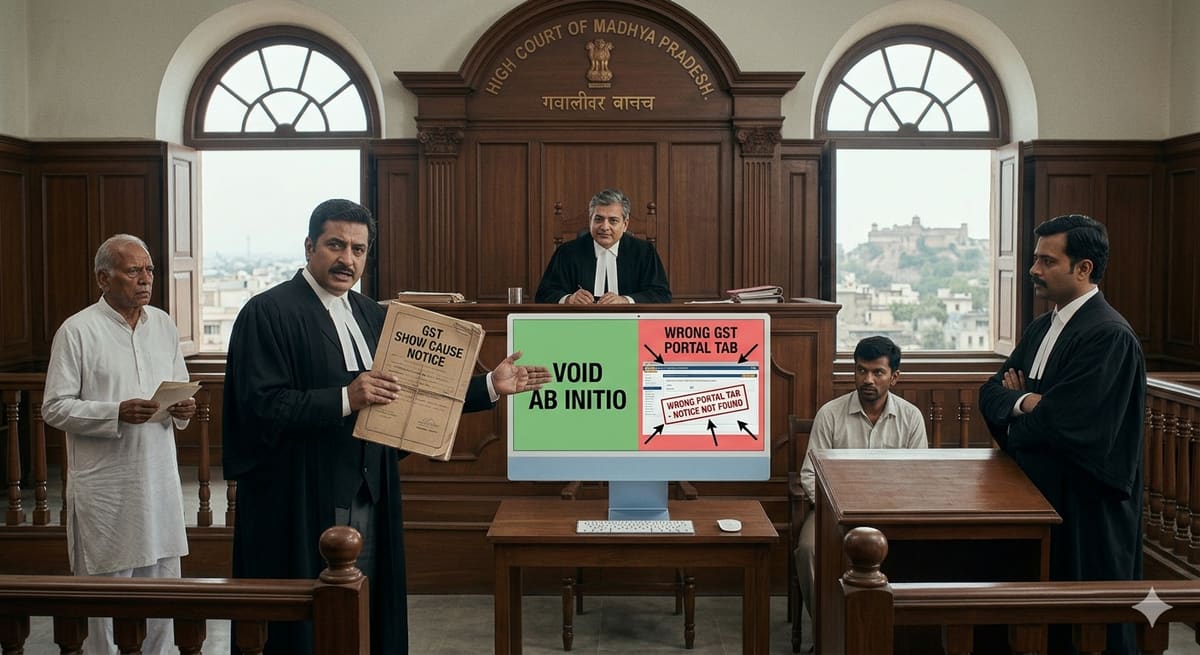
Counsel for the petitioner argued that the Appellate Authority’s failure to serve notice, upload orders, or record judicial satisfaction on service constituted a fundamental breach of natural justice and Section 107(5) of the CGST Act, which mandates a fair hearing. Reliance was placed on State of U.P. v. Mohammad Noor and K. S. Puttaswamy v. Union of India to underscore that procedural fairness is a constitutional imperative, not a technicality. The absence of any record of service rendered the order void ab initio.
For the Respondent
Learned counsel for the respondents initially sought a pass over when questioned by the Court. Upon obtaining instructions, counsel conceded that the procedural lapses were apparent and unchallenged. Counsel fairly submitted that the respondents had no objection to the impugned order being set aside and the matter being remanded for fresh adjudication with due opportunity to the petitioner.
The Court's Analysis
The Court did not delve into the merits of the tax dispute. Instead, it focused squarely on the procedural violations. The Bench observed that the Appellate Authority acted in complete disregard of the foundational principles of audi alteram partem. The absence of any notice, communication, or upload of proceedings on the designated portal was not a mere irregularity but a fatal flaw.
"The failure to serve notice, to upload the order, and to record judicial satisfaction on service renders the impugned order legally unsustainable and void for want of compliance with the most elementary principles of natural justice."
The Court emphasized that statutory mandates under the CGST Act and Rules are not optional. The portal upload requirement under Rule 109 is not a formality but a transparency mechanism designed to ensure accountability. The Appellate Authority’s silence on service, coupled with the complete absence of any record, meant the petitioner was deprived of a meaningful opportunity to defend its position.
The Court further noted that even if the Revenue’s appeal had merit, the manner in which it was adjudicated rendered the outcome illegitimate. The law does not permit substantive justice to be achieved through procedural injustice.
The Verdict
The petitioner succeeded. The Court set aside the Appellate Authority’s order dated 18.12.2025. The matter was remanded to the Appellate Authority with a direction to issue notice to the petitioner requiring its appearance within two weeks of such notice. The Appellate Authority must grant the petitioner at least one effective and meaningful opportunity of hearing before passing a fresh speaking order. If warranted, additional hearings may be granted. All pending applications are disposed of.
What This Means For Similar Cases
Procedural Compliance Is Non-Negotiable
- Practitioners must now insist on proof of service and portal uploads in every GST appeal.
- Any appellate order lacking a record of notice or upload is vulnerable to being set aside on writ petition.
- Tax authorities cannot rely on presumed service or administrative convenience to bypass statutory mandates.
Natural Justice Trumps Technical Defenses
- Even if the Revenue’s appeal has strong factual or legal grounds, failure to afford hearing invalidates the outcome.
- Courts will not entertain arguments that the petitioner "would have lost anyway" - the process itself is the safeguard.
- This ruling reinforces that audi alteram partem is a constitutional right, not a procedural formality.
Duty to Record Judicial Satisfaction
- Appellate authorities must explicitly record in writing how notice was served, whether by post, email, or portal notification.
- Blanket assumptions of service are no longer acceptable.
- Failure to record judicial satisfaction renders the order void, regardless of the outcome.