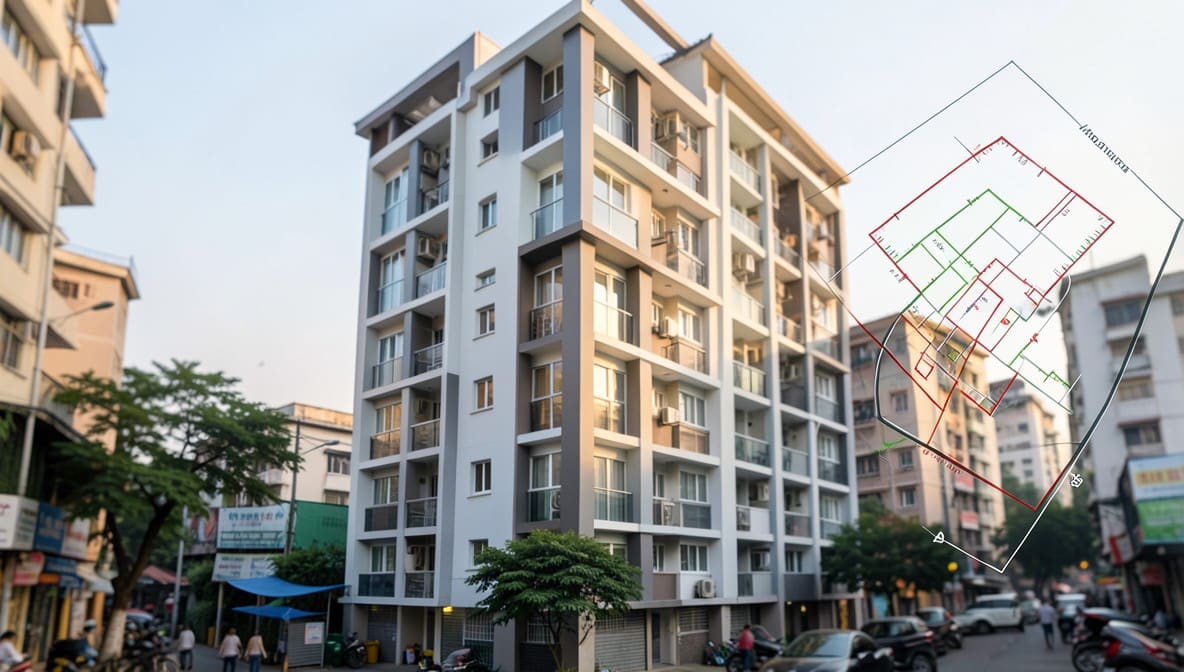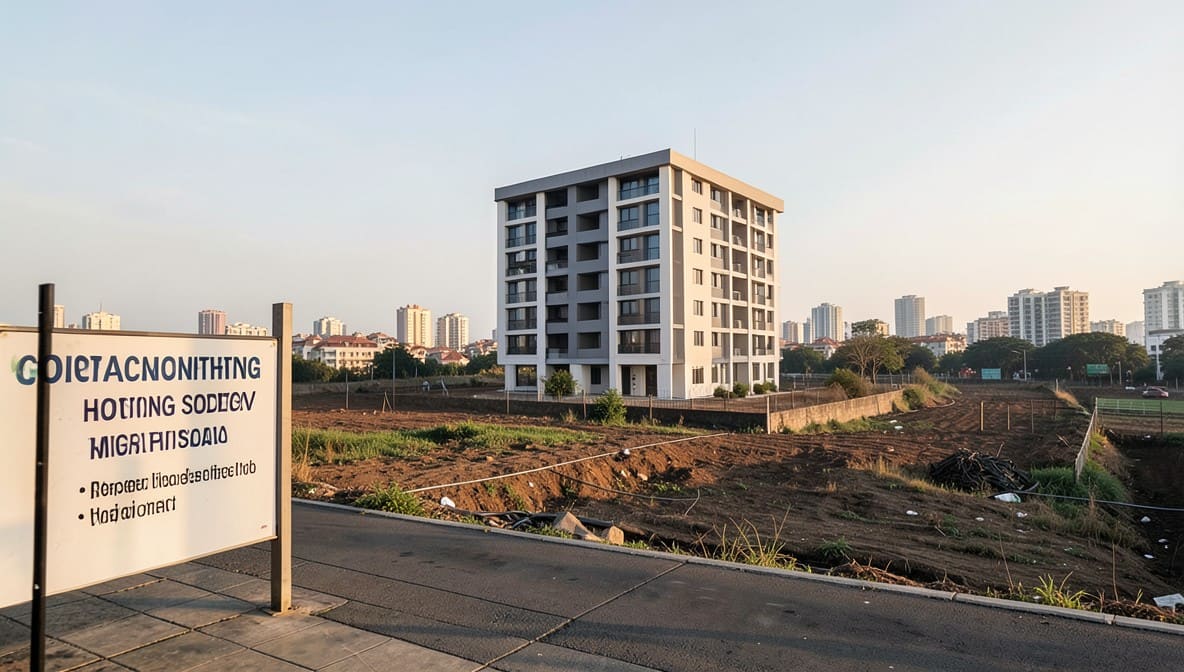
The Bombay High Court has clarified that the extent of deemed conveyance under the Maharashtra Ownership Flats Act, 1963, must be determined by the original sanctioned project area as reflected in statutory permissions and sale agreements, not by subsequent administrative changes in revenue records. This ruling reinforces the primacy of contractual and statutory representations made to flat purchasers at the time of development.
Background & Facts
The Dispute
The petitioner, Jai Ram Krishna Cooperative Housing Society Limited, sought deemed conveyance of the entire plot of land on which its residential building was constructed. The society, formed by flat purchasers, applied for conveyance of 631.27 square metres, the total area identified in the original development permissions. However, the Competent Authority under Section 11 of the Maharashtra Ownership Flats Act, 1963 (MOFA), granted conveyance only for 472.36 square metres, excluding 158.91 square metres on the grounds of later subdivisions reflected in revenue records.
Key Facts
- The petitioner-society was registered on 10.07.2007.
- Agreements under Section 4 of MOFA were executed in or about 2003 between flat purchasers and Respondent No. 2, the promoter.
- The project consisted of a single residential building with no larger layout.
- The promoter obtained development permission under the Urban Land (Ceiling and Regulation) Act, 1976, on 05.05.2001, which explicitly permitted use of a plot of 631.27 square metres for residential development.
- The sanctioned FSI of 0.85 corresponded to a built-up area of 536.138 square metres, confirming that the underlying plot was larger than the built-up area.
- The agreements executed under Section 4 of MOFA referenced the sanctioned plan and the Urban Land Ceiling Act permission.
- Subsequent to the development, revenue records were subdivided, creating separate property cards for a portion of 72.63 square metres, which the promoter claimed was not part of the project.
- The promoter retained possession of the 72.63 square metre portion, which housed an independent structure.
Procedural History
- 2007: Petitioner-society registered.
- 2012: Petition filed before the Competent Authority under Section 11 of MOFA seeking conveyance of 631.27 square metres.
- Date unknown (prior to 2012): Competent Authority passed order granting conveyance only for 472.36 square metres, relying on revenue record subdivisions.
- 2012: Writ Petition No. 2030 of 2012 filed before the Bombay High Court challenging the order.
- 07.04.2026: Judgment delivered by the Bombay High Court.
The Parties' Positions
Petitioner: Argued that the entire 631.27 square metres formed part of the project as per the sanctioned plan, Urban Land Ceiling Act permission, and MOFA agreements. Contended that subsequent revenue record changes, made for administrative convenience, cannot override the original contractual and statutory entitlement of flat purchasers.
Respondent No. 2 (Promoter): Argued that the 72.63 square metre portion was never part of the MOFA agreements, was separately owned, and was not included in the project scope. Asserted that the promoter cannot be deprived of title without due process and that revenue records reflect the true legal position.
Relief Sought
The petitioner sought: (a) quashing of the Competent Authority’s order restricting conveyance to 472.36 square metres; (b) direction to grant deemed conveyance of the full 631.27 square metres; and (c) costs.
The Legal Issue
The central question was whether the Competent Authority under Section 11 of the Maharashtra Ownership Flats Act, 1963, may limit deemed conveyance to an area smaller than that specified in the original sanctioned plans and MOFA agreements, solely on the basis of subsequent subdivisions in revenue records.
Arguments Presented
For the Petitioner
The petitioner relied on the principle that MOFA is a welfare statute designed to protect flat purchasers. It argued that the promoter is bound by the representations made in the sanctioned plans and MOFA agreements, which explicitly referenced the 631.27 square metre plot. The petitioner cited Madhuvihar Co-operative Housing Society Ltd. v. Jayantilal Investments to establish that once a promoter represents a certain area as part of the project, it cannot later deny it. The petitioner emphasized that revenue record changes are administrative and do not alter substantive property rights established at the time of sale.
For the Respondent
The respondent contended that the 72.63 square metre portion was never part of the MOFA agreements and was separately owned and possessed. It argued that the Competent Authority was justified in relying on revenue records to determine the true extent of the promoter’s interest. The respondent asserted that the promoter’s title cannot be extinguished without due process and that the society’s claim must be confined to the area actually covered by the agreements.
The Court's Analysis
The Court undertook a detailed examination of the statutory framework under Section 11 of MOFA, which mandates that the promoter transfer all rights, title, and interest in the property to the cooperative society. The Court held that the scope of conveyance must be determined by the original documents forming the basis of the transaction: the agreements under Section 4 of MOFA and the permissions referenced therein.
"The extent of 631.27 square metres cannot be lightly reduced without proper legal basis."
The Court rejected the Competent Authority’s reliance on subsequent revenue record subdivisions, observing that such entries are made for administrative purposes and do not alter the nature of the original transaction between the promoter and flat purchasers. The Court emphasized that the Urban Land Ceiling Act permission dated 05.05.2001, which permitted the full 631.27 square metres for residential use, formed the foundation of the project and was explicitly incorporated into the MOFA agreements.
The Court further held that the promoter, having represented the entire plot as part of the project in statutory documents and agreements, is estopped from later claiming otherwise. The Court cited Madhuvihar Co-operative Housing Society Ltd. v. Jayantilal Investments to reinforce that promoters cannot take inconsistent positions after flat purchasers have relied on their representations.
"If such later entries are allowed to control rights, then very object of MOFA will be defeated."
The Court concluded that the promoter’s retention of any portion of the land after the society’s formation violates the scheme of MOFA, which aims to ensure complete transfer of ownership to the collective of flat purchasers.
The Verdict
The writ petition was allowed. The Court set aside the Competent Authority’s order dated prior to 2012, which restricted conveyance to 472.36 square metres. The Court directed the Competent Authority to grant deemed conveyance of the entire plot area of 631.27 square metres to the petitioner-society. The Court rejected the promoter’s request for a stay, noting that the society has been registered since 2007 and the promoter had failed to fulfill its statutory obligation for nearly two decades. No monetary relief was sought or granted.
What This Means For Similar Cases
Deemed Conveyance Is Based on Original Documentation, Not Revenue Records
- Practitioners must argue that Section 11 of MOFA requires conveyance of the area explicitly referenced in sanctioned plans and MOFA agreements, not the area reflected in later revenue records.
- Revenue record subdivisions, even if officially recorded, cannot override the contractual and statutory basis of the transaction.
- Any attempt by a promoter to retain land based on post-sale revenue entries is legally unsustainable.
Promoters Are Estopped From Denying Representations Made in Sanctioned Plans
- Once a promoter represents a specific plot area in development permissions and MOFA agreements, it is bound by that representation.
- Flat purchasers and subsequent societies are entitled to rely on these representations as the basis of their ownership rights.
- Courts will apply the doctrine of promissory estoppel to prevent promoters from reneging on statutory disclosures.
MOFA’s Welfare Objective Overrides Administrative Convenience
- The statute’s purpose is to ensure complete transfer of property to cooperative societies.
- Administrative convenience, such as revenue record subdivisions, cannot be used to defeat this statutory objective.
- Courts will prioritize the rights of flat purchasers over technical or bureaucratic adjustments made after the sale.