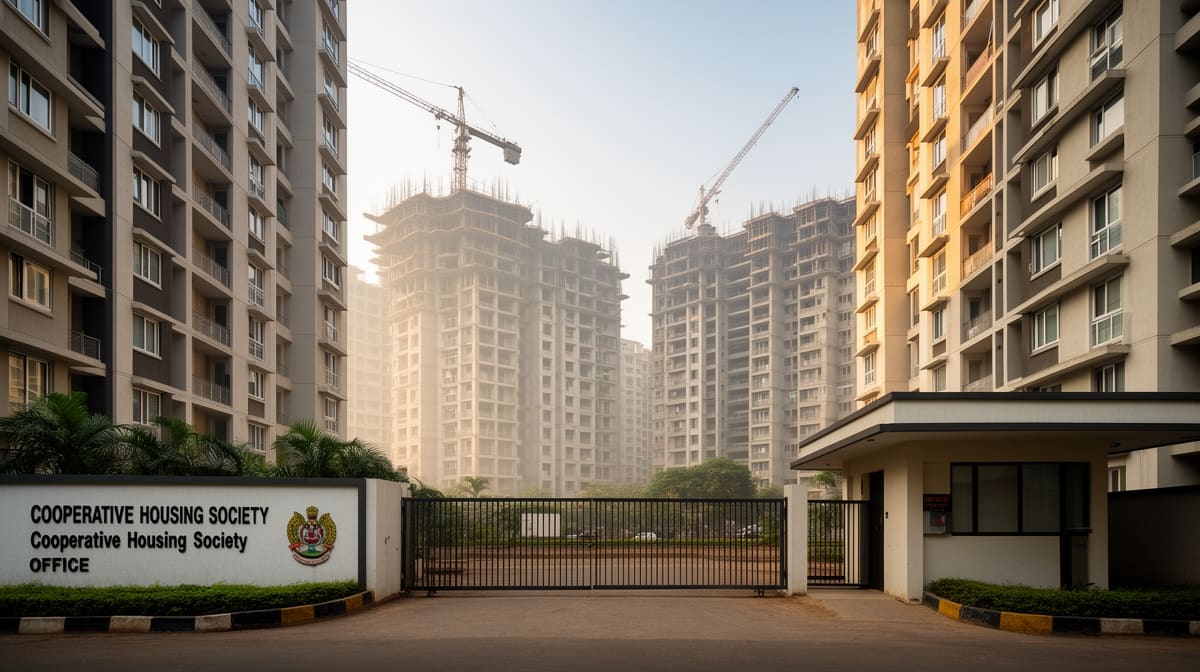
The Bombay High Court has affirmed that a cooperative housing society may obtain deemed conveyance of proportionate land under Section 11 of the Maharashtra Ownership Flats Act, 1963, even when the entire residential layout remains under development. This ruling clarifies that statutory obligations to transfer land cannot be indefinitely delayed by developers awaiting full project completion, reinforcing the Act’s protective intent toward flat purchasers.
Background & Facts
The Dispute
The petitioner, Vardhaman Homes, is a real estate developer who constructed multiple buildings within a large layout of 87,144.82 sq. mtrs. The respondent, a duly registered cooperative housing society, sought unilateral deemed conveyance of the land proportionate to the constructed buildings under Section 11 of the Maharashtra Ownership Flats Act, 1963. The developer contested the area calculation, claiming that conveyance should only occur after completion of the entire layout and in favor of a federation, not individual societies.
Procedural History
- 2022: The Competent Authority issued a certificate of deemed conveyance for 4,954.60 sq. mtrs. of land to the society.
- The authority relied on 7/12 extracts, sale agreements, sanctioned plans, and an Architect’s Certificate certifying proportionate land for the constructed structure and common areas.
- The petitioner challenged the order before the Bombay High Court via Writ Petition No. 195 of 2022, alleging procedural irregularities and lack of jurisdiction.
- The petitioner also referenced an interim order in Writ Petition No. 8120 of 2023, which had stayed further steps, but failed to demonstrate any material defect in the conveyance process.
Relief Sought
The petitioner sought quashing of the deemed conveyance certificate, arguing that the Competent Authority lacked jurisdiction to grant conveyance before full project completion and that the area calculation was erroneous.
The Legal Issue
The central question was whether Section 11 of the Maharashtra Ownership Flats Act, 1963 permits deemed conveyance of proportionate land to a housing society when the developer has not completed the entire layout, and whether the absence of a counter-certification from the developer invalidates the society’s claim.
Arguments Presented
For the Petitioner
The petitioner contended that the conveyance under Section 11 could only be granted after the entire layout was completed and that the statutory intent required conveyance to a federation, not individual societies. It argued that the developer retained rights over the entire FSI and that the Competent Authority exceeded its jurisdiction by granting conveyance prematurely. Reliance was placed on the interim order in another writ petition to argue that the process was procedurally flawed due to non-compliance with Section 11(5), which mandates notice to the developer.
For the Respondent
The society argued that the developer had failed to fulfill its statutory duty to execute conveyance within the stipulated time. It submitted that the Architect’s Certificate, supported by sale agreements and sanctioned plans, provided sufficient evidence of proportionate land entitlement. It further relied on Government Resolution dated 22 June 2018, which explicitly permits proportionate conveyance even in incomplete layouts, and cited binding precedents affirming that deemed conveyance does not determine title but merely facilitates possession.
The Court's Analysis
The Court examined the statutory framework under Section 11 of the Maharashtra Ownership Flats Act, 1963, which empowers the Competent Authority to grant deemed conveyance when a developer defaults in transferring title. The Court emphasized that the Act’s purpose is to protect flat purchasers from developer inaction, not to enable delay.
"The grant of deemed conveyance does not determine title finally and parties may seek declaration in civil proceedings."
The Court cited Mazda Construction Company v. Sultanabad Darshan CHS Ltd. and Shree Chintamani Builders v. State of Maharashtra to reaffirm that deemed conveyance is a remedial mechanism, not a final adjudication of ownership. The petitioner’s failure to produce any technical rebuttal - such as a counter-certification or survey report - rendered its challenge speculative. The Court noted that the Competent Authority had meticulously reviewed all available documents, including the Architect’s Certificate, and had followed the procedural guidelines laid down in the Government Resolution of 2018.
The Court further held that Article 227 supervisory jurisdiction cannot be invoked to re-appreciate evidence or substitute the authority’s factual findings, especially where no material defect is demonstrated. The petitioner’s reliance on an unrelated interim order was deemed irrelevant to the merits of the conveyance.
The Verdict
The petitioner’s writ petition was dismissed. The Court held that Section 11 of the Maharashtra Ownership Flats Act, 1963 permits deemed conveyance of proportionate land to a housing society even before full project completion, provided the society establishes entitlement through documentary evidence. The Competent Authority’s order was upheld as lawful, procedurally sound, and consistent with statutory intent.
What This Means For Similar Cases
Proportionate Conveyance Is Statutorily Permitted
- Practitioners must now advise housing societies to invoke Section 11 MOFA as soon as construction is complete, even if the larger layout remains under development.
- Developers cannot delay conveyance by claiming the project is "incomplete" - the law recognizes phased completion.
- Societies must ensure they submit certified architectural documentation to substantiate proportionate land claims.
Developer’s Burden to Dispute Is Onerous
- A developer challenging deemed conveyance must produce technical evidence (e.g., counter-certifications, survey reports) to rebut the society’s claim.
- Mere oral objections or unsubstantiated assertions will not suffice before the Competent Authority or the High Court.
- Failure to rebut documentary evidence renders the challenge legally unsustainable.
Civil Remedies Remain Open, But Not as a Stay Tool
- While developers retain the right to file civil suits for title declaration, such suits cannot be used to stall statutory conveyance.
- Civil courts must decide title disputes independently, without being bound by the Competent Authority’s findings.
- Writ petitions under Article 227 are not a substitute for civil litigation and will be dismissed if used to re-litigate factual disputes.