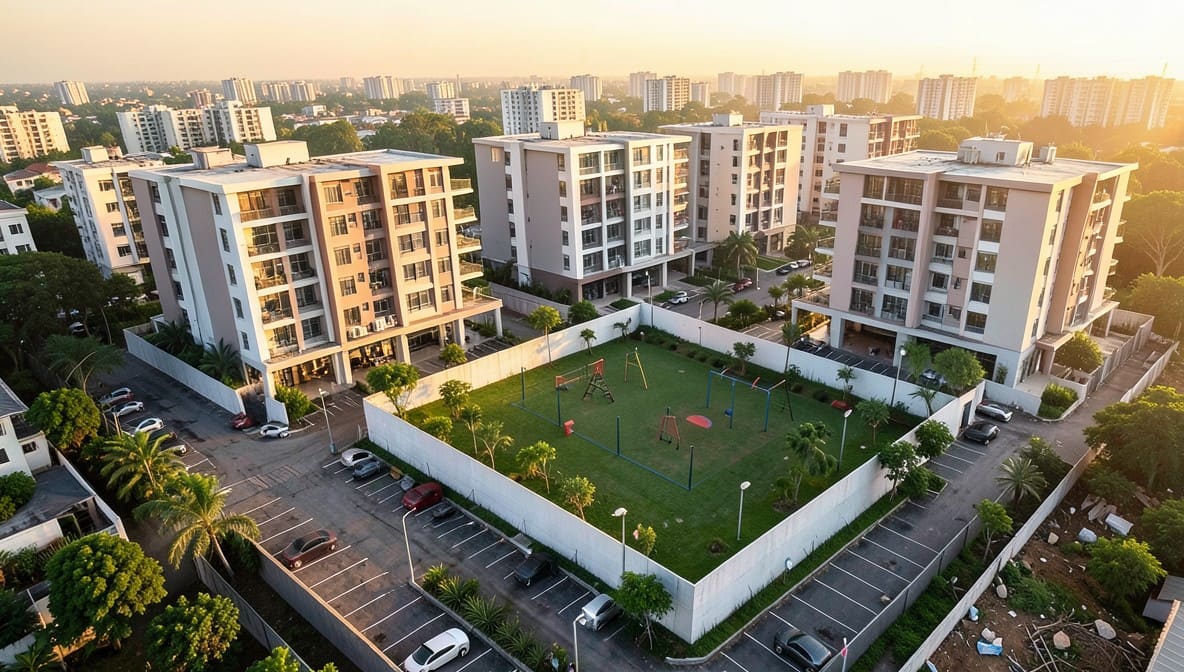
The Bombay High Court has clarified that deemed conveyance under the Maharashtra Ownership Flats Act, 1963, must be determined by proportionate allocation based on built-up area, not total plot area. This ruling resolves long-standing ambiguity in cooperative housing societies and provides a uniform methodology for land transfer in multi-society layouts.
Background & Facts
The Dispute
The petitioners, comprising multiple cooperative housing societies in a shared layout, challenged an order by the District Deputy Registrar granting unilateral deemed conveyance of 1490.79 square meters of land to Respondent No. 2, Ayub Ltd. The conveyed area represented 36.87% of the total plot of 4042.49 square meters. The petitioners argued that this allocation would prejudice their own future claims to deemed conveyance and infringe upon shared common amenities.
Procedural History
- 2025: Petitioners filed Writ Petition No. 10506 of 2025 before the Bombay High Court
- Prior to filing: Competent Authority issued order under Section 11(3) of the Maharashtra Ownership Flats Act, 1963, directing conveyance to Respondent No. 2
- No prior appellate challenge: The order was challenged directly via writ jurisdiction
Relief Sought
The petitioners sought quashing of the conveyance order, arguing that:
- Conveyance should reflect proportionate built-up area, not plot area
- Recreational and common areas must remain undivided and accessible to all societies in the layout
- Granting exclusive entitlement to one society would violate equitable principles under the Act
The Legal Issue
The central question was whether Section 11(3) of the Maharashtra Ownership Flats Act, 1963 permits deemed conveyance to be calculated on the basis of total plot area, or whether it must be proportionate to the built-up area occupied by the applicant society.
Arguments Presented
For the Petitioner
The petitioners contended that the Competent Authority erred in using total plot area (4042.49 sq.m.) as the denominator for calculating conveyance entitlement. They relied on Government Resolution dated 22 June 2018, which explicitly mandates that conveyance be determined by the ratio of built-up area to total built-up area of the entire layout. They argued that using plot area would unfairly advantage larger developers and deprive smaller societies of their rightful share.
For the Respondent
The State and Respondent No. 2 defended the order, asserting that the Competent Authority had acted within statutory discretion and that the proportion of 36.87% was mathematically accurate. They submitted that the GR 2018 was merely advisory and not binding, and that the conveyance order did not extinguish common area rights.
The Court's Analysis
The Court undertook a detailed examination of the sanctioned layout plan and the Government Resolution dated 22 June 2018. It noted that the total built-up area across all structures in the layout was 5402.51 square meters, of which Respondent No. 2’s building occupied 1992.35 square meters. This yielded a proportion of 36.87%, matching the conveyed area. The Court held that this method was not only mathematically precise but also aligned with the legislative intent of Section 11(3) to ensure equitable distribution of land rights.
"The entitlement to land under Section 11(3) must be determined by the proportion of built-up area occupied by the applicant society relative to the total built-up area of the entire layout."
The Court further emphasized that the order explicitly preserved the undivided nature of recreational and common areas, granting only a proportionate share - not exclusive ownership - to Respondent No. 2. This safeguarded the collective rights of all societies. The Court rejected the petitioners’ argument that the grant to one society precluded others from seeking conveyance, noting that each society remains free to apply for its own proportionate share based on its built-up footprint.
The Verdict
The petitioners’ challenge was dismissed. The Court upheld the Competent Authority’s order, holding that deemed conveyance under Section 11(3) of the Maharashtra Ownership Flats Act must be calculated proportionately based on built-up area, not total plot area. The undivided nature of common areas was affirmed as legally protected.
What This Means For Similar Cases
Proportionate Built-Up Area Is the Sole Basis for Conveyance
- Practitioners must now calculate conveyance entitlement using: (Society’s built-up area ÷ Total built-up area of layout) × Total plot area
- Any attempt to use total plot area as the denominator will be legally unsustainable
- This applies uniformly to all cooperative housing societies in Maharashtra
Common Areas Cannot Be Privatized Through Conveyance
- The judgment confirms that common areas (recreational, parking, gardens) remain jointly owned by all societies
- Conveyance orders must explicitly state that ownership is undivided and non-exclusive
- Any order granting exclusive rights to common areas is void ab initio
Future Applications Must Be Timely and Proportionate
- Societies seeking deemed conveyance must file applications promptly after formation
- Delay does not extinguish rights, but may affect priority if multiple applications exist
- Each society’s entitlement is independent and based solely on its own built-up area