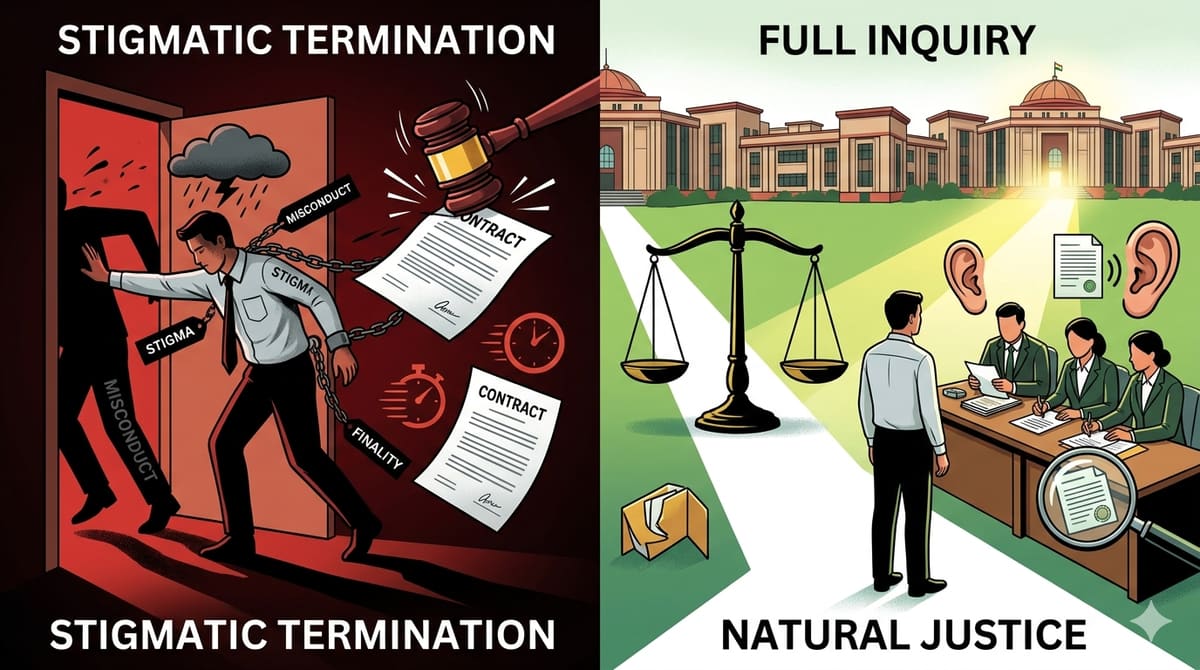
The Kerala High Court has affirmed that procedural fairness must prevail even in temporary employment arrangements, directing a welfare board to decide on pending representations for service continuation within a fixed timeframe. The judgment underscores the obligation of state bodies to act expeditiously on representations affecting livelihoods, particularly for vulnerable workers in the informal sector.
Background & Facts
The Dispute
The petitioners, Sahadevan P (aged 58) and Baby K (aged 58), were employed as construction workers under the Kerala Building and Other Construction Workers Welfare Board. Their employment was on a contractual or temporary basis, without formal regularization. On 01.06.2026, they were orally disengaged by the Board without any written order or reason provided. No replacement was appointed in their positions. The petitioners submitted a representation dated 12.06.2026 (Ext.P7) seeking reconsideration of their termination and continuation of service, which remained pending at the time of filing the writ petition.
Key Facts
- Petitioners have been engaged in construction work under the Board for several years, though exact tenure is not specified in the judgment
- No formal appointment letters or service records were produced by the Board
- Termination was communicated orally on 01.06.2026
- No written order of termination was issued
- No other worker was appointed to replace either petitioner
- Representation dated 15.01.2019 (Ext.P3) was previously submitted to the State Government
- Representation dated 12.06.2026 (Ext.P7) was submitted to the District Executive Officer and sent via postal receipt (Ext.P8)
- Ext.P4 refers to a prior High Court judgment dated 09.06.2025 in WP(C) No.15382/2019, which may have addressed similar issues
- Ext.P5 and Ext.P6 are interim orders dated 26.05.2026 and 02.06.2026 in other pending writ petitions concerning similar workers
- Ext.P9 is a judgment dated 12.06.2026 in WP(C) No.20095/2026, delivered on the same day as this judgment
Procedural History
- 01.06.2026: Petitioners orally disengaged by the Welfare Board
- 12.06.2026: Ext.P7 representation submitted to the District Executive Officer (4th Respondent)
- 12.06.2026: Postal receipt (Ext.P8) confirms dispatch of Ext.P7 to the 2nd Respondent
- 18.06.2026: Writ Petition (WP(C) No.20694/2026) filed before the High Court of Kerala
- 18.06.2026: Court heard arguments and delivered judgment on the same day
Relief Sought
The petitioners sought:
- A direction not to terminate their service
- A direction to the 2nd Respondent to consider and decide Ext.P7 representation
- An expeditious disposal of the pending representation
- Continuation of employment pending decision
The Legal Issue
The central question was whether the oral termination of temporary workers without a written order or opportunity of hearing violates principles of natural justice, and whether the Board can be directed to decide a pending representation within a stipulated time while permitting continued employment in the interim.
Arguments Presented
For the Petitioner
Counsel argued that the petitioners had been working for years under the Board, and their sudden oral disengagement without any notice, reason, or opportunity to be heard amounted to a violation of Article 14 and Article 21 of the Constitution. Reliance was placed on State of U.P. v. Renusagar Power Co. and Maneka Gandhi v. Union of India to assert that even temporary employment carries a legitimate expectation of fair procedure. The pending representation (Ext.P7) had not been addressed despite being submitted on the same day as the filing of the writ petition, indicating administrative inaction.
For the Respondent
Learned counsel for the Board conceded that the petitioners had been disengaged orally but claimed no formal appointment existed and that the termination was administrative in nature. Counsel submitted that no other person had been appointed in their place, implying no immediate replacement was necessary. No counter-affidavit or detailed justification for termination was filed.
The Court's Analysis
The Court observed that while the petitioners were not regular employees, their long-standing association with the Board created a legitimate expectation of fair treatment. The oral termination without any written order or reason was held to be procedurally defective. The Court emphasized that the principle of audi alteram partem applies even in non-permanent employment contexts when livelihood is at stake.
"Taking into consideration the fact that no other person has been appointed in the place of the petitioners, it is ordered that till a decision is taken as directed above, petitioners shall be permitted to continue in employment."
The Court noted the pendency of Ext.P7 representation since 12.06.2026 and the absence of any response from the Board. It held that administrative delay in deciding representations affecting employment rights cannot be countenanced. The Court relied on the doctrine of legitimate expectation and the constitutional obligation under Article 21 to protect livelihood.
The Court declined to decide the merits of regularization, explicitly leaving that claim open. Instead, it focused on ensuring procedural fairness and preventing arbitrariness in employment decisions.
The Verdict
The petitioners succeeded. The Court directed the 2nd Respondent, the Kerala Building and Other Construction Workers Welfare Board, to consider and pass orders on Ext.P7 representation dated 12.06.2026 after affording the petitioners an opportunity of being heard, within two months from the date of receipt of a copy of this judgment. Until such decision is rendered, the petitioners shall be permitted to continue in employment. The claim for regularization is left open for adjudication in appropriate proceedings.
What This Means For Similar Cases
Oral Termination Is Legally Deficient
- Practitioners must challenge any oral termination of temporary or contractual workers without written notice or reason
- Even non-regular employees are entitled to a hearing before termination if they have a reasonable expectation of continued employment
- Administrative agencies must issue formal orders, even for temporary staff
Pending Representations Cannot Be Ignored
- Representations submitted by workers must be decided within a reasonable time
- Courts may impose timelines for disposal when delay is evident and livelihood is affected
- Failure to respond to representations may result in interim employment continuation orders
Legitimate Expectation Protects Livelihood
- Long-term association with a public body, even without formal appointment, can create a legitimate expectation of fair procedure
- Article 21 protections extend to informal sector workers in public employment
- Courts will intervene to prevent arbitrary disengagement where no replacement is made