The Rajasthan High Court has clarified that a change in government policy eliminating outsourcing agencies cannot be used as a blanket justification to terminate contractual employees without ensuring their reemployment under the new model. The judgment establishes that procedural fairness and substantive continuity of service must be preserved even when administrative schemes are restructured.
Background & Facts
The Dispute
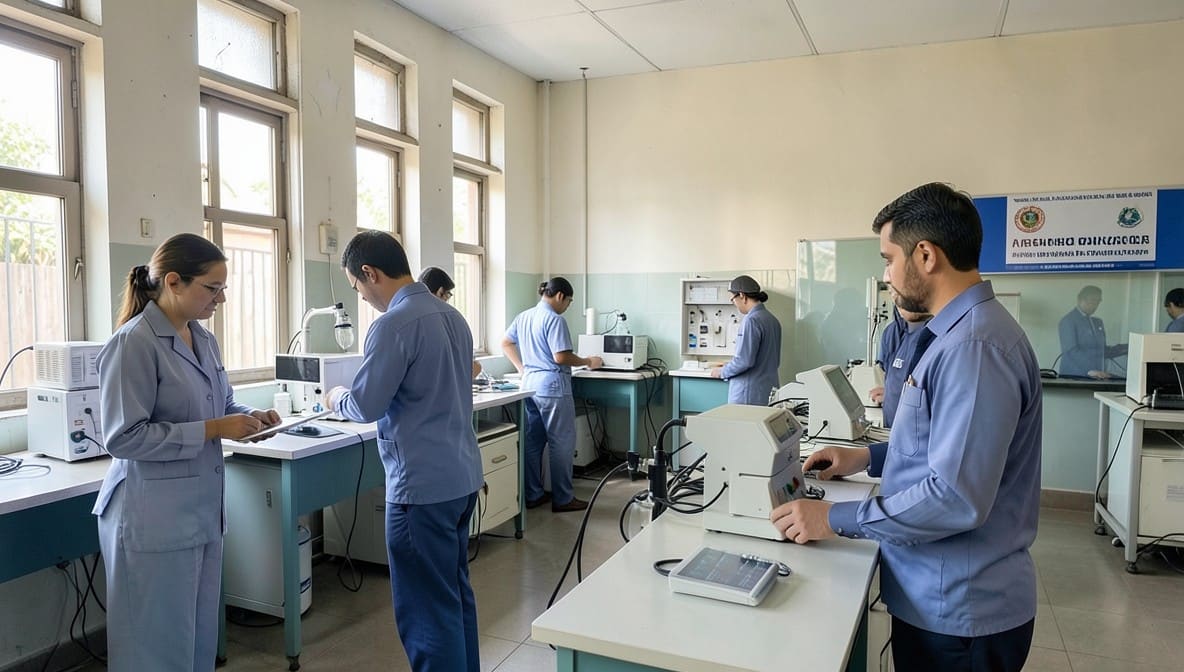
The petitioners, Rishav Pal and Rahul Saini, were employed as Lab Technicians through an outsourcing agency, M/s Kiran Enterprises, under a government scheme for public health laboratory services in Karauli. The Government of Rajasthan had previously constructed and maintained the laboratory infrastructure, while the services of technicians were contracted through third-party manpower agencies. This arrangement was in place for several years prior to 2026.
Key Facts
- The petitioners were engaged on a contractual basis through M/s Kiran Enterprises, with no direct employment relationship with the State
- Their services were rendered at the General Hospital, Karauli, under the State’s public health infrastructure
- The Government initiated a policy shift to consolidate service delivery: instead of separate infrastructure (provided by Government) and manpower (provided by agencies), a single private lab entity would now provide both infrastructure and manpower
- The new scheme involved selection of recognized private labs to operate end-to-end laboratory services
- As a consequence, the outsourcing agency’s contract was terminated, and the petitioners’ services were terminated on or before March 2026
- The petitioners had no formal appointment letters from the State, but had been continuously working since at least 2020
- No formal assessment, interview, or selection process was conducted for the petitioners under the new scheme
- The petitioners were not offered any alternative position or priority consideration under the new model
Procedural History
- 2020 - 2025: Petitioners employed continuously through M/s Kiran Enterprises under the old outsourcing model
- Early 2026: Government notified policy change to consolidate infrastructure and manpower under single private lab providers
- March 2026: M/s Kiran Enterprises terminated petitioners’ services without notice or severance
- 15.04.2026: Writ Petition No. 7821/2026 filed before the Rajasthan High Court
- 30.04.2026: Hearing concluded and judgment delivered
The Parties' Positions
For the Petitioners: Argued that their long-term service, institutional knowledge, and role in public health delivery entitled them to reemployment under the new scheme. They contended that termination without opportunity to compete or be considered was arbitrary and violative of Article 14 and Article 21 of the Constitution.
For the Respondents: Contended that the policy shift was a legitimate administrative decision to improve efficiency and accountability. They asserted that the State was no longer hiring manpower directly, and therefore had no obligation to retain previous contractors.
Relief Sought
The petitioners sought:
- Restoration of their services under the new scheme
- Direction to the selected private lab to absorb them on equivalent terms
- Pay protection equivalent to other technicians hired under the new model
- Compensation for wrongful termination
The Legal Issue
The central question was whether a change in government policy eliminating outsourcing agencies can lawfully result in the termination of contractual employees without offering them reemployment under the new scheme, particularly when their roles remain functionally identical and the State retains control over the infrastructure.
Arguments Presented
For the Petitioner
Counsel relied on the principle that long-term contractual service creates legitimate expectation of continuity, especially in public service roles. They cited State of Haryana v. Sardar Singh and Rajasthan State Road Transport Corporation v. Bhagwan Das to argue that termination without opportunity for reapplication or consideration violates the doctrine of fair play. They emphasized that the petitioners were performing duties integral to public health and had no alternative employment prospects.
For the Respondent
The State argued that the new scheme represented a structural overhaul, not merely a change in agency. They contended that the State was no longer a direct or indirect employer under the new model, and therefore had no legal obligation to retain previous workers. The policy change, they asserted, was aimed at improving accountability and reducing fragmentation in service delivery.
The Court's Analysis
The Court acknowledged the legitimacy of the State’s policy objective: consolidating infrastructure and manpower under a single accountable entity to enhance efficiency and quality control. However, it drew a critical distinction between terminating a contractual arrangement and extinguishing the rights of individuals who had rendered continuous service under the prior system.
"The fact that the mode of execution has changed does not ipso facto extinguish the rights of those who have been functioning in the same capacity for years, particularly when the nature of work, location, and public purpose remain unchanged."
The Court noted its prior jurisprudence protecting contractual employees when outsourcing agencies were merely replaced by others. Here, the change was more fundamental - the entire employment model was replaced. Yet, the Court held that this did not absolve the State of its duty to ensure continuity for those whose skills and experience were indispensable to the public service.
The Court rejected the argument that the State was no longer an employer. It observed that the State retained ownership of the infrastructure, funded the operations, and dictated the standards of service. The private lab was merely an implementing agent. Therefore, the State remained the de facto employer in substance.
The Court further emphasized that the petitioners were not seeking direct government employment, but rather inclusion in the new scheme on equitable terms. The State’s own admission - that petitioners willing to work should be taken on by the new lab - undermined its legal position.
The Verdict
The petitioners succeeded in part. The Court held that while the policy change was valid, the termination of services without reemployment consideration was impermissible. The respondents are directed to ensure that the petitioners, if willing, are absorbed by the selected private lab under the new scheme on terms equivalent to other technicians employed under the new model. Pay protection shall be extended to them from the date of their original engagement. The State shall ensure compliance within six weeks. Costs of Rs. 15,000 are awarded to the petitioners.
What This Means For Similar Cases
Contractual Workers Cannot Be Discarded on Policy Shifts
- Practitioners must now argue that long-term contractual service in public infrastructure roles creates a legitimate expectation of reemployment when the underlying function remains unchanged
- Termination without reemployment consideration violates Article 14 even if the employer structure changes
- The State cannot outsource responsibility while retaining control and then deny continuity to workers
Pay Protection Is Mandatory in Replaced Schemes
- Where new entities take over public service delivery, pay parity with existing workers must be guaranteed for those absorbed
- This applies even if the new entity is private - the State’s funding and oversight make it a de facto employer
- Failure to extend pay protection may constitute arbitrary discrimination under Article 14
Policy Changes Must Include Transition Mechanisms
- Government policy reforms affecting contractual workers must include clear transition protocols
- Absence of such mechanisms renders termination procedurally unfair
- Courts will intervene where workers are rendered jobless despite continued public need for their skills