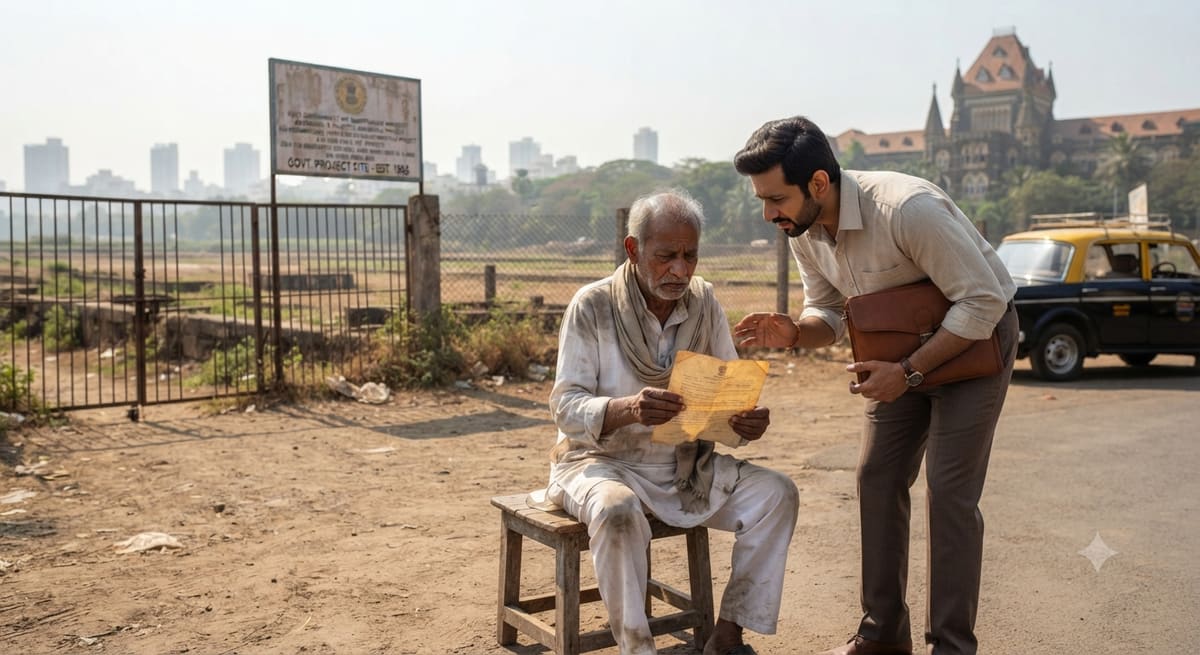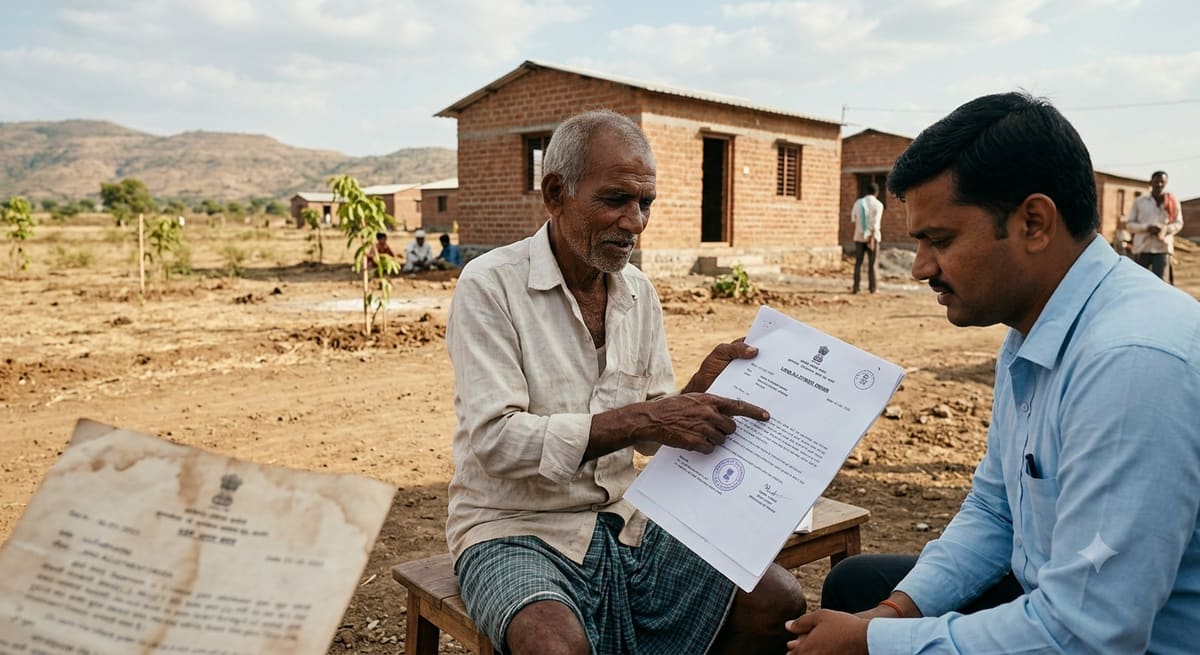
A landmark order from the Bombay High Court has affirmed that the state cannot impose retrospective documentary conditions to deny land allotment to flood-affected persons after decades of inaction. The Court directed immediate possession of a residential plot to a petitioner whose entitlement was formally recognized by the government but withheld for over 30 years on grounds never raised at the time of allotment.
Background & Facts
The Dispute
The petitioner, Jagnath Ramchandra Patil, was identified as a flood-affected person eligible for residential land allotment under the Maharashtra Land Revenue (Disposal of Government Lands) Rules, 1971. Plot No.63 at village Kanegaon, Taluka Walwa, District Sangli, was sanctioned to him pursuant to proceedings under Section 31 of the Maharashtra Land Revenue Code, 1966. Despite payment of all requisite fees and formal acknowledgment by the Sub-Divisional Officer (SDO), Walwa, the physical allotment and possession were never delivered.
Key Facts
The petitioner was formally allotted Plot No.63 in 1996 or 1997, as per government records and internal communications.
On 20.06.2006, the SDO, Walwa, issued a congratulatory letter to the petitioner confirming his allotment.
The petitioner paid the full price of the plot and measurement charges as required.
No request for surrender documents relating to an old site or land was made at the time of allotment or during the subsequent 17 years.
On 08.05.2023, the petitioner and 12 others submitted a joint representation to the Collector, Sangli, seeking implementation of their allotments.
On 16.05.2023, the Collector directed the SDO, Walwa, to inquire and respond to the representation.
On 23.03.2023, a list of 69 eligible families for allotment was prepared by the SDO, excluding the petitioner’s name, thereby barring him from filing objections.
The petitioner filed a further collective representation to the Collector and also sent copies to the Chief Minister and Revenue Minister, without response.
The State’s affidavit-in-reply, filed on 172 onward, admitted that the plot was sanctioned and that payment had been received, but denied final allotment on the ground that the petitioner had not submitted documents evidencing surrender of his pre-1983 land.
Procedural History
1996/1997: Plot No.63 allotted to petitioner by government authorities.
20.06.2006: SDO, Walwa, issues congratulatory letter confirming allotment.
08.05.2023: Petitioner and 12 others submit joint representation to Collector, Sangli.
16.05.2023: Collector directs SDO, Walwa, to inquire and respond.
23.03.2023: SDO publishes list of eligible families excluding petitioner.
2023: Writ Petition No.10615 of 2023 filed before Bombay High Court, Circuit Bench, Kolhapur.
25.06.2026: Court passes interim order noting prima facie validity of petitioner’s claim and adjourns for hearing.
02.07.2026: Final hearing and disposal.
Relief Sought
The petitioner sought a writ directing the State to hand over possession of Plot No.63, declare the denial of allotment arbitrary and illegal, and direct compliance within a fixed timeframe.
The Legal Issue
The central question was whether the State can, after more than three decades and following formal acceptance of allotment and payment, impose a new, retrospective condition - submission of pre-1983 land surrender documents - to deny possession to a flood-affected person.
Arguments Presented
For the Petitioner
The petitioner’s counsel argued that the State had, through its own conduct, accepted the petitioner’s entitlement. The congratulatory letter of 20.06.2006, payment receipts, and the State’s own affidavit-in-reply all confirmed the validity of the allotment. The demand for pre-1983 documents was raised for the first time in litigation, violating principles of natural justice and legitimate expectation. The Government Resolution dated 10.12.1983 was not applicable to flood rehabilitation schemes and had never been communicated to the petitioner during the allotment process.
For the Respondent
The State, through the AGP, conceded that the plot was sanctioned and payment received but contended that final allotment was conditional upon submission of documents proving surrender of prior landholdings under the 1983 Resolution. The SDO, Walwa, appeared in court and raised procedural objections regarding subsequent land awards, but offered no legal basis to override the State’s own admission of entitlement.
The Court's Analysis
The Court conducted a meticulous review of the State’s affidavit-in-reply, which explicitly acknowledged that Plot No.63 had been sanctioned and that the petitioner had paid the full price and measurement fees. The Court observed that the State’s reliance on the 1983 Government Resolution was both legally and factually untenable.
"The State’s stand calling upon the Petitioner to submit documents prior to 1983 period, which the Petitioner may or may not have, does not make any sense. Rather it is not any requirement of law either."
The Court emphasized that the petitioner’s status as a flood-affected person was never in dispute and had been formally accepted by the State since 1996. The demand for pre-1983 documents was introduced only in litigation, after 30 years of inaction, and thus violated the doctrine of legitimate expectation and the principle of non-arbitrariness under Article 14 of the Constitution.
The Court further noted that the SDO’s claim of subsequent land awards did not extinguish the petitioner’s prior, legally recognized right. The State’s own admission in the affidavit rendered any procedural objection moot. The Court held that once the State accepts entitlement and accepts payment, it cannot later impose new, retrospective conditions to defeat the beneficiary’s rights.
The Verdict
The petition was allowed. The Court directed the State to hand over possession of Plot No.63 to the petitioner within four weeks from the date of judgment. The Court further ordered that if necessary, police protection shall be provided for implementation. Costs were not awarded, but the State was directed to complete all formalities for registration and possession without further delay.
What This Means For Similar Cases
Post-Allotment Conditions Are Unlawful
Practitioners must challenge any attempt by state agencies to impose new documentary conditions after allotment has been formally accepted and payment received.
The doctrine of legitimate expectation protects beneficiaries who act in reliance on official assurances, even if formal registration is pending.
Flood Rehabilitation Schemes Are Distinct
Government Resolutions applicable to general resettlement (e.g., 1983 Resolution) cannot be retroactively applied to flood rehabilitation schemes unless explicitly incorporated.
Each rehabilitation scheme must be interpreted on its own terms; generic conditions cannot override specific entitlements.
Administrative Delay Cannot Be Used to Deny Rights
Delays exceeding 20 - 30 years in implementing land allotments, especially for vulnerable groups, constitute a violation of substantive rights.
Courts will not permit the State to use its own inaction as a shield to deny legally recognized benefits.
Always demand the State’s official records and affidavits to prove admission of entitlement.
File writ petitions early if possession is withheld beyond a reasonable time, even if formal registration is pending.
Cite Maneka Gandhi v. Union of India and State of Punjab v. Baldev Singh to establish that arbitrary conditions violate Article 14.