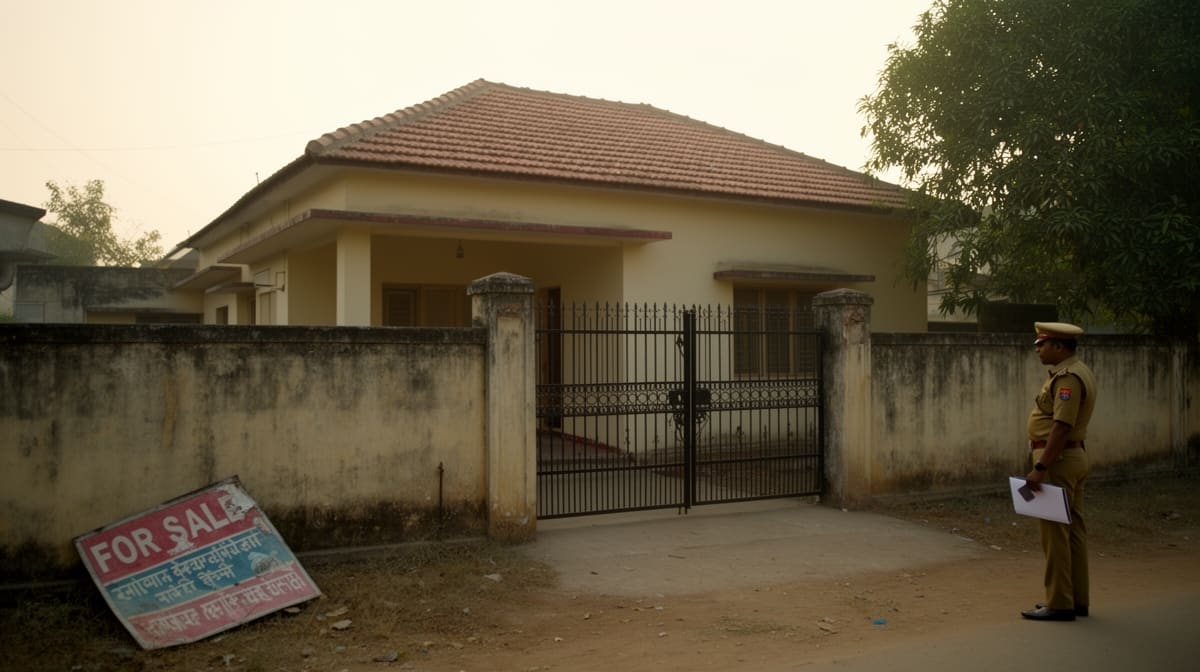
The High Court of Telangana has reaffirmed that peaceful possession of land allotted under assignment patta cannot be disturbed by revenue authorities pending a lawful inquiry into alleged violations. This judgment underscores the constitutional imperative of due process and natural justice in land administration, particularly for marginalized landholders.
Background & Facts
The Dispute
The petitioner, Smt. Markam Ankulamma, a woman from a backward community and landless agricultural laborer, was allotted agricultural land measuring Ac.4.10 Gts in Survey No.85/165 at Konetipur Village, Vanguru Mandal, Nagarkurnool District. She has been cultivating the land since 2019. In 2024, she obtained a patta (patta No.194) and a pattadar passbook (No.350419) in her name, following an agreement of sale executed under Sada Binama with the previous holder, Respondent No.5, Devarakona Balaiah. Despite this regularization, Respondent No.5, whose name still appears in revenue records under Land Revenue Rules, began challenging her possession and sought to have the patta cancelled.
Procedural History
- 2024: Revenue authorities issued Notice No.B/956/2024 under the Telangana Land Revenue Act, proposing cancellation of the petitioner’s patta on grounds of alleged violation of assignment conditions.
- March 2025: Respondent No.5 filed W.P.No.9137 of 2025 seeking cancellation of the patta. The High Court disposed of it at the admission stage, directing the Tahsildar to conduct a fair inquiry after issuing notice to both parties.
- December 2025: The petitioner filed the present Writ Petition No.23834 of 2025 under Article 226, seeking protection of her possession and restraining unauthorized interference.
Relief Sought
The petitioner sought a writ of mandamus to declare the revenue authorities’ actions illegal, arbitrary, and violative of Articles 14, 15, 21 and 300-A of the Constitution. She demanded protection of her peaceful possession and prohibition of any transfer of the land to Respondent No.5 without due process.
The Legal Issue
The central question was whether revenue authorities can interfere with peaceful possession of land under an assignment patta pending a statutory inquiry, and whether due process under Article 21 requires notice and hearing before any adverse action is taken against a bona fide possessor.
Arguments Presented
For the Petitioner
Counsel argued that the petitioner is a bona fide purchaser who obtained patta and passbook through legal regularization. She has been in continuous, open, and peaceful possession since 2019. The notice issued under Section 10 of the Telangana Land Revenue Act was issued without affording her a meaningful opportunity to be heard. Reliance was placed on State of U.P. v. Ramlal and K.S. Puttaswamy v. Union of India to assert that possession is a protected interest under Article 300-A and that natural justice is non-negotiable in land matters affecting livelihood.
For the Respondent
The State and Respondent No.5 contended that the petitioner’s patta was issued in violation of assignment conditions, as the land was originally allotted to Respondent No.5 under a restricted patta. They argued that the notice issued under Notice No.B/956/2024 was lawful and that the petitioner had been given opportunity to respond in W.P.No.9137 of 2025. They claimed the petitioner’s failure to file a reply in that proceeding amounted to waiver of rights.
The Court's Analysis
The Court examined the interplay between assignment patta rules, procedural fairness under Article 21, and the constitutional right to property under Article 300-A. It noted that while the State has the power to cancel assignments for breach of conditions, such power cannot be exercised arbitrarily. The Court emphasized that possession, even if not absolute title, is a legally recognized interest deserving protection.
"The petitioner has been in continuous possession since 2019, has obtained a patta and passbook, and has invested her livelihood in cultivating the land. To disturb such possession without a reasoned order after notice and hearing would violate the principles of natural justice and the spirit of Article 300-A."
The Court distinguished the earlier order in W.P.No.9137 of 2025, which merely directed an inquiry, from the current petition, which sought immediate protection of possession. It held that the issuance of notice does not equate to a final determination of title or validity of possession. The Court rejected the argument that the petitioner’s silence in the earlier writ petition waived her rights, noting that a writ petition is not a substitute for a statutory inquiry.
The Court further held that the burden of proving violation of assignment conditions lies squarely on the revenue authorities, and that mere registration of a prior name in revenue records does not override actual possession and regularization.
The Verdict
The petitioner succeeded. The Court held that peaceful possession under a regularized patta cannot be disturbed pending inquiry, and that due process under Article 21 mandates notice and hearing before any adverse action. The Tahsildar was directed to complete the inquiry within 90 working days, while both parties were ordered to maintain the status quo.
What This Means For Similar Cases
Possession Trumps Record Title
- Practitioners must argue that actual possession coupled with patta regularization creates a protected interest, even if revenue records show a prior name.
- Revenue authorities cannot rely solely on old records to dispossess a possessor who has obtained patta through lawful means.
- Courts will intervene where possession is disrupted without statutory inquiry and hearing.
Due Process Is Non-Negotiable in Land Matters
- Notice under Section 10 of the Telangana Land Revenue Act must be meaningful - mere issuance is insufficient; the party must be given adequate time and opportunity to respond.
- Silence in a writ petition does not constitute waiver of rights in a separate statutory proceeding.
- Any order cancelling patta must be reasoned, specific, and based on evidence adduced during hearing.
Status Quo Orders Are Essential in Land Disputes
- Courts will routinely grant status quo orders in land possession cases involving marginalized communities.
- Practitioners should immediately seek interim protection under Article 226 when possession is threatened, even if a revenue inquiry is pending.
- The 90-day timeline for inquiry sets a new benchmark for administrative efficiency in land disputes.