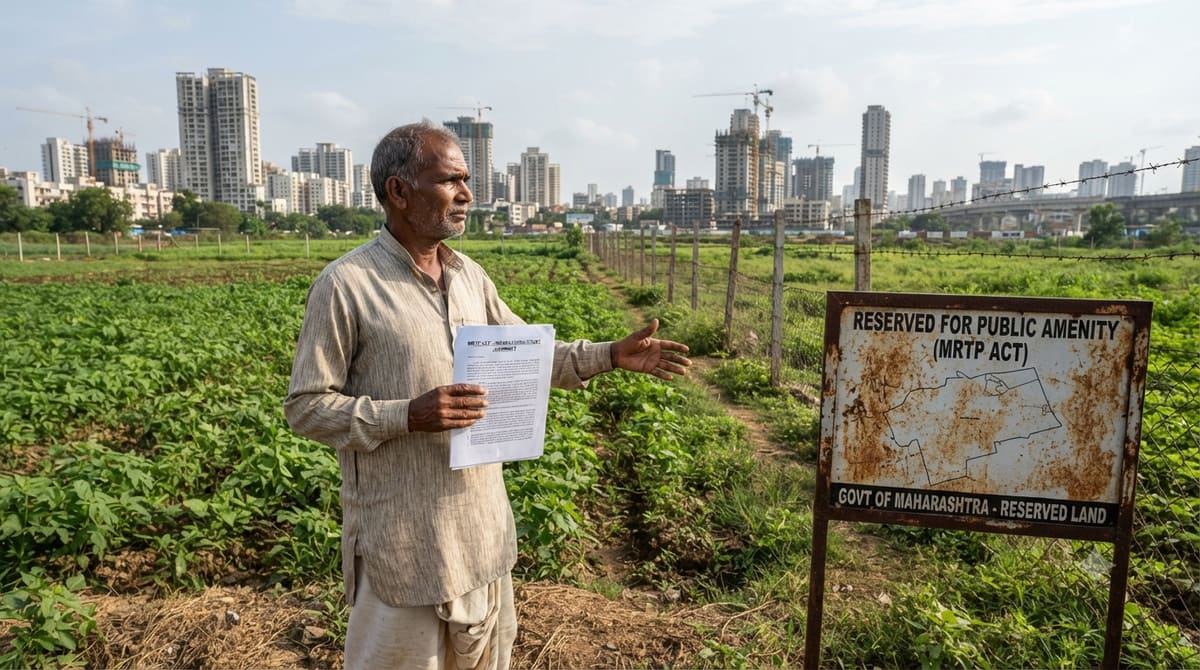
The Bombay High Court has issued a stern directive compelling state departments to ensure continuous legal representation in pending land acquisition appeals, holding that systemic neglect by government officials constitutes serious professional misconduct and causes avoidable financial harm to public exchequer.
Background & Facts
The Dispute
The appeal concerns a long-pending land acquisition matter under the Land Acquisition Act, 1894, where the acquiring body failed to appoint any advocate after its original panel counsel ceased to be on the panel or retired. Despite the State’s statutory obligation to pay mandatory interest at 15% and 9% per annum on delayed compensation, the appeal remained unrepresented for over two decades.
Procedural History
- The appeal was filed in 2004 and remained pending for over 20 years.
- The original advocate for Respondent No. 2 (acquiring body) was removed from the panel and no replacement was appointed.
- The Court issued notices twice in prior years, but no representative appeared.
- The Registrar (Judicial) confirmed that despite a 2026 directive to review all pending appeals over 25 years old, no department took action to reassign cases.
Relief Sought
The Court did not adjudicate the merits of the land acquisition claim but sought systemic reform to prevent future delays caused by administrative apathy.
The Legal Issue
The central question was whether the State, as a statutory party under the Land Acquisition Act, 1894, can evade its duty to maintain legal representation in pending appeals due to changes in its panel advocates, thereby causing financial loss and judicial backlog.
Arguments Presented
For the Appellant
The appellant did not press for substantive relief but relied on the Court’s inherent power to prevent abuse of process and protect public interest. The absence of opposition allowed the Court to focus on institutional accountability.
For the Respondent/State
No advocate appeared for Respondent No. 2. The State did not file any written submission, leaving the Court to infer dereliction of duty from the prolonged non-appearance and lack of administrative follow-up.
The Court's Analysis
The Court examined the statutory framework under the Land Acquisition Act, 1894, which imposes a mandatory obligation on the State to pay interest at 15% and 9% per annum on delayed compensation. It noted that hundreds of such appeals remain unrepresented for over a decade, resulting in compounding financial liabilities.
"If hundreds of appeals remain unrepresented and undecided for years indeed for one or two decades, it is bound to cause a heavy financial burden and loss to the State Government, involving public money."
The Court held that the failure of government officials to appoint new advocates from their existing panel - despite known vacancies - is not mere administrative oversight but a deliberate neglect of statutory duty. It emphasized that public bodies are not entitled to treat litigation as a low-priority function. The Court distinguished this from ordinary delays, characterizing it as institutional failure that undermines the rule of law.
It further referenced its own prior directive in First Appeal No. 63 of 2003, which had explicitly instructed departments to review and reassign cases. The fact that no action followed rendered the earlier order ineffective and demonstrated systemic non-compliance.
The Verdict
The Court ruled in favor of institutional accountability. It held that the State’s failure to appoint advocates constitutes professional misconduct and directed immediate departmental action against responsible officials. The Court mandated proactive reassignment of cases and issued binding administrative directions to senior state officers.
What This Means For Similar Cases
Departmental Accountability Is Non-Negotiable
- Practitioners must now raise institutional dereliction as a ground for adjournment denial in long-pending government cases.
- Courts may invoke Article 226 to compel departments to assign counsel when delays exceed five years without justification.
- Departmental inquiries triggered by this order may lead to disciplinary proceedings under service rules.
Statutory Interest Accrues Even Without Representation
- The State remains liable for interest even if it fails to appear, meaning financial exposure grows daily.
- Legal teams representing landowners should calculate and plead accrued interest as a separate head of claim, regardless of the State’s non-appearance.
- This judgment empowers claimants to seek cost awards for unnecessary delays caused by state inaction.
Proactive Case Reassignment Is Mandatory
- All government departments must maintain updated advocate panels and assign cases automatically upon counsel’s exit.
- Registrars must flag cases with no representation for over three years and report to the Chief Justice.
- Law officers should advise departments to include reassignment protocols in their internal SOPs to avoid future contempt or inquiry.