The Manipur High Court has reaffirmed the principle that judicial intervention in executive decisions regarding the location of public infrastructure is permissible only in exceptional circumstances. In dismissing a Public Interest Litigation seeking to reverse the relocation of a District Institute of Education and Training (DIET) Centre, the Court emphasized the primacy of administrative discretion in welfare planning, particularly where no substantive harm or procedural illegality is demonstrated.
Background & Facts
The Dispute
The petitioner, Yumnam Dijendro Meitei, filed a Public Interest Litigation challenging the Government of Manipur’s decision to relocate the District Institute of Education and Training (DIET) Centre from its original proposed site in Mayang Imphal, Imphal West District, to a new site at Salam Mamang Leikai (referred to as ‘Lamsang’) in Village No. 76 of Salam Keikhu. The petitioner’s sole grievance was that the new location falls outside the 23-Mayang Imphal Assembly Constituency, despite both locations being within Imphal West District.
Key Facts
- The DIET Centre was originally located within the DM College campus in Imphal West.
- In 2016, the State Government decided to upgrade DM College into a Deemed University, necessitating the relocation of the DIET Centre.
- A preliminary proposal was made to shift the DIET Centre to Mayang Imphal, Imphal West District.
- The foundation stone for the DIET Centre at Mayang Imphal was laid, but no construction commenced - no brick was laid.
- Subsequent evaluation concluded that Mayang Imphal was unsuitable due to poor transportation access for students.
- An alternative proposal to shift the DIET Centre to Canchipur was abandoned due to unavailability of sufficient land.
- The final decision, dated 22.05.2021 (Ref: 13/1/2007-SE/SCERT(Pt-11)), selected Lamsang, a site measuring 4.95 acres under C.S. Dag Chitha No. 182 (New), classified as Sarkari Sanjabung.
- The petitioner filed the PIL on 03.12.2021, but no interim order was granted.
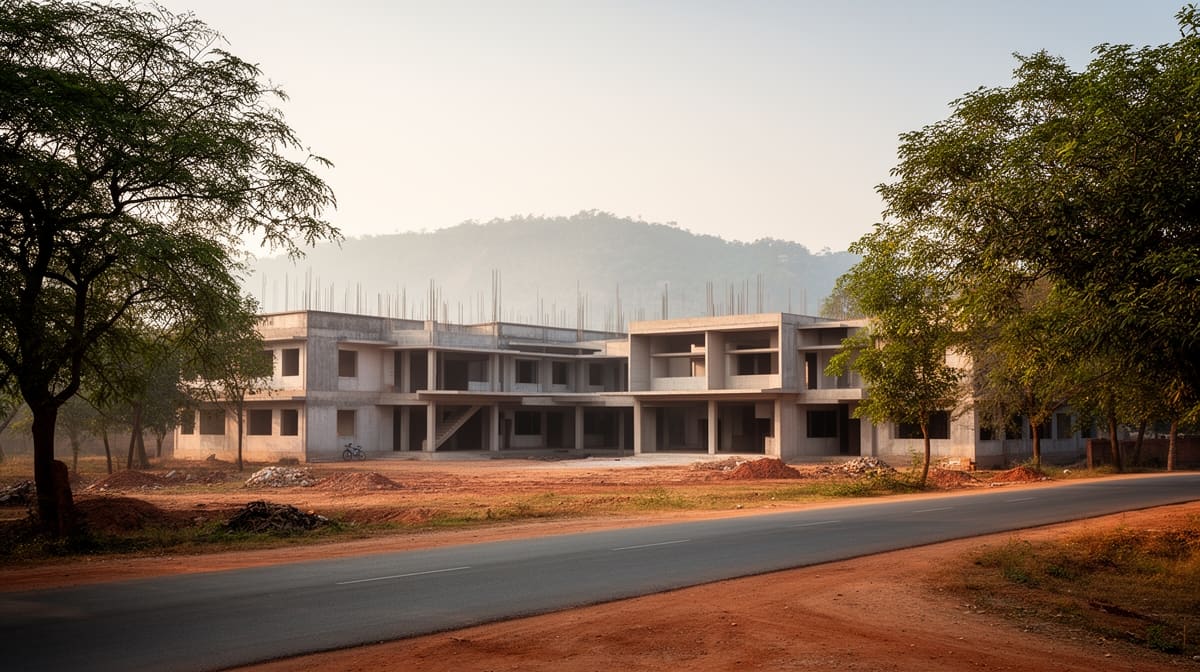
- By July 2025, construction at Lamsang was reported to be at an advanced stage, nearing completion.
- The petitioner owns homestead land in Mayang Imphal, approximately 2 km from the originally proposed DIET site.
- The State submitted an affidavit by Respondent-4 (Chief Engineer, Education Engineering Wing) dated 03.02.2022, asserting that Lamsang is 9 km from Imphal, easily accessible via NH-37 and Imphal-Kangchup Road, with no contestation of this assertion in the petitioner’s reply affidavit.
Procedural History
- 2016: Policy decision taken to upgrade DM College into a Deemed University, necessitating DIET relocation.
- 2016 - 2020: Evaluation of alternative sites: Mayang Imphal (proposed), Canchipur (rejected due to land shortage).
- May 2021: Foundation stone laid at Mayang Imphal; no construction initiated.
- 22.05.2021: Government order issued selecting Lamsang as the new site for DIET Centre.
- 03.12.2021: PIL filed before the Manipur High Court.
- 03.02.2022: Affidavit-in-opposition filed by Respondent-4 detailing accessibility of Lamsang.
- July 2025: Photographs submitted showing advanced stage of construction at Lamsang.
- 16.03.2026: Final hearing and judgment delivered.
Relief Sought
The petitioner sought a direction to the State to relocate the DIET Centre to Mayang Imphal, as originally proposed, on the ground that it lies within the 23-Mayang Imphal Assembly Constituency.
The Legal Issue
The central question was whether the judiciary can interfere in the executive’s administrative decision regarding the location of a public educational institution under Article 226 of the Constitution, where the chosen site is functionally superior, no public funds have been wasted on the abandoned site, and the petitioner’s only objection is based on territorial constituency boundaries.
Arguments Presented
For the Petitioner
The petitioner contended that relocating the DIET Centre from Mayang Imphal to Lamsang violated the principle of equitable distribution of public infrastructure within legislative constituencies. He argued that the original proposal to locate the DIET Centre in Mayang Imphal was a settled policy decision, and shifting it elsewhere - despite no construction having begun - was arbitrary and politically motivated. He emphasized that the DIET Centre’s location within his constituency was a matter of public representation and access for local students.
For the Respondent
The State, represented by Senior Advocate S. Nepolean, argued that the relocation decision was based on objective administrative considerations: accessibility, road connectivity, and student convenience. The affidavit of Respondent-4 established that Lamsang was 9 km from Imphal and well-connected via NH-37 and the Imphal-Kangchup Road, with no rebuttal from the petitioner. The State highlighted that no public money had been spent on the Mayang Imphal site, and construction at Lamsang was nearly complete. The State relied on Aleemuddin v. State of Uttar Pradesh to assert that such site selection falls squarely within the domain of executive discretion and is not subject to judicial review absent mala fide or illegality.
The Court's Analysis
The Court undertook a structured review of the administrative process, the factual record, and the legal precedents cited. It noted that the decision to relocate the DIET Centre was not impulsive but followed a reasoned evaluation of multiple sites, including Canchipur, which was rejected due to land constraints. The Court emphasized that the petitioner’s grievance was purely political - concerned only with constituency boundaries - and not with the functionality, accessibility, or educational utility of the new site.
"The question as to whether an institute like DIET Centre or other public offices should be situate is usually in the realm of decision of executive arm in a welfare State and interference of Courts that too in a PIL petition is an exception when there are compelling reasons to do so."
The Court found no evidence of arbitrariness, mala fide, or procedural irregularity. The petitioner failed to demonstrate any material disadvantage to students, teachers, or the public arising from the Lamsang location. The State’s affidavit, unchallenged in reply, established the logistical superiority of Lamsang. The Court further noted that the petitioner himself owned land in Mayang Imphal, 2 km from the proposed site, indicating his personal stake did not translate into a public interest.
The Court distinguished the facts from Aleemuddin v. State of Uttar Pradesh, where the Supreme Court held that the location of a Tehsil building is an administrative matter beyond judicial review unless the petitioner has a direct, personal, and demonstrable interest beyond mere constituency representation. The Court observed that the petitioner’s claim was analogous to that in Aleemuddin - a constituency-based grievance without substantive public harm - and therefore fell outside the scope of judicial intervention under Article 226.
The Court also weighed the financial and practical consequences of reversing the decision: nearly complete construction at Lamsang, funded by public money, would be jeopardized, resulting in wastage of public resources and disruption of educational planning.
The Verdict
The PIL was dismissed. The Court held that the State’s decision to locate the DIET Centre at Lamsang, Imphal West, was a valid exercise of administrative discretion. No direction was issued to relocate the Centre. The Court declined to impose costs. Construction at Lamsang was permitted to proceed without interference.
What This Means For Similar Cases
Administrative Site Selection Is Beyond Judicial Review Absent Bad Faith
- Practitioners must demonstrate concrete harm, procedural illegality, or mala fide intent to challenge executive decisions on public infrastructure location.
- Constituency-based objections alone, without evidence of functional disadvantage, are insufficient to invoke judicial intervention.
- Courts will not entertain PILs that seek to substitute administrative judgment with political preference.
Public Funds and Completed Works Are Material Considerations
- Where substantial public expenditure has been incurred and construction is advanced, courts are reluctant to order reversal absent compelling public interest.
- Delay in filing PILs, especially after construction has commenced, weighs heavily against the petitioner.
- Affidavits detailing logistical advantages, if unchallenged, become decisive evidence in favor of the State.
PILs Must Be Grounded in Public Interest, Not Personal or Political Gain
- The Court reaffirmed that PILs are not tools for political lobbying or constituency-based demands.
- Petitioners must show how the impugned decision affects the public at large, not merely their personal or electoral interests.
- Ownership of private land near the proposed site does not confer standing unless it directly impacts public access or welfare.