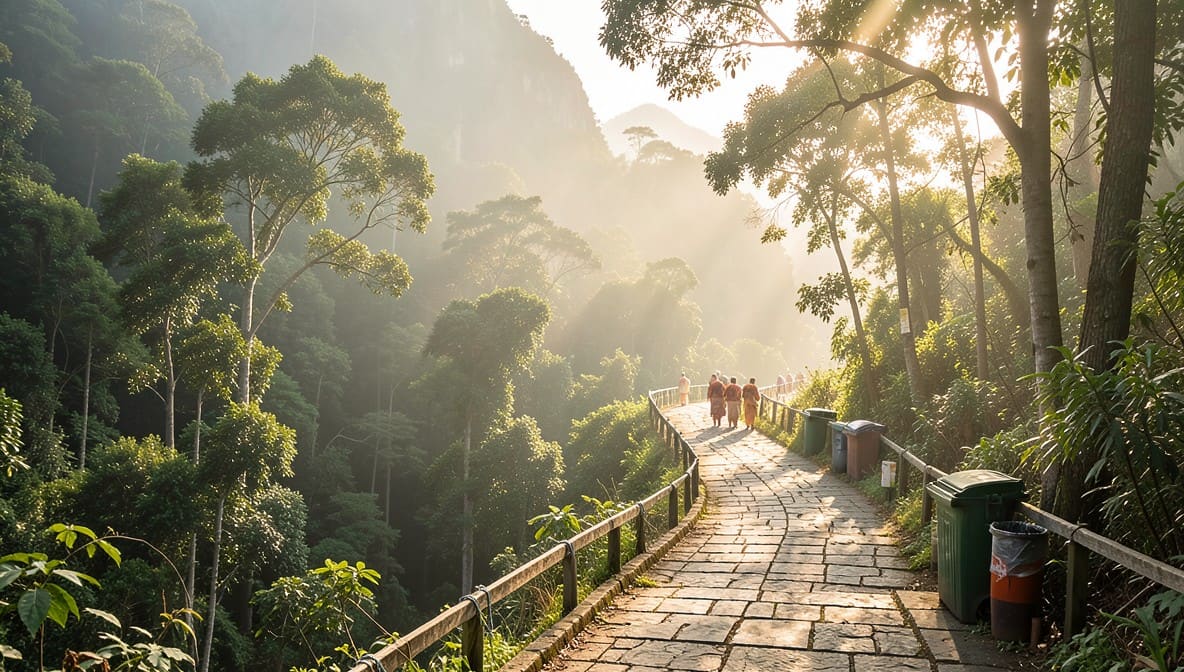
The Kerala High Court has taken decisive judicial action to ensure continuity in the implementation of the Sabarimala Master Plan by appointing a new Chairman to the High Power Committee, following the demise of the incumbent. This order underscores the Court’s institutional commitment to managing one of India’s largest religious pilgrimages through structured governance, ecological preservation, and transparent public fund utilization.
Background & Facts
The Dispute
The matter arises from the need to appoint a new Chairman to the High Power Committee for the Implementation of the Sabarimala Master Plan, following the death of the previous Chairman, Hon’ble Mr. Justice S. Siri Jagan, on 24.01.2026. The Committee, originally constituted by this Court in 2009 and reconstituted in 2017, is vested with overarching authority to oversee the implementation of a comprehensive, multi-phase infrastructure and pilgrim management plan for the Sabarimala pilgrimage site. With the Chairman’s demise, the Committee became functionally paralyzed, threatening the continuity of critical developmental works.
Key Facts
- The Sabarimala Master Plan was prepared by M/s. IL&FS Eco Smart Limited, New Delhi, and approved by the Government of Kerala via order dated 03.05.2007.
- The Plan envisions three phases: immediate (to be completed by November 2007), short-term (by 2015), and long-term (extending to 2050).
- The Master Plan addresses: traffic and transport management, solid waste and sewage systems, water supply, base camp development, healthcare infrastructure, communication systems, and disaster management.
- The High Power Committee was constituted by this Court on 02.04.2009 (DBP No. 3 of 2009) with Sri K. Jayakumar, IAS, as Chairman.
- Reconstituted on 30.08.2017 (DBP No. 136 of 2012 and SSCR No. 9 of 2017) with Hon’ble Mr. Justice S. Siri Jagan as Chairman.
- The Committee comprises approximately 21 members, including a Technical Committee of 10 members and two special invitees, and a Special Technical Committee of environmental experts.
- A Sabarimala Master Plan Infrastructure Fund Trust Board was registered to mobilize resources, with an initial corpus of ₹1 Crore from Travancore Devaswom Board and ₹2 Crores from donations.
- From FY 2011-12 to 2025-26, the Government of Kerala has allocated ₹390.2 Crores for Sabarimala development.
- Completed infrastructure includes: a 5 MLD Sewage Treatment Plant, Annadanamandapam (capacity: 5,000 pilgrims), Darsanam Complex, RCC water tanks, integrated toilet complexes, and parking areas.
- Pending works include: Pilgrim Management Plan, queue complexes along trek routes, removal of structures near Thazikakkudam and upper Thirumuttom, and implementation of disaster management components.
- Proposed future projects: Pilgrim Amenity Centre, Prasadam Complex, firefighting systems, rescue bridge at Sannidhanam, ropeway from Pampa to Sannidhanam, and development of Nilakkal core area.
- The Court initiated suo motu proceedings via W.P.(C) 8529 of 2026 on 06.02.2026, following severe crowd management failures during Mandala-Makaravilakku Season 2025-26.
- The Audit Department confirmed that the Master Plan is comprehensive but lacks Detailed Project Reports (DPRs), leading to misalignment of ongoing projects with original phases.
- The disaster management component under the Master Plan remains unimplemented.
- Justice S. Siri Jagan passed away on 24.01.2026, leaving the Committee without leadership.
Procedural History
- 03.05.2007: Government of Kerala approves Sabarimala Master Plan prepared by M/s. IL&FS Eco Smart Limited.
- 02.04.2009: Kerala High Court constitutes High Power Committee via DBP No. 3 of 2009; Sri K. Jayakumar, IAS, appointed Chairman.
- 30.08.2017: Court reconstitutes Committee via DBP No. 136 of 2012 and SSCR No. 9 of 2017; Hon’ble Mr. Justice S. Siri Jagan appointed Chairman.
- 2010: Sabarimala Master Plan Infrastructure Fund Trust Board registered.
- 24.01.2026: Hon’ble Mr. Justice S. Siri Jagan passes away; Committee rendered non-functional.
- 06.02.2026: Court initiates suo motu proceedings (W.P.(C) 8529 of 2026) following crowd management crisis during Makaravilakku 2025-26.
- 07.04.2026: Final hearing held; Court delivers order appointing new Chairman.
The Parties' Positions
- The High Power Committee, represented by Smt. Sayujya Radhakrishnan, SC, submitted that the Committee’s functioning had ceased due to the Chairman’s demise and urgently required reconstitution.
- The State of Kerala and Travancore Devaswom Board, represented by Smt. Rashmi K.M. and Sri G. Biju, SC, acknowledged the functional vacuum and supported immediate appointment of a new Chairman.
- No opposing party contested the necessity of the appointment.
Relief Sought
The petitioner sought the immediate appointment of a new Chairman for the High Power Committee to ensure uninterrupted implementation of the Sabarimala Master Plan, with specific emphasis on restoring institutional leadership, enforcing timelines, and maintaining ecological and financial accountability.
The Legal Issue
The central question was whether the High Court, having originally constituted the High Power Committee and defined its powers, has the authority and duty to appoint a new Chairman upon the demise of the incumbent to ensure continuity of a judicially supervised public infrastructure project.
Arguments Presented
For the Petitioner
The petitioner argued that the High Power Committee, as a creature of this Court’s order, derives its authority and mandate solely from judicial directives. The Chairman’s role is not merely administrative but judicially mandated to ensure compliance with the Court’s orders dated 02.04.2009 and 30.08.2017. The absence of a Chairman has rendered the Committee dysfunctional, jeopardizing the implementation of a project involving public funds, ecological preservation, and pilgrim safety. The petitioner relied on the Court’s inherent jurisdiction under Article 226 of the Constitution to safeguard the integrity of its own orders and prevent institutional collapse.
For the Respondent
The State of Kerala and Travancore Devaswom Board concurred with the petitioner’s submission. They acknowledged that the Committee’s functioning is entirely dependent on the Chairman’s leadership as defined by the Court’s orders. They submitted that no statutory provision governs the appointment, and therefore, the Court’s intervention is both necessary and appropriate to prevent further delay in critical infrastructure development.
The Court's Analysis
The Court undertook a detailed review of its own prior orders dated 02.04.2009 and 30.08.2017, which established the High Power Committee and defined the Chairman’s role as central to the entire implementation framework. The Court emphasized that the Chairman is not a mere convenor but the institutional linchpin responsible for:
"presiding over all meetings of the Committee and exercising overall supervision and control over its functioning and the implementation of the Master Plan... [and] is entrusted with the responsibility of ensuring the time-bound implementation of the Master Plan in accordance with the directions issued by this Court."
The Court noted that the Chairman’s functions include co-opting representatives from key departments (Pollution Control Board, Public Works Department), submitting bi-monthly status reports to the Court, conducting site inspections, prioritizing projects based on fund availability, and ensuring financial discipline. The absence of a Chairman has led to a complete halt in decision-making, despite the allocation of ₹390.2 Crores in public funds.
The Court further observed that the Master Plan’s success hinges on phased execution, and the lack of Detailed Project Reports (DPRs) has already caused deviations from the original plan. The unimplemented disaster management component and pending queue systems pose direct risks to pilgrim safety. The Court held that its suo motu jurisdiction under Article 226 is not only available but imperative to prevent the erosion of judicial authority and public interest.
The Court rejected any notion that the appointment of a Chairman is an executive function outside judicial purview. It held that when a judicial body is created to oversee a public project of national significance, the Court retains supervisory authority over its composition and continuity. The Court cited its own precedents affirming that judicial orders creating institutional mechanisms must be sustained through judicial intervention when their functionality is compromised.
The Court also emphasized the ecological imperative: the Chairman must ensure no project compromises the Periyar Tiger Reserve and Western Ghats. This duty cannot be delegated or left unattended.
The Verdict
The Court appointed Hon’ble Mr. Justice Arun V.G., former Judge of this Court, as Chairman of the High Power Committee for the Implementation of the Sabarimala Master Plan. The Chairman is directed to resume all functions as defined in the Court’s orders dated 02.04.2009 and 30.08.2017, including: submitting bi-monthly status reports through the Advocate General, conducting site inspections, prioritizing projects, and ensuring compliance with ecological norms. The Committee is directed to prepare Detailed Project Reports for all pending components within 90 days. All developmental works must align strictly with the Master Plan’s immediate, short-term, and long-term phases. The Court retains jurisdiction to review progress and intervene if deadlines are not met.
What This Means For Similar Cases
Judicial Oversight Extends to Institutional Continuity
- Practitioners must recognize that courts creating special committees for public projects retain ongoing supervisory authority over their composition and functioning.
- The demise or resignation of a judicially appointed head does not terminate the committee’s mandate; the court may appoint a successor to preserve institutional integrity.
DPRs Are Non-Negotiable for Public Infrastructure
- All state-led infrastructure projects under judicial supervision must prepare Detailed Project Reports before fund disbursement.
- Absence of DPRs renders expenditures vulnerable to judicial scrutiny and may lead to suspension of funds.
Ecological Compliance Is a Judicial Priority
- Projects in ecologically sensitive zones (e.g., Western Ghats, Tiger Reserves) must have explicit environmental safeguards embedded in their design.
- Failure to comply with ecological conditions can result in judicial intervention, even if statutory clearances are obtained.
Inter-Departmental Coordination Is Judicially Mandated
- The Chairman’s power to co-opt departmental representatives is not discretionary but mandatory.
- Delays caused by inter-departmental friction are now actionable before the court through the Chairman’s reporting mechanism.
Time-Bound Implementation Is Enforceable
- Phased deadlines (immediate, short-term, long-term) in judicially approved plans are binding.
- Non-compliance with timelines may trigger contempt proceedings or withdrawal of funding authority.