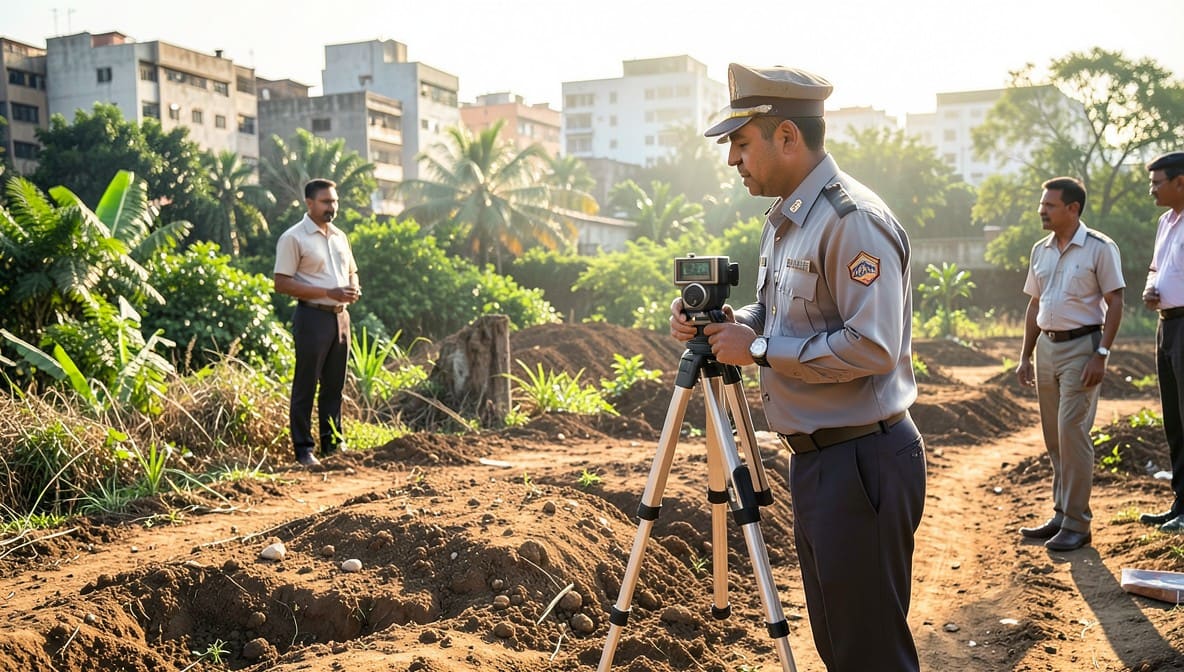
The Bombay High Court, Nagpur Bench, has set aside an order rejecting a joint measurement application in a boundary dispute between adjoining landowners. The Court emphasized the necessity of joint measurement to resolve conflicting reports and quashed the trial court's refusal, directing the appointment of a Court Commissioner for the purpose. The judgment underscores the procedural safeguards available to parties in civil suits involving boundary disputes and the court's role in ensuring fair evidence collection.
Background & Facts
The Genesis
The petitioner, Kailash Dama Landge, filed Regular Civil Suit No. 213/2023 before the Joint Civil Judge, Junior Division, Bhandara, seeking a declaration of title and permanent injunction against the respondents, Baccharaj Ishwardas Bansod and others. The dispute pertains to the boundary between the petitioner's plot and the defendants' adjoining plots.
Key Facts
- The petitioner and respondents are owners of adjoining agricultural plots in Bhandara district, Maharashtra.
- The dispute arose over the exact boundary line between the plots, with conflicting measurement reports submitted by the parties.
- The petitioner filed an application (Exhibit 19) before the trial court on 15.09.2025, seeking the appointment of a Court Commissioner for joint measurement of the plots.
- The trial court rejected the application, observing that the suit was not for removal of encroachment but for declaration and permanent injunction, and that the application was an attempt to collect evidence on possession.
- The petitioner had previously filed an appeal against a measurement report that allegedly showed his encroachment onto the defendants' land.
Procedural History
- 15.09.2025: Trial court rejected the petitioner's application for joint measurement (Exhibit 19) in Regular Civil Suit No. 213/2023.
- 16.07.2026: Present writ petition filed before the Bombay High Court, Nagpur Bench.
The Parties' Positions
- Petitioner's Stand: The petitioner argued that joint measurement was essential to resolve the boundary dispute, as conflicting reports had been submitted by the parties.
- Respondents' Stand: The respondents contended that the suit was not for removal of encroachment and that the application was an attempt to collect evidence on possession, which was not permissible.
Relief Sought
The petitioner sought quashing of the trial court's order dated 15.09.2025 rejecting the joint measurement application and a direction for the trial court to appoint a Court Commissioner for joint measurement of the adjoining plots.
The Legal Issue
The central question was whether a trial court, in a suit for declaration and permanent injunction involving a boundary dispute, could reject an application for joint measurement of adjoining plots when conflicting measurement reports had been submitted by the parties.
Arguments Presented
For the Petitioner
The petitioner relied on the settled legal position that joint measurement of adjoining plots is necessary to resolve boundary disputes. It was argued that the trial court's refusal to appoint a Court Commissioner for joint measurement would prejudice the petitioner's right to a fair trial and proper evidence collection. The petitioner also highlighted that the respondents had themselves filed an appeal against a measurement report, indicating the necessity of joint measurement to resolve the dispute.
For the Respondent
The respondents contended that the suit was not for removal of encroachment but for declaration and permanent injunction, and that the application was an attempt to collect evidence on possession. It was argued that the trial court's rejection of the application was justified as the petitioner was trying to collect evidence on the point of possession, which was not permissible in the suit.
The Court's Analysis
The Court examined the nature of the dispute and the procedural history of the case. It noted that the dispute pertained to the boundary between the parties' adjoining plots and that conflicting measurement reports had been submitted. The Court observed that joint measurement of adjoining plots is a well-settled procedure for resolving boundary disputes, as it ensures that the boundary is determined accurately and fairly.
"In view of the settled legal position that joint measurement of adjoining plots is necessary in order to resolve the boundary disputes, the impugned order cannot be sustained and is liable to be quashed and set aside."
The Court also noted that the respondents had themselves filed an appeal against a measurement report, indicating the necessity of joint measurement to resolve the dispute. The Court held that the trial court's refusal to appoint a Court Commissioner for joint measurement would prejudice the petitioner's right to a fair trial and proper evidence collection.
The Verdict
The writ petition was allowed in the following terms:
- The order dated 15.09.2025 passed by the learned Joint Civil Judge, Junior Division, Bhandara, rejecting the application for joint measurement was quashed and set aside.
- The application (Exhibit 19) for joint measurement was allowed.
- In the event an appeal against the measurement report is preferred by the plaintiff, the effect of the outcome of the appeal will also be taken into consideration by the learned Trial Court while evaluating the evidence at the stage of final hearing of the suit.
- The fees of the appointed advocate for the respondent were to be paid in accordance with the schedule.
What This Means For Similar Cases
Joint Measurement Is Essential for Boundary Disputes
- In suits involving boundary disputes between adjoining landowners, joint measurement of plots is a necessary procedural safeguard to ensure accurate and fair resolution of the dispute.
- Courts must not reject applications for joint measurement solely on the ground that the suit is not for removal of encroachment or that the application is an attempt to collect evidence on possession.
Appellate Proceedings Do Not Preclude Joint Measurement
- The pendency of an appeal against a measurement report does not negate the necessity of joint measurement. Courts must consider the outcome of such appeals while evaluating evidence at the final hearing stage.
- Joint measurement ensures that the boundary is determined accurately, even if conflicting reports have been submitted by the parties.
Procedural Safeguards Must Be Upheld
- Courts must uphold the procedural safeguards available to parties in civil suits, including the right to fair evidence collection and the appointment of Court Commissioners for joint measurement.
- Rejection of applications for joint measurement without valid grounds would prejudice a party's right to a fair trial and proper evidence collection.