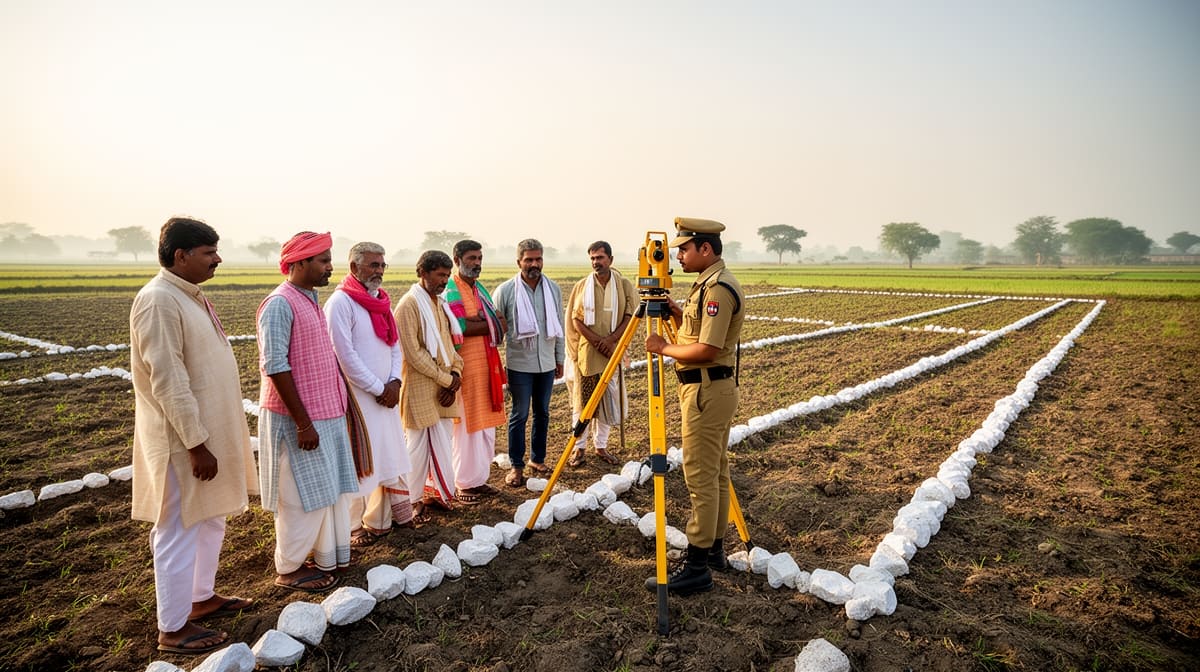
The Bombay High Court has clarified that in suits involving land encroachment, the appointment of a Court Commissioner to physically measure disputed property is not an attempt to collect evidence but a necessary step for accurate adjudication. This ruling reinforces procedural fairness in property disputes where survey boundaries are contested.
Background & Facts
The Dispute
The petitioners, legal representatives of the deceased Baburao Sambshiv Chaudhari, were plaintiffs in a civil suit seeking declaration of title and recovery of an encroached portion of land bearing Survey No. 397 in Nagpur. The suit alleged unauthorized occupation by the defendant of a portion of the plaintiffs’ land. The dispute centered on the exact demarcation of the property, particularly whether the original Survey No. 397 had been renumbered as Survey No. 397/3A.
Key Facts
- The plaintiffs filed the suit for declaration and possession of the encroached land on an unspecified date prior to 2021
- The suit property was originally recorded as Survey No. 397, but the plaintiffs claimed it had been renumbered to Survey No. 397/3A
- The plaintiffs had submitted documents supporting the renumbering, but the trial court found no conclusive material on record
- The plaintiffs examined three witnesses before filing the application for appointment of a Court Commissioner
- The application was filed after the third witness was examined, during the evidence stage
- The plaintiffs specifically sought appointment of the Taluka Inspector of Land Records, a government official, to conduct the measurement
Procedural History
- Date of filing of suit: Not specified in judgment, but prior to 2021
- Date of third witness examination: Prior to 25.11.2021
- 25.11.2021: Trial Court rejected the application for appointment of Court Commissioner (Exhibit 48), holding that there was no material on record to establish the renumbering of Survey No. 397 to 397/3A, and that the application was an attempt to collect evidence
- 05.12.2021: Petitioners filed the writ petition (No. 6609/2024) before the Bombay High Court, Nagpur Bench
- 16.03.2026: Hearing before Justice Raj D. Wakode; judgment delivered
The Parties' Positions
The petitioners contended that the trial court’s refusal was legally untenable because:
- The nature of the suit - encroachment over land - demanded precise measurement
- The Taluka Inspector is a neutral, government-appointed official whose report would assist, not replace, judicial determination
- The renumbering of Survey No. 397 to 397/3A was a matter of public record, and measurement would clarify the position
The respondent contended that:
- The plaintiffs had the burden to prove their case through pleadings and evidence
- The application was a disguised attempt to shift the burden of proof to the court
- The court should not act as an investigative agency
Relief Sought
The petitioners sought:
- Quashing of the trial court’s order dated 25.11.2021 rejecting the application for appointment of Court Commissioner
- Direction to appoint the Taluka Inspector of Land Records as Court Commissioner to measure the disputed land
- Costs of the Commissioner to be borne by the plaintiffs
The Legal Issue
The central question was whether, in a suit for removal of encroachment where the exact boundaries of the suit property are in dispute and renumbering of survey numbers is alleged, the court may refuse appointment of a Court Commissioner under Order XXVI Rule 9 read with Section 151 of the Code of Civil Procedure, 1908 merely on the ground that there is no documentary proof of renumbering.
Arguments Presented
For the Petitioner
The learned counsel relied on two precedents: Kashinath Chindhuji Shastri v. Haribhau Nathuji Bawanthade [2004(2) Mh.L.J. 724] and Vijay Shrawan Shende v. State of Maharashtra & Others [2009(5) Mh.L.J. 279]. He argued that:
- In suits involving physical boundaries and encroachment, measurement by an independent expert is indispensable
- The appointment of a Court Commissioner is not evidence collection but a procedural aid to assist the court in understanding the physical reality of the dispute
- The Taluka Inspector, being a government official, is impartial and his report carries inherent credibility
- The trial court’s reasoning - that absence of documentary proof of renumbering justified rejection - was circular, as measurement would resolve the very issue in dispute
For the Respondent
The respondent’s counsel contended that:
- The plaintiffs must prove their case through pleadings and oral/documentary evidence
- The court cannot be used as a tool to gather evidence on behalf of a party
- The application was filed belatedly, after three witnesses had been examined, indicating delay and tactical intent
- The trial court’s discretion to reject such applications must be respected unless manifestly arbitrary
The Court's Analysis
The Court examined the nature of the suit and the purpose of the application. It noted that the plaintiffs did not seek to introduce new evidence but sought to clarify the physical dimensions of the property in dispute - a matter central to the very cause of action.
"The reason recorded by the trial Court in the impugned order that there is no material on record to show that the suit property bearing Survey no.397 is converted into Survey no.397/3A does not appear to be convincing for rejecting the application. Rather, measurement of the property will clarify the position about existence of the plot of the plaintiffs over the suit properties."
The Court distinguished between collecting evidence and facilitating accurate fact-finding. It held that the appointment of a Court Commissioner under Order XXVI Rule 9 and Section 151 is a discretionary power, but one that must be exercised in the interest of justice, particularly in land disputes where visual inspection is essential.
The Court emphasized that the plaintiffs sought appointment of a government official, not a private expert, thereby minimizing bias and enhancing reliability. It further noted that the trial court’s refusal was based on a technicality - the absence of documentary proof of renumbering - when the very purpose of the Commissioner’s visit was to resolve that ambiguity.
The Court also rejected the argument that the application was belated. It held that the timing of the application, filed after examination of three witnesses, did not render it invalid, as the need for measurement became apparent only after the evidence revealed the extent of the boundary dispute.
The Verdict
The writ petition was allowed. The order dated 25.11.2021 rejecting the application for appointment of the Court Commissioner was quashed and set aside. The trial court was directed to appoint the Taluka Inspector of Land Records as Court Commissioner to measure the disputed land bearing Survey No. 397/3A. The plaintiffs were directed to bear the costs of the Commissioner. The writ petition was disposed of with no order as to costs.
What This Means For Similar Cases
Appointment of Court Commissioner Is Not Evidence Collection
- Practitioners in land encroachment suits must promptly move for appointment of a Court Commissioner when physical demarcation is in dispute
- Courts cannot reject such applications on the ground that the plaintiff has not yet proved the survey number - measurement is the means to establish it
- The use of government officials like Taluka Inspectors strengthens the legitimacy of the process and reduces scope for challenge
Procedural Flexibility Under Section 151 Is Broadly Available
- Section 151 CPC empowers courts to act in the interest of justice, even if not explicitly covered by other rules
- Delay in filing the application is not fatal if the need arises during trial and the opposing party is not prejudiced
- Courts must distinguish between procedural aids and attempts to shift evidentiary burden
Documentary Proof Is Not Prerequisite for Measurement Orders
- The absence of a document proving renumbering of survey numbers cannot justify refusal to measure
- Measurement is the primary method to verify such claims, not a secondary step
- Courts must not require plaintiffs to prove the very fact they seek to establish through the Commissioner’s report