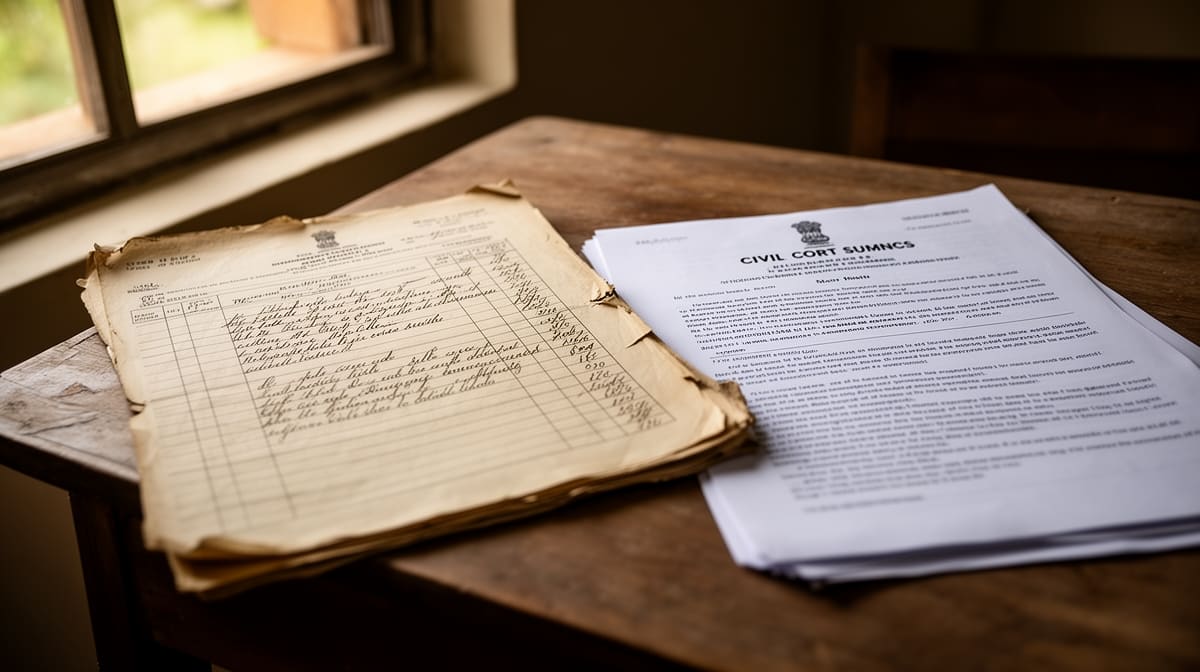
The Bombay High Court has reaffirmed that judicially appointed cadastral surveys, conducted with proper notice and adherence to procedural norms, constitute conclusive evidence in land encroachment disputes. This judgment reinforces the primacy of objective measurement over contested oral claims and clarifies that pending applications for land record correction do not automatically stay civil suits.
Background & Facts
The Dispute
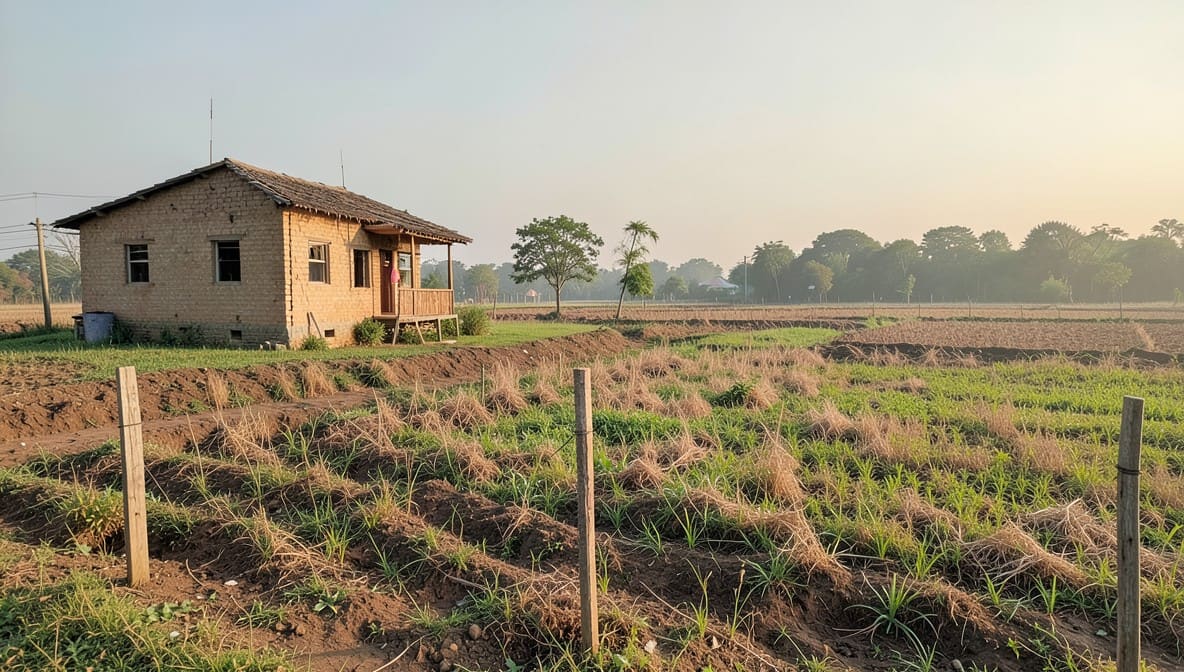
The plaintiff, Balkisan s/o Rajaram Anande, claimed ownership of 2 Hectares 6 Ropanis (54 Ropanis + 36 Ropanis) of agricultural land in Block No.216, Masegaon, Jalna. He alleged that Defendant No.1 encroached 54 Ropanis from the northern boundary and Defendants Nos.2-5 encroached 36 Ropanis from the eastern boundary, both from his legally demarcated land. The defendants denied ownership and claimed the encroached areas were part of their own holdings in adjacent Blocks 215 and 214.
Procedural History
- 2012: Plaintiff filed suit for injunction, later withdrawn and refiled as suit for possession.
- 2013: Regular Civil Suit No.151/2013 filed in Civil Judge (Junior Division), Ghansawangi.
- 2017: Trial Court appointed a Cadastral Surveyor as Court Commissioner under Order 26 Rule 9 CPC to measure Blocks 214, 215, and 216.
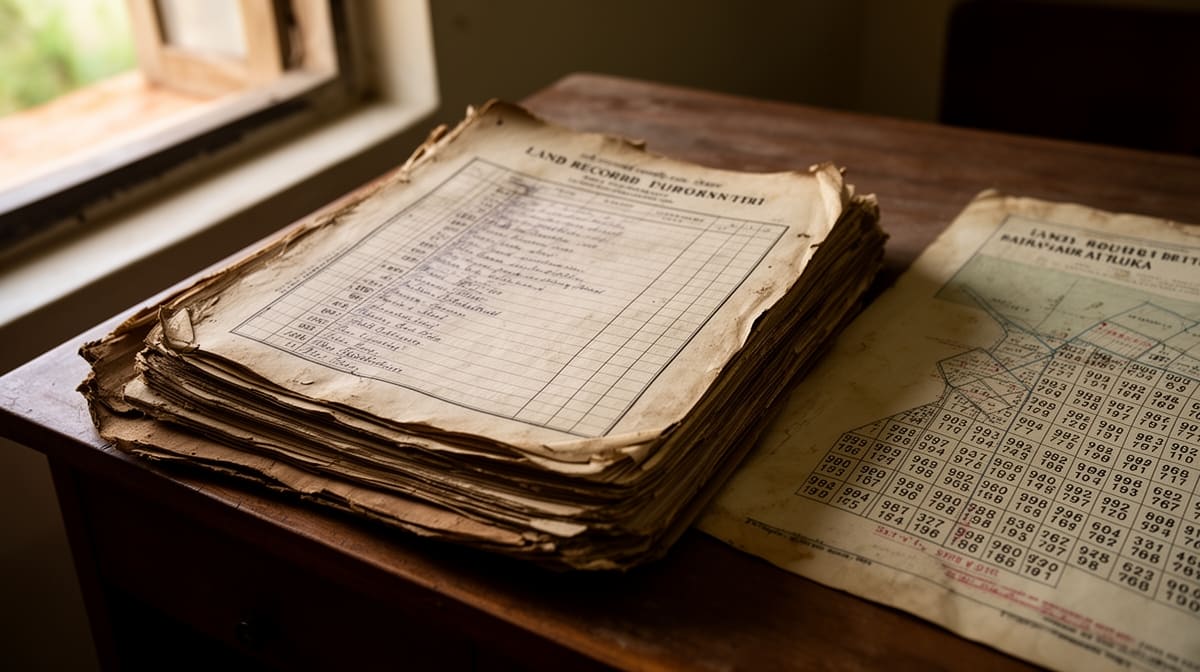
- 2018: Surveyor issued notices, conducted on-site measurement using ETS and prism rod, prepared panchanama (Exh.47) and measurement map (Exh.48).
- 2022: Trial Court decreed suit, ordering possession to plaintiff based on survey report and 7/12 extracts.
- 2023: District Judge dismissed appeal, upholding trial court’s findings.
- 2025: Second Appeal filed before Bombay High Court.
Relief Sought
The plaintiff sought declaration of ownership and recovery of possession of 90 Ropanis of encroached land. The defendants sought dismissal of the suit on grounds of defective survey procedure and pending land record correction proceedings.
The Legal Issue
The central question was whether a court-appointed cadastral survey, conducted after filing of suit with notice to all parties, can form the basis for a decree of possession despite the pendency of an application for correction of land records under Section 36A of the Maharashtra Prevention of Fragmentation and Consolidation of Holdings Act.
Arguments Presented
For the Appellant
The appellants contended that the survey was invalid because: (1) no notice was served under the Maharashtra Land Revenue Code prior to measurement; (2) the surveyor failed to measure lands held by shareholders in the same block; and (3) the trial court erred in deciding the suit without staying proceedings under Section 36B, which bars civil courts from adjudicating disputes involving land record corrections. They relied on Raghunath Kashinath Chavan v. Sakharam Maroti Chavan and Laxman Wamanrao Nagapure v. Shankar Haribhau Adhau to argue that survey procedures were non-compliant.
For the Respondent
The respondent argued that the survey was conducted under a valid court order under Order 26 Rule 9 CPC, with notices issued to all parties, including adjacent landowners. The panchanama was signed by Defendant No.1, and the surveyor’s methodology was scientifically sound. The respondent further submitted that the appellants’ application for correction of land records had been rejected by the Tahsildar and merely remanded for fresh hearing, with no final order issued. The suppression of the 2004 sale deed by Defendant No.1 rendered their claim of 7 Acres 13 Ropanis unreliable.
The Court's Analysis
The Court examined the procedural compliance of the court-appointed surveyor and the applicability of the bar under Section 36B of the Maharashtra Act. It held that the appointment of a Cadastral Surveyor as Court Commissioner under Order 26 Rule 9 CPC was lawful and sufficient to determine factual boundaries in a civil suit.
"The Cadastral Surveyor... had issued notices to the plaintiff, defendants and neighbouring land owners... and carried out measurement by means of ETS Machine and prism rod..."
The Court distinguished Raghunath Kashinath Chavan, noting that in that case, the survey preceded the suit and no court order was obtained. Here, the survey was ordered during pendency of the suit, with all parties present and boundaries marked by line stones. The Court also rejected the appellants’ reliance on Laxman Wamanrao Nagapure, observing that the surveyor had followed the prescribed procedure of boundary identification with party participation.
Regarding Section 36B, the Court held that the mere pendency of an application for correction of land records does not oust the jurisdiction of civil courts. The application filed by Defendant No.1 had been rejected by the Tahsildar and only remanded for reconsideration, with no final order passed. The 7/12 extract (Exh.40) clearly showed Defendant No.1’s holding as 6 Acres 4 Ropanis, not 7 Acres 13 Ropanis as claimed. The suppression of the 2004 sale deed warranted an adverse inference under Section 114 of the Evidence Act.
The Court further noted that Defendants Nos.2-5 failed to examine any witness or produce any document to rebut the survey findings, triggering the presumption under Vidhyadhar v. Manikrao that their claim was false.
The Verdict
The appellants lost. The Bombay High Court dismissed the second appeal, upholding the trial court’s decree for possession. The Court held that a court-ordered cadastral survey with proper notice and party participation constitutes conclusive evidence in encroachment suits, and pendency of a land record correction application does not bar civil adjudication unless a final order is pending.
What This Means For Similar Cases
Survey Reports Are Conclusive Absent Procedural Defects
- Practitioners must challenge cadastral survey reports on grounds of procedural non-compliance, not mere disagreement with findings.
- Failure to object during survey or refuse to sign panchanama weakens subsequent challenges.
- ETS and prism rod measurements, when documented with panchanama and map, are admissible and reliable.
Land Record Correction Applications Do Not Stay Civil Suits
- Civil courts retain jurisdiction to decide possession claims even if a land record correction application is pending.
- A mere remand for fresh hearing does not constitute a pending final order under Section 36B.
- Suppressing sale deeds or failing to produce title documents invites adverse inference under Section 114 of the Evidence Act.
Non-Participation by Defendants Triggers Presumption of False Claim
- Defendants who do not examine witnesses or produce documents to rebut survey evidence risk adverse inference.
- The Vidhyadhar v. Manikrao principle applies even in joint defendants - silence by one party can be used against all.
- Practitioners should advise clients to actively participate in court-ordered surveys and preserve all title documents.