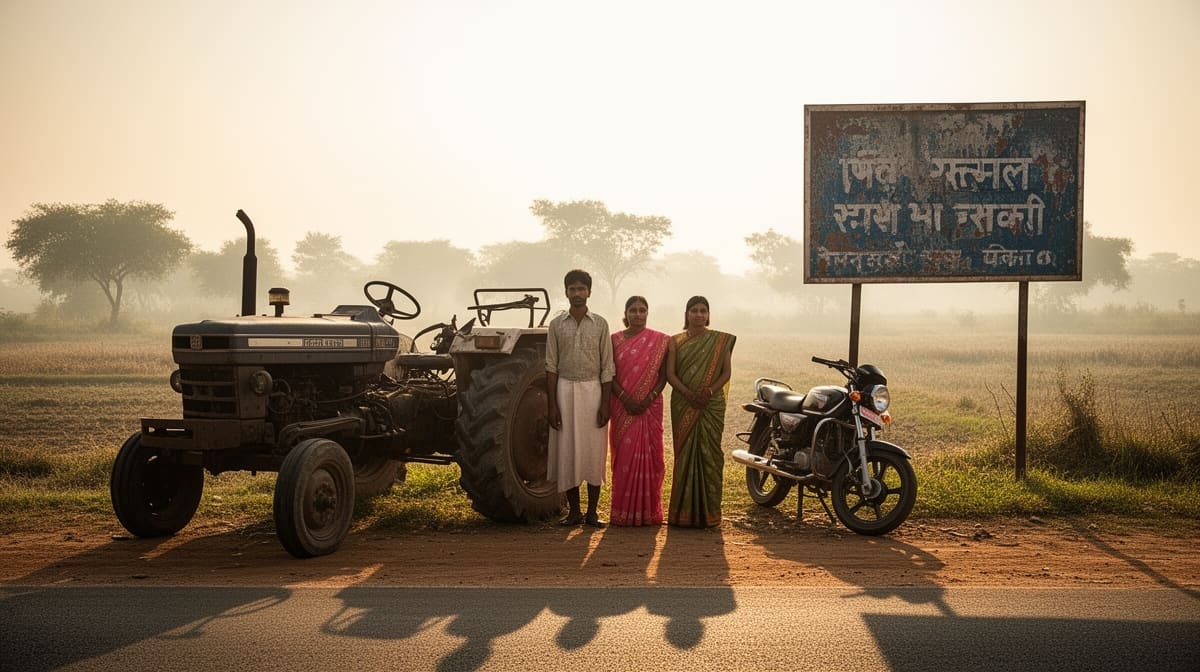
The Punjab and Haryana High Court has affirmed a critical principle in motor insurance law: a personal accident cover taken for one vehicle extends to the owner-driver when operating any other vehicle owned by him, provided the policy is valid and the statutory framework permits such coverage. This ruling clarifies the scope of standalone personal accident policies under IRDAI guidelines and reinforces the protective intent of consumer-centric insurance regulations.
Background & Facts
The Dispute
The petitioner, The New India Assurance Company Ltd., challenges an award dated 19.01.2026 passed by the Permanent Lok Adalat (PLA) directing it to pay Rs. 15 lakhs as personal accident cover to the legal heirs of Rakesh Kumar, who died in a road accident on 20.09.2023. The petitioner contends that the deceased was driving a two-wheeler (HR-85W-2743) at the time of death, which was not the vehicle insured under its policy. The insured vehicle was a four-wheeler (HR-85A-5364), covered under a standalone personal accident (CPA) policy issued by the petitioner for the period 10.03.2023 to 09.03.2024.
Key Facts
- Rakesh Kumar was the owner of two vehicles: a two-wheeler (HR-85W-2743) and a four-wheeler (HR-85A-5364)
- He purchased a standalone CPA policy from the petitioner for the four-wheeler only, with a sum insured of Rs. 15 lakhs
- The two-wheeler was insured with a different insurer
- On 20.09.2023, Rakesh Kumar met with a fatal accident while driving the two-wheeler
- His legal heirs (respondents No. 2 to 6) filed a claim before the Permanent Lok Adalat on 01.01.2026 without first approaching the insurer
- The petitioner, in its reply dated 25.08.2025, rejected the claim on grounds that the deceased was not driving the insured vehicle
- The PLA, relying on IRDAI Circular No. IRDAI/NL/CIR/MOTP/200/12/2018 dated 11.12.2018, allowed the claim
Procedural History
- 20.09.2023: Fatal accident involving Rakesh Kumar while driving HR-85W-2743
- 01.01.2026: Claim petition filed before Permanent Lok Adalat
- 19.01.2026: PLA passed award directing payment of Rs. 15,00,000 with interest
- 22.01.2026: Petition under Articles 226/227 filed before the High Court
- 01.04.2026: Judgment delivered by the High Court
Relief Sought
The petitioner sought quashing of the PLA’s award dated 19.01.2026, arguing that the claim was non-maintainable since the deceased was not driving the insured vehicle. The respondents sought enforcement of the PLA’s award of Rs. 15 lakhs as personal accident benefit.
The Legal Issue
The central question was whether a standalone personal accident cover taken for one vehicle extends to the owner-driver when he is involved in an accident while driving any other vehicle owned by him, under the IRDAI Circular dated 11.12.2018.
Arguments Presented
For the Petitioner
The petitioner argued that the claim was not maintainable under the terms of the policy, as the deceased was not driving the insured vehicle (HR-85A-5364) at the time of death. It contended that the PLA erred in relying on IRDAI Circular No. IRDAI/NL/CIR/MOTP/200/12/2018, particularly Clause 4(v), which it claimed was not intended to override the fundamental principle of policy-specific coverage. It further argued that the policy was issued for a specific vehicle and that extending coverage to other vehicles would amount to judicial overreach and create moral hazard.
For the Respondent
The respondents, through the PLA’s reasoning, relied on Clause 4(v) and 4(vii) of the IRDAI Circular, which state that coverage under a standalone CPA policy extends to all vehicles owned by the owner-driver. They argued that the purpose of such a policy is to protect the driver, not the vehicle, and that the Circular explicitly permits a single CPA cover to apply across multiple owned vehicles. They further cited Clause 4(viii), which states that if an owner-driver already has a 24-hour personal accident cover of at least Rs. 15 lakhs, no separate CPA cover is required for each vehicle.
The Court's Analysis
The Court undertook a detailed examination of the IRDAI Circular dated 11.12.2018, particularly Clauses 4(v), 4(vii), and 4(viii). It noted that the Circular was issued to standardize and simplify personal accident coverage for owner-drivers, recognizing that individuals often own multiple vehicles and should not be compelled to purchase duplicate personal accident covers.
"Clause 4 (v) of the Circular... says that coverage under Stand Alone CPA will extend to all the vehicles owned by the owner-driver under the same policy. In other words, the cover under the Stand Alone CPA policy would be valid when the owner drives any of the vehicles he/she owns."
The Court emphasized that the Circular’s language is unambiguous and purposive. It rejected the petitioner’s narrow interpretation that coverage is tied exclusively to the insured vehicle. The Court held that the policy’s object is to protect the life of the owner-driver, irrespective of the vehicle being operated at the time of the accident. The fact that the deceased had insured both vehicles with different insurers was irrelevant; the critical factor was the existence of a valid CPA policy on one vehicle, which, under the Circular, automatically extended to all other owned vehicles.
The Court further observed that the PLA correctly applied the Circular and did not exceed its jurisdiction. It noted that the PLA’s interpretation aligns with the consumer protection ethos of insurance regulation and prevents insurers from exploiting technicalities to deny legitimate claims. The Court found no error in the PLA’s conclusion that the petitioner could not absolve itself of liability merely because the accident occurred in a different vehicle.
The Verdict
The petition was dismissed. The High Court upheld the Permanent Lok Adalat’s award dated 19.01.2026, directing the petitioner to pay Rs. 15,00,000 as personal accident cover to the legal heirs of Rakesh Kumar, along with interest at the rate of 9% per annum from the date of the accident (20.09.2023) until actual payment. The Court ordered compliance within six weeks from the date of judgment.
What This Means For Similar Cases
Personal Accident Cover Is Driver-Centric, Not Vehicle-Centric
- Practitioners must now argue that standalone CPA policies are designed to protect the driver, not the vehicle
- Insurers cannot deny claims on the basis that the insured was driving a different vehicle, provided the CPA policy is active and the driver owns the vehicle involved
- This principle applies even if the accident vehicle is insured by another insurer
IRDAI Circulars Override Strict Policy Wording
- When IRDAI Circulars provide broader consumer protection, courts will prioritize their intent over restrictive policy language
- Insurers must revise policy documentation and internal guidelines to reflect IRDAI Circulars, especially Clause 4(v) and 4(viii)
- Claims handlers should be trained to recognize that a single CPA policy covers all owned vehicles
PLA Jurisdiction in Insurance Claims Is Valid and Expansive
- Permanent Lok Adalats have authority to interpret IRDAI Circulars and apply them to claims, even where policy terms appear restrictive
- Insurers cannot avoid PLA jurisdiction by claiming technical non-compliance with pre-claim procedures when the claimant is a consumer seeking statutory relief