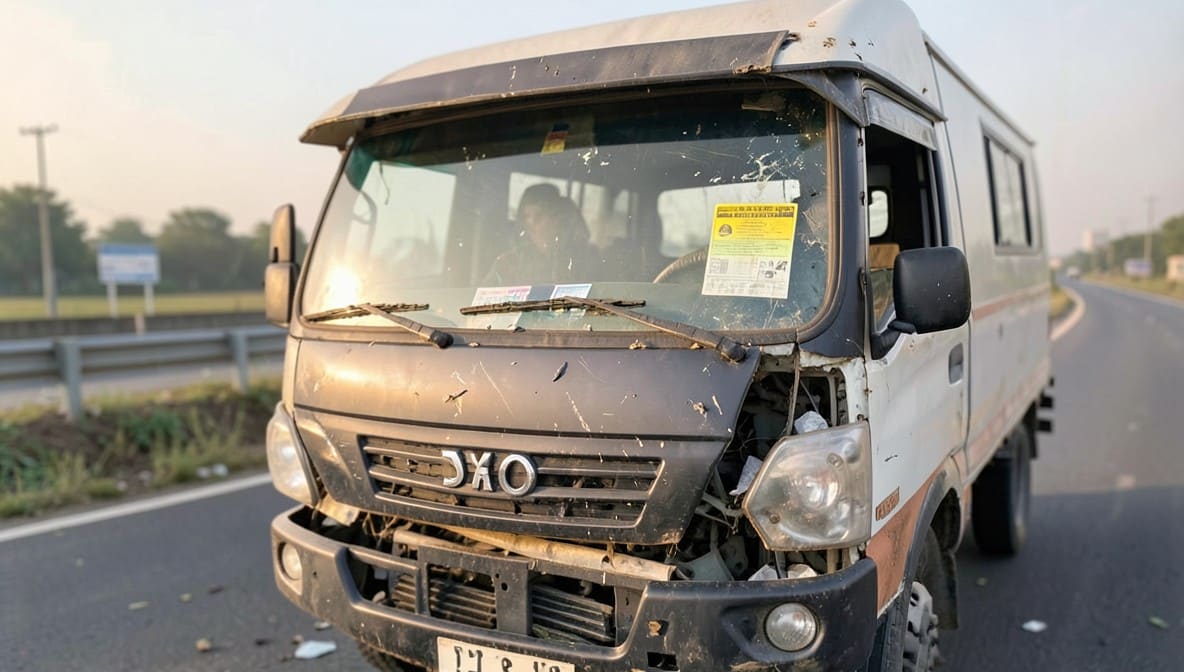
The Punjab and Haryana High Court has affirmed that an insurer’s obligation to compensate for the loss of a vehicle is triggered by the fact of loss itself, not by the precise legal characterization of the incident as theft or robbery. This ruling clarifies a critical principle in insurance jurisprudence, ensuring that technical discrepancies in police reports do not defeat legitimate claims.
Background & Facts
The Dispute
The petitioners, M/s Oriental Insurance Co. Ltd. and another, sought to set aside an award dated 28.07.2023 passed by the Permanent Lok Adalat, Faridabad, which directed them to pay ₹10 Lakhs along with 7% interest to the respondents, Ajit Singh and another. The dispute arose from the insurer’s refusal to honor a claim for the loss of a Tata LPT Turbo Truck, Registration No. HR-38T-0167, insured under a comprehensive policy with an Insured Declared Value (IDV) of ₹10,00,000.
Key Facts
- The insured vehicle was registered in the name of respondent No. 1.
- The policy was in force at the time of the incident.
- On 26.05.2015, the truck was taken from the driver while returning from Kanpur to Faridabad.
- An FIR was lodged on 30.05.2015 under Section 379 IPC at the Faridabad Police Station, describing the incident as "theft".
- The insured submitted a claim application on or before 03.03.2017, describing the incident as "robbery" or "snatching".
- The insurer repudiated the claim solely on the ground of inconsistency between the terms "theft" (in FIR) and "robbery" (in claim form).
- The insurer’s investigator recorded the insured’s statement on 15.06.2015 (Ex. R-8), wherein he described the incident as "robbery".
- The insurer did not dispute the fact of loss, the validity of the policy, or the IDV amount.
- No other ground for repudiation was raised by the insurer at any stage.
Procedural History
- 26.05.2015: Vehicle lost during transit from Kanpur to Faridabad.
- 30.05.2015: FIR registered under Section 379 IPC, describing incident as "theft".
- 03.03.2017: Claim application filed with insurer, describing incident as "robbery" or "snatching".
- 2017 - 2023: Insurer delayed response and ultimately repudiated claim on grounds of inconsistency.
- 28.07.2023: Permanent Lok Adalat, Faridabad, passed award directing payment of ₹10,00,000 with 7% interest from 03.03.2017.
- 20.03.2026: Writ petition filed before the Punjab and Haryana High Court challenging the PLA award.
Relief Sought
The petitioners sought quashing of the Permanent Lok Adalat’s award dated 28.07.2023, arguing that the discrepancy between "theft" and "robbery" invalidated the claim. The respondents sought enforcement of the award and payment of ₹10 Lakhs with 7% interest from 03.03.2017.
The Legal Issue
The central question was whether an insurer can lawfully repudiate a claim for loss of an insured vehicle on the ground that the police report describes the incident as "theft" while the claimant describes it as "robbery", when the fact of loss is undisputed.
Arguments Presented
For the Petitioner
The petitioners contended that the terms "theft" and "robbery" are legally distinct under the Indian Penal Code. Theft (Section 378 IPC) involves dishonest taking without violence, while robbery (Section 390 IPC) involves theft accompanied by force or threat. They argued that the insured’s inconsistent description of the incident amounted to misrepresentation, vitiating the claim under the principle of uberrimae fidei (utmost good faith). They relied on the FIR as the primary official record and claimed the claim form contained a material falsehood.
For the Respondent
The respondents argued that the distinction between theft and robbery is irrelevant to the insurer’s liability under a comprehensive motor policy, which covers loss of the vehicle regardless of the mode. They explained that police officers often classify incidents as "theft" for procedural convenience, even when force was used. The insured had no control over police terminology. The insurer’s own investigator recorded the insured’s statement describing the incident as "robbery", confirming the insured’s version. The insurer never disputed the loss occurred or that the vehicle was insured.
The Court's Analysis
The Court examined the findings of the Permanent Lok Adalat and the insurer’s conduct over an eight-year period. It noted that the insurer had not produced any evidence to suggest the vehicle was not lost, nor had it alleged fraud, collusion, or fabrication. The sole ground of repudiation was the semantic difference between "theft" and "robbery".
"Whether there was theft or robbery, however, there was loss of vehicle. The petitioner neither before the learned PLA nor this Court has produced any evidence to the effect that there was no loss of vehicle."
The Court emphasized that the policy’s obligation arises upon loss of the insured object, not upon the precise legal classification of the criminal act. The insurer’s reliance on the FIR as the sole determinant of claim validity was found to be legally untenable. The Court observed that the insured’s description in the claim form was consistent with his statement recorded by the insurer’s own investigator, and that the police’s classification of the offence was beyond the insured’s control.
The Court further noted that the insurer’s delay of nearly eight years in resolving the claim, without raising any other ground, amounted to a deficiency in service under the Legal Services Authorities Act, 1987. The PLA’s conclusion that the insurer’s repudiation was unjustified was therefore legally sound.
The Verdict
The petition was dismissed. The Court upheld the Permanent Lok Adalat’s award dated 28.07.2023, directing the insurer to pay ₹10,00,000 with 7% interest from 03.03.2017 until realization. No costs were awarded. The judgment affirmed that the insurer’s liability is triggered by the fact of loss, not by the terminology used to describe the criminal act in police records or claim forms.
What This Means For Similar Cases
Loss, Not Label, Triggers Insurance Liability
- Practitioners must argue that insurers cannot deny claims based on semantic differences between "theft", "robbery", "snatching", or "burglary" if the vehicle’s loss is confirmed.
- The burden shifts to the insurer to prove fraud or non-occurrence of loss - not to prove the precise legal category of the crime.
Police Reports Are Not Conclusive in Insurance Claims
- Insurers cannot treat FIRs as infallible documents; they must investigate independently and consider the insured’s consistent statements.
- If the insured’s version is corroborated by the insurer’s own investigation, discrepancies with police terminology cannot justify repudiation.
Delay in Claim Resolution Constitutes Deficiency in Service
- A delay of over eight years without payment or valid reason supports a finding of deficiency under the Legal Services Authorities Act.
- Claimants may now invoke PLA jurisdiction more confidently where insurers unreasonably delay settlement.