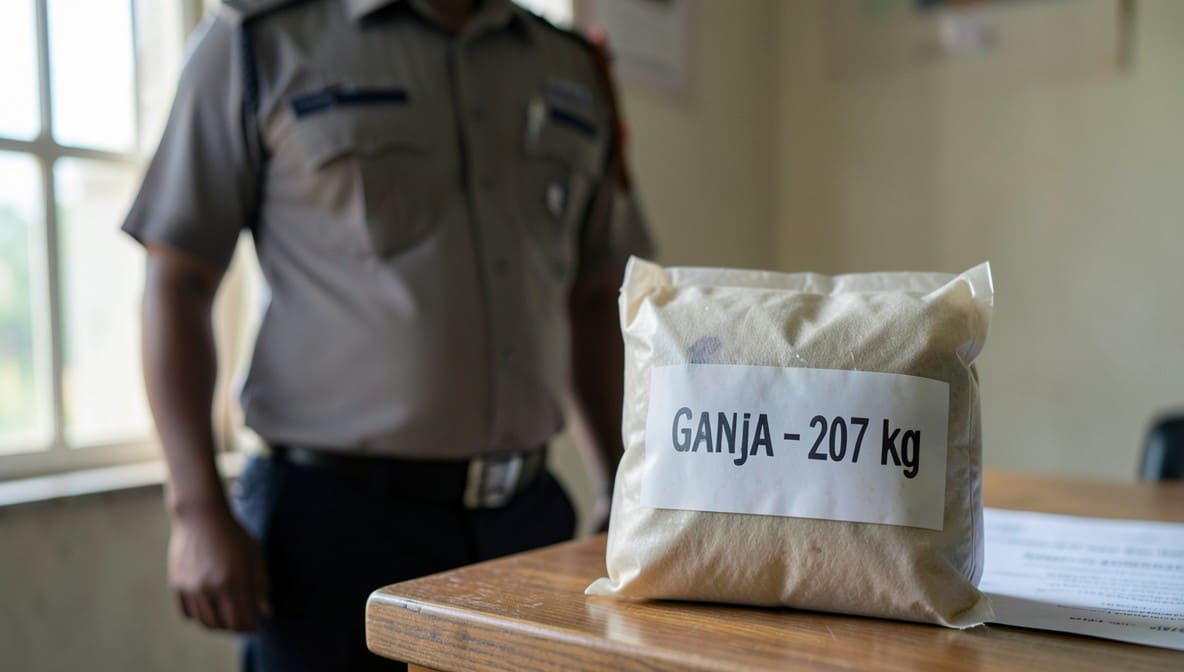
The Tripura High Court has reaffirmed that the constitutional mandate to inform an arrestee of the grounds of arrest is not a procedural formality but a fundamental safeguard under Article 22(1). In a case involving 207 kg of ganja, the Court granted bail not on the merits of the offence but due to the state’s failure to discharge its non-negotiable duty to communicate arrest grounds, rendering the detention illegal.
Background & Facts
The Dispute
The accused, Sri Raj Kumar Ray, was arrested on 14.07.2025 in connection with Mungiakami PS Case No. 2025 MGK 006, later reclassified as Special (NDPS) 61 of 2025 under Sections 22(b)(ii)(c) and 29 of the Narcotic Drugs and Psychotropic Substances Act, 1985. The arrest followed the seizure of 207 kg and 200 grams of ganja from a hidden chamber in a commercial vehicle bearing registration HR-39-D-0522, during a routine check at the 41 Mile Naka Point on National Highway-8 in Tripura. The driving license found in the vehicle was in the name of the accused.
Key Facts
- The accused was arrested on 14.07.2025 by SI Kasnarai Reang and other police personnel
- A total of 29 packets of suspected ganja were recovered
- The accused was produced before the Special Judge (NDPS), Khowai, on 15.07.2025 for police remand
- An arrest memo was prepared and submitted to the court
- A memorandum of grounds of arrest was prepared by the arresting officer but no acknowledgment of receipt by the accused was obtained
- The accused, through affidavit, stated that he was never informed of the grounds of his arrest
- No family member received a copy of the grounds of arrest
- The investigating officer forwarded the grounds of arrest to the Special Judge but did not prove delivery to the accused
Procedural History
- 14.07.2025: Arrest of Sri Raj Kumar Ray
- 15.07.2025: Production before Special Judge (NDPS), Khowai; application for police remand filed
- 17.03.2026: Bail petition filed before the High Court of Tripura
- 17.03.2026: Hearing conducted; arguments presented by both sides
- 17.03.2026: Judgment delivered
The Parties' Positions
For the Petitioner
The petitioner, through counsel Mr. Sankar Lodh, contended that the arresting officers failed to communicate the grounds of arrest to the accused at the time of arrest or thereafter, in violation of Article 22(1) of the Constitution and Section 47 of the Bharatiya Nagarik Suraksha Sanhita (BNSS). Reliance was placed on Pankaj Bansal v. Union of India (2024) 7 SCC 576, Prabir Purkayastha v. State (NCT of Delhi) (2024) 8 SCC 254, Kasireddy Upender Reddy v. State of Andhra Pradesh (2025 SCC OnLine SC 1228), Ahmed Mansoor v. State (2025 SCC OnLine SC 2650), and Mihir Rajesh Shah v. State of Maharashtra (2026) 1 SCC 500. It was argued that the absence of any signed acknowledgment or proof of delivery rendered the arrest and subsequent remand illegal.
For the Respondent
The Public Prosecutor, Mr. Raju Datta, submitted that the grounds of arrest were prepared and submitted to the Special Judge, and that the accused was aware of the charges since he participated in the remand proceedings. It was implied that the accused had constructive knowledge of the grounds, and that the failure to obtain a signature was a mere technical lapse.
Relief Sought
The petitioner sought bail on the ground that the arrest was illegal due to non-compliance with Article 22(1) and Section 47 BNSS, and that the accused’s detention was therefore unlawful.
The Legal Issue
The central question was whether the failure to communicate the grounds of arrest to the accused, despite preparation of a written document, constitutes a violation of Article 22(1) of the Constitution and Section 47 of the BNSS, rendering the arrest and detention illegal, even in cases involving large-scale narcotics trafficking.
Arguments Presented
For the Petitioner
The petitioner relied on multiple Supreme Court judgments to establish that the communication of grounds of arrest is a substantive right, not a formality. The Court in Mihir Rajesh Shah held that non-communication curtails personal liberty under Article 21 and renders the arrest illegal. The burden of proof lies on the state to demonstrate actual communication. The absence of any signature, receipt, or witness to delivery, coupled with the accused’s affidavit denying receipt, created an irrebuttable presumption of violation. The state’s failure to maintain a verifiable record of compliance was fatal to the legality of detention.
For the Respondent
The state contended that since the grounds of arrest were submitted to the Special Judge and the accused participated in the remand proceedings, he was aware of the charges. It was argued that technical non-compliance should not override the gravity of the offence involving 207 kg of ganja. The state did not produce any evidence - such as witness testimony, CCTV footage, or signed acknowledgment - to prove delivery.
The Court's Analysis
The Court examined the constitutional imperative under Article 22(1), which mandates that every arrested person shall be informed of the grounds of arrest as soon as may be. The Court emphasized that this is not a procedural formality but a foundational safeguard against arbitrary detention. The Court cited Vihaan Kumar v. State of Haryana (2025) 5 SCC 799, holding that when an arrestee alleges non-communication, the burden shifts to the state to prove compliance.
"The obligation to inform the grounds of arrest to the arrestee is thus, not just a mere procedural formality, instead it flows from the fundamental right of personal liberty which sets the further course for protection from the oppressive restrictions imposed upon the free movement in the society of an arrestee during remand."
The Court noted that while the arresting officer prepared the grounds of arrest and submitted them to the court, there was no proof that they were ever delivered to the accused. The absence of a signature, witness, or any corroborative evidence meant the state failed to discharge its burden. The Court rejected the argument that participation in remand proceedings equated to knowledge of grounds, stating that an accused may appear before a court without understanding the legal basis of detention.
The Court acknowledged the seriousness of the offence but held that the rule of law cannot be suspended for the sake of expediency. The Court observed:
"It is not a case that he was not aware of the settled principle of law about communication of grounds of arrest and that is why he has also prepared the same in a separate sheet but prima facie Court is constrained to observe that he has been negligent in either handing over the said grounds of arrest to the arrestee or has negligently missed to obtain his signature in the said document irresponsibly, regarding the arrest illegal."
The Court concluded that the arrest was illegal and the detention unlawful, irrespective of the quantity of contraband.
The Verdict
The bail petition was allowed. The accused, Sri Raj Kumar Ray, is granted bail on furnishing a personal bond of Rs. 2,00,000 with one surety of like amount, or Rs. 1,00,000 with two sureties of like amount, to the satisfaction of the Special Judge, Khowai. The conditions include: (a) sureties must be residents of Tripura; (b) the accused shall not leave the State without prior permission; (c) weekly attendance before the Special Judge; (d) no contact or influence on witnesses; (e) regular court attendance; and (f) submission of residential address and mobile number to the court and investigating officer. The order is to be communicated immediately to the Special Judge and the Director General of Police for taking note of the arresting officer’s negligence.
What This Means For Similar Cases
Grounds of Arrest Must Be Proven, Not Assumed
- Practitioners must now insist on production of signed acknowledgment or verifiable proof of delivery in all arrest cases
- Merely submitting grounds to the court is insufficient; actual communication to the accused is mandatory
- In NDPS and other serious offence cases, the state’s failure to comply with Article 22(1) cannot be excused by the gravity of the crime
Burden of Proof Rests Entirely on the State
- The accused need only allege non-communication; the burden shifts to the police to prove delivery
- Affidavits from the accused denying receipt, if uncontradicted, will be accepted as prima facie evidence of violation
- Police must maintain a contemporaneous record - signed receipts, video footage, or witness statements - to establish compliance
Procedural Compliance Is Non-Negotiable in Drug Cases
- This judgment closes the loophole that allowed police to treat procedural safeguards as optional in high-value narcotics cases
- Courts will no longer tolerate negligence in arrest procedures, even when the evidence against the accused is overwhelming
- This ruling reinforces that Article 21 and Article 22 are not suspended during anti-narcotics operations
Implications for Remand Applications
- Any remand application based on an illegal arrest is vulnerable to challenge
- Defence counsel should routinely file applications under Section 47 BNSS to demand proof of ground communication
- Courts must now scrutinize arrest records for compliance before granting remand