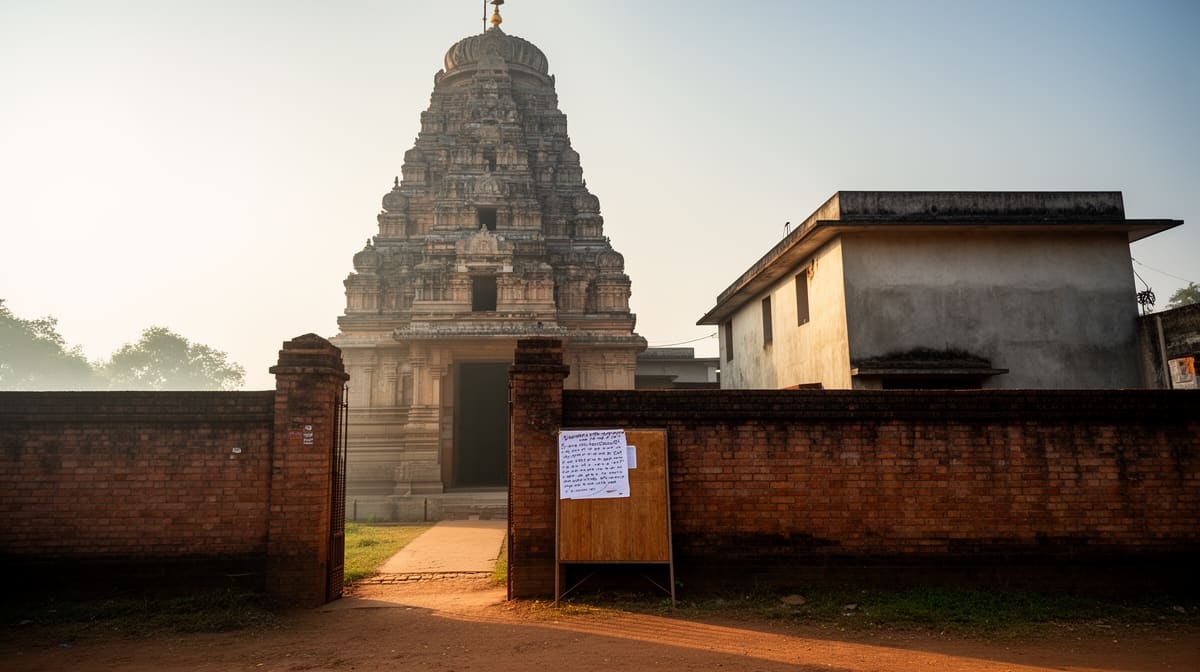
The Madras High Court has reaffirmed that even religious institutions acting as landlords must adhere to principles of natural justice when fixing rent on temple property. The judgment underscores that procedural fairness is non-negotiable, regardless of the owner’s religious character, and sets a binding standard for rent determination under the HR&CE Act.
Background & Facts
The Dispute
The petitioner, G. Rajan, became the tenant of a property owned by the Arulmighu Vedhagireeswarar Thirukkoil temple in Thirukkazhukkundram after the original tenant, Krishna Naicker, died leaving an unpaid debt. The petitioner assumed tenancy following a formal name transfer approved by the Joint Commissioner in 2008. Subsequently, with permission from the same authority, the petitioner constructed a superstructure on the land using personal funds. Years later, in 2021, the temple’s Executive Officer issued a demand notice fixing retrospective rent at Rs. 2,19,180 for the period 2016 - 2021 without providing the petitioner any opportunity to be heard or applying the HR&CE Department’s own 2009 guidelines.
Procedural History
- 2008: Petitioner’s name was officially transferred as tenant by the Joint Commissioner
- 2008: Permission granted to construct superstructure on the property
- 2021: Third respondent issued impugned demand notice fixing rent retrospectively without hearing
- 2022: Writ petition filed under Article 226 challenging the notice as arbitrary and illegal
Relief Sought
The petitioner sought quashing of the demand notice and a direction to the temple authorities to re-fix fair rent in accordance with the HR&CE Department’s Na.Ka.No.40651/2008/M3 guidelines issued on 02.02.2009, which mandate procedural fairness and transparent methodology.
The Legal Issue
The central question was whether a religious institution, acting as a landlord under the HR&CE Act, can unilaterally impose retrospective rent without affording the tenant an opportunity to be heard or applying the department’s own statutory guidelines.
Arguments Presented
For the Petitioner
The petitioner’s counsel argued that the demand notice violated natural justice and procedural fairness, as no hearing was granted prior to fixation. Reliance was placed on the HR&CE Department’s 2009 guidelines, which explicitly require a fair and transparent process for rent determination. The petitioner also emphasized that the superstructure was built at his own cost, and the retrospective demand ignored this material fact.
For the Respondent
The State Government Pleader conceded that the petitioner had paid no rent since 2016 and acknowledged the outstanding amount of Rs. 3,75,920. However, the respondents did not contest the procedural irregularity. Instead, they proposed a settlement: fixed monthly rent of Rs. 6,360, 15% escalation every three years, and execution of a gift deed for the superstructure.
The Court's Analysis
The Court examined the nature of the HR&CE Department’s regulatory role over temple properties and found that while temples are religious entities, their function as landlords is governed by statutory frameworks. The 2009 guidelines issued by the Department were not mere recommendations but binding procedural norms. The Court held that failure to follow these guidelines renders any rent fixation arbitrary and violative of Article 14.
"The right to be heard is not a privilege but a constitutional imperative, even when the landlord is a temple. The petitioner had invested substantial funds in construction; the retrospective demand without notice or opportunity to explain was legally unsustainable."
The Court further noted that the respondents had not produced any evidence of prior notice, assessment, or application of the prescribed formula under the guidelines. The absence of such documentation confirmed the procedural illegality. The Court declined to merely quash the notice, recognizing the need for finality and practical resolution, and instead opted to fix a fair rent prospectively while directing compliance with due process going forward.
The Verdict
The petitioner prevailed. The Court held that fair rent fixation by temple authorities must follow statutory guidelines and afford due process. It fixed the monthly rent at Rs. 6,360, permitted 15% escalation every three years, directed execution of a gift deed for the superstructure, and mandated recognition of the petitioner as tenant upon compliance.
What This Means For Similar Cases
Due Process Is Mandatory Even for Religious Landlords
- Practitioners must challenge unilateral rent hikes by temple or charitable trusts if no hearing was granted
- The 2009 HR&CE guidelines are binding; non-compliance invalidates rent notices
- Courts will not tolerate retrospective demands without procedural safeguards
Constructive Improvements Cannot Be Ignored in Rent Fixation
- Tenants who invest in superstructures have a legitimate claim to recognition and fair assessment
- Rent calculations must account for improvements made with permission and at tenant’s cost
- Gift deeds may be required, but only after fair rent is established and tenant’s rights acknowledged
Settlements Must Not Preempt Legal Rights
- While the Court facilitated a settlement, it did so only after affirming the illegality of the original notice
- Practitioners should not accept settlements that waive challenges to procedural violations unless the violation is formally acknowledged
- This case sets a precedent: procedural flaws cannot be cured by subsequent compromise alone