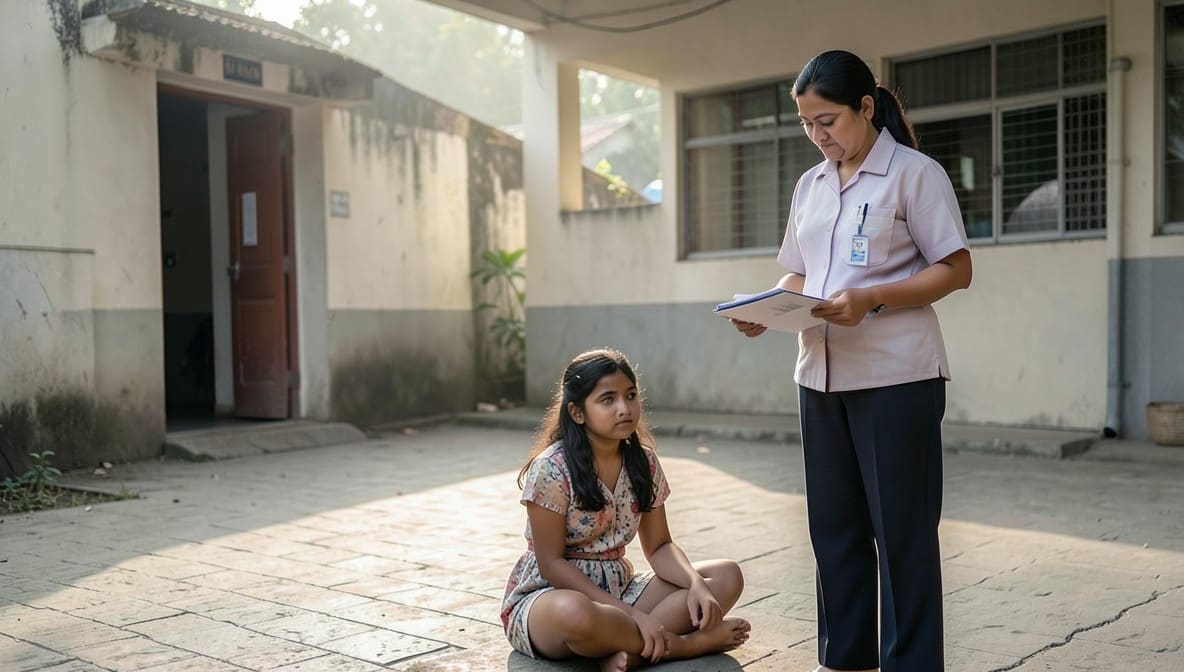
The Madurai Bench of the Madras High Court has reaffirmed that the welfare of a minor child supersedes familial claims in cases involving alleged sexual abuse. In a habeas corpus petition filed by a mother seeking custody of her 16-year-old daughter, the Court intervened not merely to secure the child’s physical presence, but to protect her from a toxic and abusive household environment.
Background & Facts
The Dispute
The petitioner, the mother of Ponselvi, a 16-year-old girl, filed a habeas corpus petition under Article 226 of the Constitution seeking the production of her daughter before the Court. The petitioner alleged that her daughter had been compelled into a marriage with Paulraj, the brother of her second husband, Vanniraj. The petitioner claimed that Paulraj had coerced the minor into the relationship and that both Paulraj and Vanniraj had subjected her to sexual harassment.
Key Facts
- The petitioner’s husband passed away prior to her remarriage to Vanniraj
- Paulraj is the brother of Vanniraj, making him the minor’s step-uncle
- A complaint was lodged with the 2nd respondent police station on 09.02.2026 under Crime No. 159/2026, invoking Sections 296(b), 115(2), 74, and 351 of the Bharatiya Nyaya Sanhita (BNS) and Section 4 of the Tamil Nadu Prohibition of Harassment of Women Act
- The minor disclosed to the Court that she had reported the abuse to her mother, who advised her to "adjust"
- The minor stated she was in love with Paulraj, despite the relationship being legally and socially prohibited
- Both Paulraj and Vanniraj were alleged to have sexually harassed the minor
Procedural History
- 09.02.2026: Complaint registered at Thalamuthunagar Police Station under Crime No. 159/2026
- 07.05.2026: Habeas Corpus Petition (H.C.P.(MD) No. 600 of 2026) filed before the Madurai Bench of the Madras High Court
- 07.05.2026: Detainee produced before the Court during hearing
Relief Sought
The petitioner sought the production of her daughter before the Court and her custody, asserting her rights as the biological mother.
The Legal Issue
The central question was whether the welfare of a minor child in a context of alleged sexual abuse and familial coercion overrides the parental claim to custody under a habeas corpus petition.
Arguments Presented
For the Petitioner
The petitioner argued that as the biological mother, she had the legal right to custody of her daughter and that the child’s presence with Paulraj was unlawful. She contended that the police had failed to act on her complaint and that the Court must intervene to restore the child to her lawful guardian.
For the Respondent
The State, through the Additional Public Prosecutor, did not oppose the petition but acknowledged the gravity of the allegations. The police had not yet registered a case under the POCSO Act and had not conducted a medical examination, despite the minor’s disclosures.
The Court's Analysis
The Court examined the minor’s statement, which revealed a complex dynamic of emotional manipulation, familial pressure, and alleged sexual misconduct by two adult male relatives. The Court noted that while the minor expressed affection for Paulraj, this did not negate the existence of abuse or the legal prohibition against such relationships. The Court emphasized that the best interest of the child is the paramount consideration under Section 1(3) of the Juvenile Justice (Care and Protection of Children) Act, 2015, and under Article 21 of the Constitution.
"If the detenue is sent along with her mother, it is against the interest and welfare of the detenue."
The Court rejected the notion that parental authority, even when exercised by a biological mother, can override the child’s safety when the home environment is implicated in abuse. The Court further observed that the failure of the police to register a case under the POCSO Act, despite clear indicators of sexual abuse involving a minor, constituted a dereliction of statutory duty.
The Court also underscored the necessity of a medical examination to document evidence of abuse, which is critical for future prosecution and child protection proceedings.
The Verdict
The petition was disposed of with the following directions:
- The detenue, Ponselvi, shall be kept in the Muthukuviyal Home for Children, 176, Muthumalai Building, Maninagar 2nd Street, Tuticorin 628003
- The police shall register a case against Paulraj and Vanniraj under the Protection of Children from Sexual Offences (POCSO) Act, 2012
- The police shall produce the minor before a medical board for forensic examination
- Upon completion of the medical report, the minor shall be returned to the custody of the State for further care and placement
- No monetary relief or custody award was granted to the petitioner
What This Means For Similar Cases
Child Welfare Trumps Parental Rights in Abuse Cases
- Practitioners must argue that parental custody claims cannot be upheld if the home environment is linked to sexual abuse, even if the child expresses emotional attachment to the abuser
- Courts will prioritize institutional protection over familial reunification when abuse is substantiated
Police Must Proactively Register POCSO Cases
- Merely receiving a complaint is insufficient; police are under a mandatory duty to register POCSO cases when a minor discloses sexual abuse, regardless of familial relationships
- Failure to do so may attract contempt proceedings or departmental action
Medical Examination Is Non-Negotiable
- In all minor abuse cases, a forensic medical examination must be ordered as a matter of course
- Delay in medical evaluation may compromise evidentiary value and violate the child’s right to justice under Section 16 of the POCSO Act