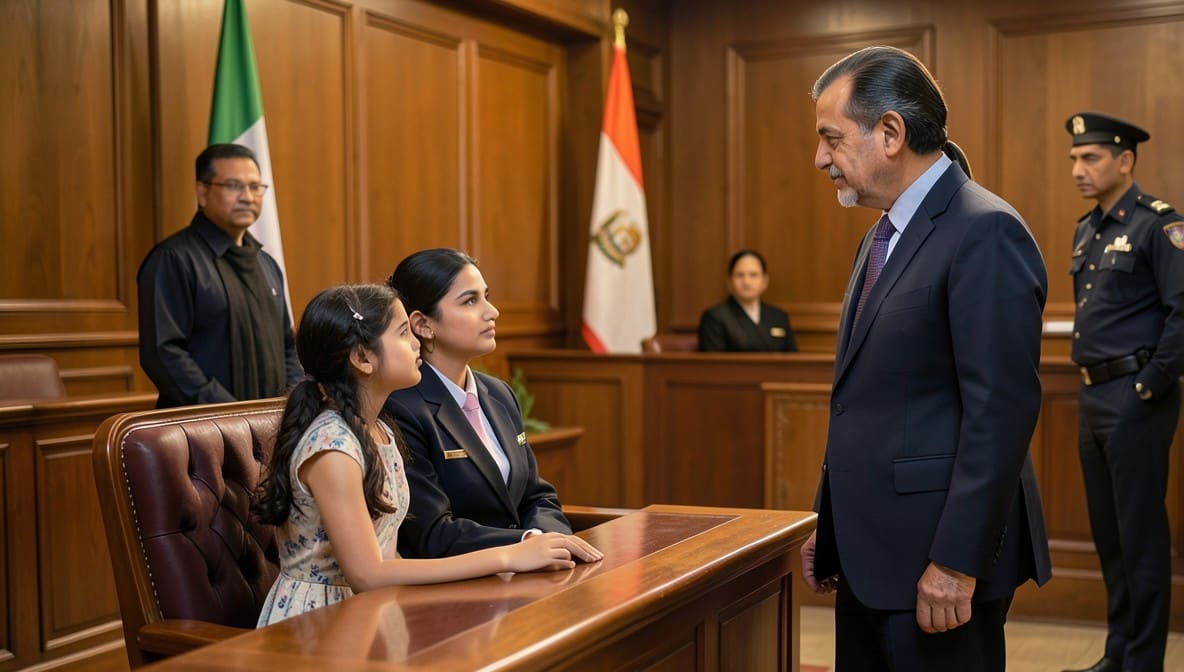
The Madras High Court closed a habeas corpus petition after the 17-year-old detenue herself affirmed her voluntary desire to return to her parents and continue her education, reinforcing that the liberty of a minor cannot be overridden by parental claims absent evidence of coercion. The judgment underscores the primacy of the minor’s expressed will in custody disputes under Article 226.
Background & Facts
The Dispute
The petitioner, Karuppasamy, filed a writ petition under Article 226 of the Constitution seeking the production of his daughter, Kayalvizhi, aged approximately 17 years, who had gone missing while pursuing her first-year B.Tech at M.A.M. College, Tiruchirappalli. The petitioner alleged that the 3rd and 4th respondents, Mariappan and Rajalakshmi, had illegally detained her. The 1st and 2nd respondents, the Superintendent of Police and the Inspector of Police, were named for their failure to locate and produce the detenue.
Key Facts
- Kayalvizhi was enrolled in her first year of B.Tech at M.A.M. College, Tiruchirappalli
- She went missing from the college premises without prior notice to her parents
- The petitioner filed the habeas corpus petition on an unspecified date prior to 07.05.2026
- The police, acting on the petition, located and produced Kayalvizhi before the Court on 07.05.2026
- Both parents were present in court during the hearing
Procedural History
- Date of disappearance: Unspecified, but occurred during academic term at M.A.M. College
- Date of petition filing: Prior to 07.05.2026
- 07.05.2026: Habeas Corpus Petition heard before the Madurai Bench of the Madras High Court
- 07.05.2026: Detenue produced before the Court by the 2nd respondent (Inspector of Police)
- 07.05.2026: Court recorded the personal statement of Kayalvizhi in open court
The Parties' Positions
- Petitioner (Father): Alleged unlawful detention by the 3rd and 4th respondents and sought production of his daughter under Article 226
- Respondents 1 & 2 (Police): Responded by locating and producing the detenue before the Court, demonstrating compliance
- Respondents 3 & 4 (Mariappan and Rajalakshmi): Not present in court; no formal defense recorded
- Detenue (Kayalvizhi): Expressed her own意愿 to return to her parents and continue her education
Relief Sought
The petitioner sought a writ of habeas corpus directing the respondents to produce Kayalvizhi before the Court and ensure her safe return to parental custody.
The Legal Issue
The central question was whether a writ of habeas corpus must be granted when a minor, capable of forming an independent will, expresses a voluntary desire to return to her parents, even in the absence of evidence of unlawful detention by third parties.
Arguments Presented
For the Petitioner
The petitioner contended that the disappearance of his daughter constituted unlawful detention, invoking the state’s duty under Article 226 to protect personal liberty. He argued that the failure of the police to locate her earlier amounted to dereliction of duty and that the Court must intervene to restore her to lawful custody.
For the Respondent/State
The Additional Public Prosecutor for the 1st and 2nd respondents submitted that the police had acted promptly upon the petition, located the detenue, and produced her before the Court. No evidence of coercion or illegal confinement was presented, and the state’s obligation under habeas corpus was fulfilled by production.
The Court's Analysis
The Court emphasized that the purpose of a writ of habeas corpus is to ascertain the legality of detention and to secure the release of a person if unlawfully confined. Here, the detenue was not found in unlawful custody but was voluntarily present with third parties, and her presence before the Court was secured by the police.
"She expressed her willingness to go along with her parents and also to pursue her studies."
The Court held that the detenue, aged 17, was sufficiently mature to express a reasoned and voluntary choice. The law does not compel a minor to be returned to parental custody against her will, nor does it presume that any separation from parents constitutes unlawful detention. The absence of any allegation or evidence of force, fraud, or coercion negated the basis for a continuing writ.
The Court further noted that the state’s duty under Article 226 is satisfied once the person is produced and their wishes are ascertained. There was no legal basis to continue the proceeding or to impose liability on the third respondents without evidence.
The Verdict
The petition was closed. The Court directed the 2nd respondent, the Inspector of Police, Siruganur Police Station, to inform the management of M.A.M. College, Tiruchirappalli, not to permit any person other than the parents to contact Kayalvizhi. No further orders were issued against the 3rd and 4th respondents. The detenue was permitted to return to her parents and resume her studies.
What This Means For Similar Cases
Minor’s Voluntary Will Is Decisive
- Practitioners must now prioritize the expressed wishes of minors aged 16 - 18 in habeas corpus matters, even when parents allege unlawful detention
- Absent evidence of coercion, abduction, or trafficking, courts will not presume illegality merely due to separation from parents
- The burden shifts to petitioners to prove unlawful confinement, not merely absence from home
Police Compliance Satisfies Habeas Corpus Obligation
- Production of the detenue before the Court, even if initiated after petition filing, fulfills the state’s duty under Article 226
- Courts will not entertain prolonged proceedings once the minor’s voluntary statement is recorded
- Police need not investigate third parties unless prima facie evidence of criminality is presented
Educational Institutions Must Respect Custody Boundaries
- Schools and colleges may be directed to restrict contact with non-parental third parties if the minor’s safety or autonomy is at stake
- Such directions are preventive, not punitive, and must be narrowly tailored to the minor’s expressed wishes