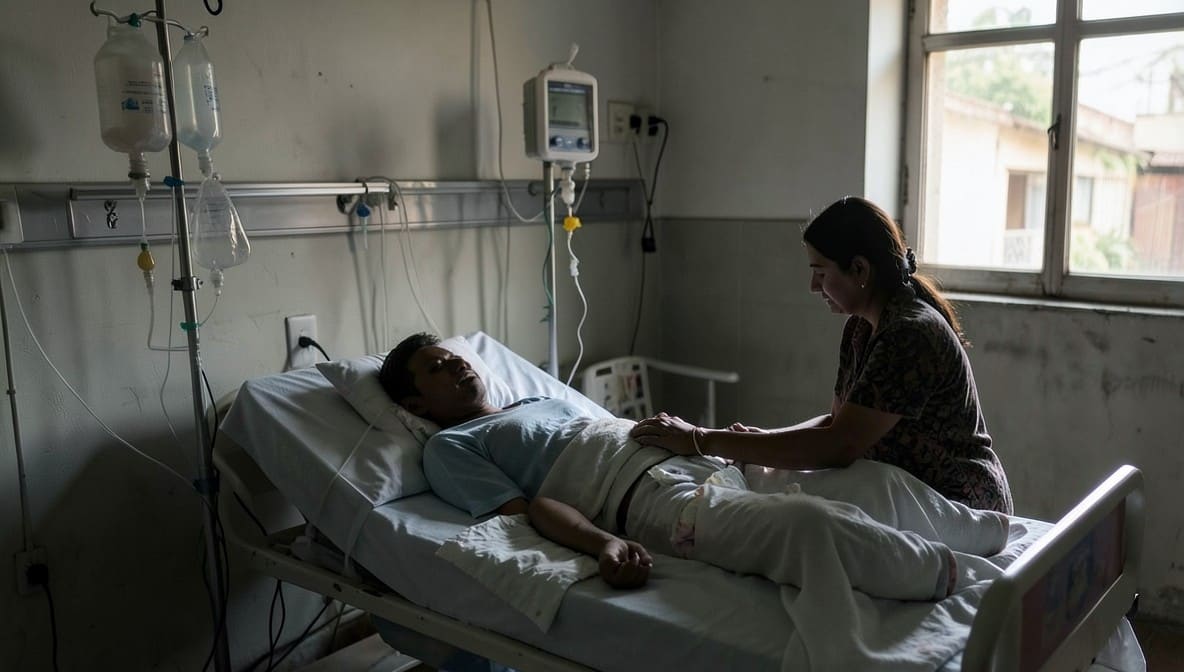
In a significant ruling on motor accident compensation, the Bombay High Court has enhanced the compensation awarded to a minor victim by applying the Supreme Court's guidelines on future prospects. The judgment underscores the need to account for a minor's lost earning potential and pain and suffering, setting a precedent for similar claims under the Motor Vehicles Act, 1988.
Background & Facts
The Accident
The appellant, Master Mohd. Javed Mohd. Salim Shaikh, was a 4-year-old minor at the time of the accident. While walking by the roadside in Dharavi, Mumbai, he was struck by a motor dumper, resulting in a fracture of the left leg below the knee and a head injury. The medical evidence, including testimony from Dr. Naresh Khanna, established that the minor suffered a permanent disability of 36%.
Procedural History
- Date of Accident: Not specified, but the minor was 4 years old at the time
- 2 February 2013: The Motor Accident Claims Tribunal awarded compensation of Rs. 52,500 along with interest
- Post-2013: The appellant, through his guardian, filed First Appeal No. 937 of 2016 before the Bombay High Court challenging the adequacy of the compensation
- 8 August 2025: The Supreme Court decided Hitesh Nagjibhai Patel vs. Bababhai Nagjibhai Rabari & Anr. (Civil Appeal No. 10278 of 2025), laying down guidelines for computing compensation in cases involving minors
- 5 May 2026: The Bombay High Court delivered the present judgment, applying the Supreme Court's guidelines
Relief Sought
The appellant sought enhancement of the compensation awarded by the Tribunal, relying on the principles laid down in Hitesh Nagjibhai Patel to account for future prospects, medical expenses, and pain and suffering.
The Legal Issue
The central question was whether the compensation awarded to a minor victim under the Motor Vehicles Act, 1988 should include future prospects and other heads of compensation, such as pain and suffering, loss of amenities, and loss of marriage prospects, as laid down by the Supreme Court in Hitesh Nagjibhai Patel.
Arguments Presented
For the Appellant
The appellant's counsel, Mr. T. J. Mendon, argued that the Tribunal's award was inadequate and failed to account for the minor's future prospects and other non-pecuniary damages. Relying on the Supreme Court's judgment in Hitesh Nagjibhai Patel, the appellant contended that the compensation should be recalculated to include:
- Notional income for a minor, with an addition for future prospects
- Medical expenses (past and future)
- Special diet and conveyance costs
- Loss of amenities and pain and suffering
- Loss of marriage prospects
For the Respondent
The counsel for the respondents, Ms. Poonam Mittal, representing Respondent No. 2 (likely the insurance company), opposed the enhancement of compensation. The respondent argued that the Tribunal's award was just and reasonable, and that the Supreme Court's guidelines in Hitesh Nagjibhai Patel should not be applied retrospectively or mechanically.
The Court's Analysis
The Bombay High Court, relying on the Supreme Court's judgment in Hitesh Nagjibhai Patel vs. Bababhai Nagjibhai Rabari & Anr., held that the compensation awarded to minor victims must account for future prospects and other heads of damages. The Court observed that the Supreme Court had laid down detailed guidelines for computing compensation in such cases, which were directly applicable to the facts of the present appeal.
The Court recalculated the compensation as follows:
"Applying the said parameters laid down by the Hon'ble Supreme Court, the compensation is worked out as under:"
The Court adopted a notional income of Rs. 3,000 per month for the minor, which was annualized to Rs. 36,000. To this, the Court added 40% for future prospects, resulting in a total of Rs. 50,400 per annum. Using a multiplier of 18 (as prescribed for minors) and applying a 30% disability factor, the Court arrived at a base compensation of Rs. 2,72,160 for loss of future earnings.
Additionally, the Court awarded the following heads of compensation:
- Medical Expenses: Rs. 5,500
- Future Medical Expenses: Rs. 5,000
- Special Diet: Rs. 10,000
- Conveyance: Rs. 25,000
- Loss of Amenities: Rs. 25,000
- Pain and Suffering: Rs. 1,00,000
- Loss of Marriage Prospects: Rs. 1,00,000
The total compensation thus computed was Rs. 5,42,660. After deducting the Tribunal's award of Rs. 52,500, the enhanced compensation payable to the appellant was Rs. 4,90,166.
The Court directed the insurance company to deposit the differential amount within twelve weeks from the date of the judgment, while allowing the claimant to withdraw the original and enhanced compensation. The rate of interest awarded by the Tribunal was not disturbed.
The Verdict
The Bombay High Court allowed the appeal in part, enhancing the compensation awarded to the minor victim from Rs. 52,500 to Rs. 5,42,660. The insurance company was directed to pay the differential amount of Rs. 4,90,166 within twelve weeks, with the original interest rate remaining unchanged. The appellant was permitted to withdraw the enhanced compensation.
What This Means For Similar Cases
Future Prospects Must Be Accounted For
This judgment reinforces the principle that compensation for minor victims must include future prospects, even when the victim has no actual income at the time of the accident. Practitioners should:
- Argue for a notional income (e.g., Rs. 3,000 per month) for minors, with an addition for future prospects (e.g., 40%)
- Use the multiplier method prescribed by the Supreme Court, applying age-appropriate multipliers (e.g., 18 for minors)
- Ensure that disability percentages are factored into the compensation calculation
Non-Pecuniary Damages Are Compensable
The Court's award of compensation for pain and suffering, loss of amenities, and loss of marriage prospects highlights that:
- Pain and suffering (Rs. 1,00,000) and loss of marriage prospects (Rs. 1,00,000) are significant heads of compensation for minors
- Medical expenses (both past and future), special diet, and conveyance costs must be pleaded and proved
- Loss of amenities (Rs. 25,000) is a distinct head of compensation, separate from pain and suffering
Compliance Timelines Are Strict
- Insurance companies must deposit enhanced compensation within twelve weeks of the judgment
- Failure to comply may result in contempt proceedings or additional interest
- Claimants should ensure timely withdrawal of compensation to avoid procedural delays
Practitioners handling similar cases should rely on the Supreme Court's guidelines in Hitesh Nagjibhai Patel and ensure that all heads of compensation are adequately pleaded and proved.