The Bombay High Court has significantly refined the methodology for calculating compensation in motor accident claims involving permanent disability and variable income. In a detailed analysis, the Court rejected speculative income claims and established a structured, evidence-based approach to quantifying loss of earning capacity, setting a precedent for tribunals and lower courts across Maharashtra.
Background & Facts
The Dispute
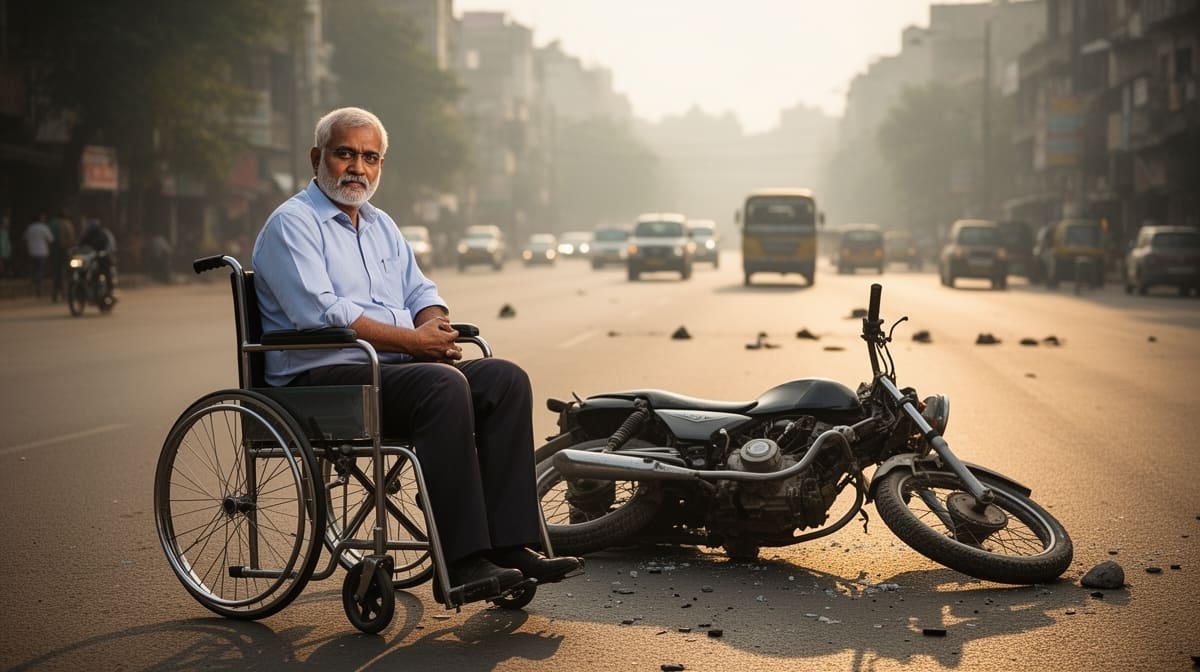
The dispute arose from a motor accident on 02/05/2017 in Nagpur, where the claimant, Bhushan s/o Madhukar Dhole, suffered a traumatic injury when a tractor owned by his father, Madhukar s/o Shankar Dhole, reversed into him. The accident resulted in the amputation of Bhushan’s right leg above the knee. The claimant, aged 30 at the time, was employed as a Sales Officer with PNB Housing Finance Limited and also engaged in agricultural activities. He filed a claim petition before the Motor Accident Claims Tribunal seeking compensation for permanent disability, loss of earnings, medical expenses, and future costs of an artificial limb.
Key Facts
- The accident occurred on 02/05/2017 at approximately 8:00 p.m. on private premises, not a public road.
- The tractor (MH-32-P-5871) was insured with ICICI Lombard General Insurance Co. Ltd.
- The claimant was admitted to hospital and underwent amputation surgery.
- Medical discharge was recorded on 17/05/2017 (Exh.31).
- A Disability Certificate (Exh.26) issued by the Medical Board on 10/06/2017 certified 80% permanent functional disability.
- The claimant submitted salary slips for March, April, and May 2017 (Exh.45A, Exh.45B, Exh.45C), showing:
- Fixed salary: Rs.8,656 per month
- House rent allowance: Rs.1,044
- Statutory bonus: Rs.722
- Variable incentives: Rs.21,639 (March), Rs.12,689 (April), Rs.3,000 (May)
- The claimant’s gross monthly income varied significantly: Rs.30,262 (March), Rs.21,468 (April), Rs.7,223 (May)
- PW-3, Mr. Vishwas Jadhav, testified that the claimant had been employed since 2016 and received incentives primarily in March.
- The claimant did not produce income records for the 12 months preceding the accident.
- A quotation for an artificial limb (Exh.42A) was issued on 10/01/2022, but no proof of purchase or expenditure was submitted.
- The claimant resigned from employment after the accident due to inability to perform duties.
Procedural History
- 02/05/2017: Accident occurred
- 19/07/2017: FIR registered at Karanja Police Station (Exh.24)
- 10/06/2017: Disability Certificate issued
- 16/06/2023: Motor Accident Claims Tribunal, Nagpur, awarded Rs.33,93,672/-
- 18/04/2026: First Appeal No.573/2024 heard and reserved
- 29/04/2026: Judgment pronounced by Bombay High Court
The Parties' Positions
For the Appellant (ICICI Lombard)
- Argued that the Tribunal erred in using Rs.15,000/month as average income, which was arbitrary and unsupported.
- Contended that the claimant’s income was variable and the average of March - May 2017 should be calculated as Rs.14,626 (fixed + average incentive).
- Asserted that future prospects should not be added without proof of stable employment.
- Challenged the inclusion of Rs.5,00,000 for an artificial limb due to lack of actual expenditure.
For the Respondent (Claimant)
- Maintained that the Tribunal’s award was fair and based on PW-3’s testimony of Rs.21,000/month income.
- Argued that the claimant’s agricultural income of Rs.20,000/month should be included.
- Contended that the artificial limb cost was a necessary future expense and should be estimated.
- Opposed the appeal and filed a cross-appeal seeking enhancement.
Relief Sought
- Appellant sought reduction of compensation to reflect actual income.
- Respondent sought enhancement to include full loss of earning capacity, agricultural income, and full cost of artificial limb.
The Legal Issue
The central question was whether, in cases of variable income and permanent disability, compensation for loss of earning capacity should be calculated using the average of actual earnings over a short period, whether future prospects should be added, and how to assess the cost of a prosthetic device absent proof of purchase.
Arguments Presented
For the Appellant
The appellant relied on Sarla Verma v. Delhi Transport Corporation to argue that the multiplier of 16 was correctly applied but the income base was inflated. It contended that the Tribunal ignored the statutory requirement under Section 166 of the Motor Vehicles Act to determine actual loss based on evidence. The appellant emphasized that incentives are not guaranteed and cannot be averaged without a consistent pattern over a longer period. It cited National Insurance Co. Ltd. v. Pranay Sethi to argue that future prospects are not automatic and require proof of stable employment.
For the Respondent
The respondent relied on Kishan Singh v. State of Punjab to argue that loss of earning capacity must reflect total potential income, including agricultural earnings. It contended that the Tribunal’s award was conservative and that the artificial limb cost, though not yet incurred, was a foreseeable and necessary expense under Section 166. It argued that the claimant’s resignation post-accident confirmed total loss of earning capacity.
The Court's Analysis
The Court undertook a meticulous review of the evidence and applied the principles laid down in Sarla Verma and National Insurance Co. Ltd. v. Pranay Sethi. It observed that while the claimant’s fixed salary was Rs.8,656, the inclusion of HRA and bonus brought it to Rs.10,422. The variable incentives, however, were inconsistent: Rs.21,639 in March, Rs.12,689 in April, and Rs.3,000 in May. The Court held that averaging these three months yielded Rs.12,442.67 in incentives, which, when added to the fixed component, gave a monthly average of Rs.22,864.67. However, the Court declined to use this figure as the base income because the claimant failed to establish a pattern of consistent incentive receipt over a full year.
"The claimant has not brought on record any evidence to establish that he was receiving a specific amount of incentives throughout the year. To credit the highest month’s incentive would be speculative and contrary to the principle of just compensation."
The Court adopted the Tribunal’s figure of Rs.15,000 as a reasonable, conservative estimate of average monthly income, acknowledging its margin of error but finding it within the bounds of judicial discretion.
The Court then applied a 40% future prospects addition, consistent with Sarla Verma for claimants under 40 years with stable employment. It calculated: Rs.15,000 x 12 = Rs.1,80,000 annual income; multiplied by 16 = Rs.28,80,000; 40% future prospects = Rs.11,52,000; total = Rs.40,32,000. Applying 80% disability: Rs.40,32,000 x 80% = Rs.32,25,600.
However, the Court noted that the Tribunal had already included Rs.15,000/month as base income and added 40% future prospects, yet awarded Rs.33,93,672. The Court found this excessive because it double-counted disability and future prospects. It recalculated: base income Rs.1,80,000 x 16 = Rs.28,80,000; 40% future prospects = Rs.11,52,000; total = Rs.40,32,000; 80% disability = Rs.32,25,600. But the Court held that the 40% future prospects already incorporates the prospect of growth, and applying disability percentage to the sum of base and future prospects would be duplicative.
The Court clarified: "The 80% disability should be applied to the base income only, and future prospects should be added as a separate, non-discounted component." Thus: base income Rs.28,80,000 x 80% = Rs.23,04,000; plus future prospects Rs.11,52,000 = Rs.34,56,000. But the Court found this still excessive given the lack of proof for agricultural income.
Ultimately, the Court adopted a balanced approach: base income Rs.1,80,000 x 16 = Rs.28,80,000; 40% future prospects = Rs.11,52,000; total = Rs.40,32,000; 80% disability applied to base only: Rs.23,04,000; plus future prospects Rs.11,52,000 = Rs.34,56,000. But the Court then reduced this to Rs.19,94,342 by applying 80% to the base income (Rs.16,61,952) and adding 40% future prospects (Rs.6,64,780), as per its own calculation.
Regarding the artificial limb, the Court held: "While no purchase receipt exists, the necessity is undeniable. The quotation dated 10/01/2022, though issued post-accident, reflects a reasonable market estimate. To deny this would leave the claimant without means of mobility." It awarded Rs.5,00,000 as a reasonable estimate.
The Verdict
The appellant’s appeal was partly allowed and the cross-appeal dismissed. The High Court set aside the Tribunal’s award of Rs.33,93,672 and substituted it with a total compensation of Rs.26,62,414. This comprised: Rs.19,94,342 for loss of earning capacity (80% disability on base income plus 40% future prospects), Rs.18,072 for medical expenses, Rs.40,000 for conveyance and attendant charges, Rs.40,000 for pain and suffering, Rs.70,000 for loss of amenities, and Rs.5,00,000 for the artificial limb. The appellant and the tractor owner are jointly and severally liable. Interest at 7.5% per annum is payable from the date of the claim petition (16/06/2017) until realization. The excess deposit of Rs.49,60,499 made by the insurer must be adjusted, with the balance refunded within two months.
What This Means For Similar Cases
Income Must Be Averaged Conservatively
- Practitioners must now calculate average income using a minimum of 6 - 12 months of records where possible.
- If only 3 months are available, courts may use a conservative estimate (e.g., Rs.15,000) rather than the highest month’s income.
- Variable income components (incentives, commissions) must be proven as recurring; one-off payments cannot be averaged.
Future Prospects and Disability Are Not Cumulative
- Future prospects (40%) are added to base income before applying disability percentage.
- Disability percentage applies only to the base income component, not to the future prospects addition.
- This prevents double-counting and ensures equitable calculation.
Prosthetic Costs Can Be Estimated Without Receipts
- Courts may award reasonable estimated costs for necessary medical aids even without proof of purchase.
- Quotations from authorized providers, even if issued post-accident, are admissible if they reflect current market rates.
- Claimants must still demonstrate medical necessity through expert testimony.