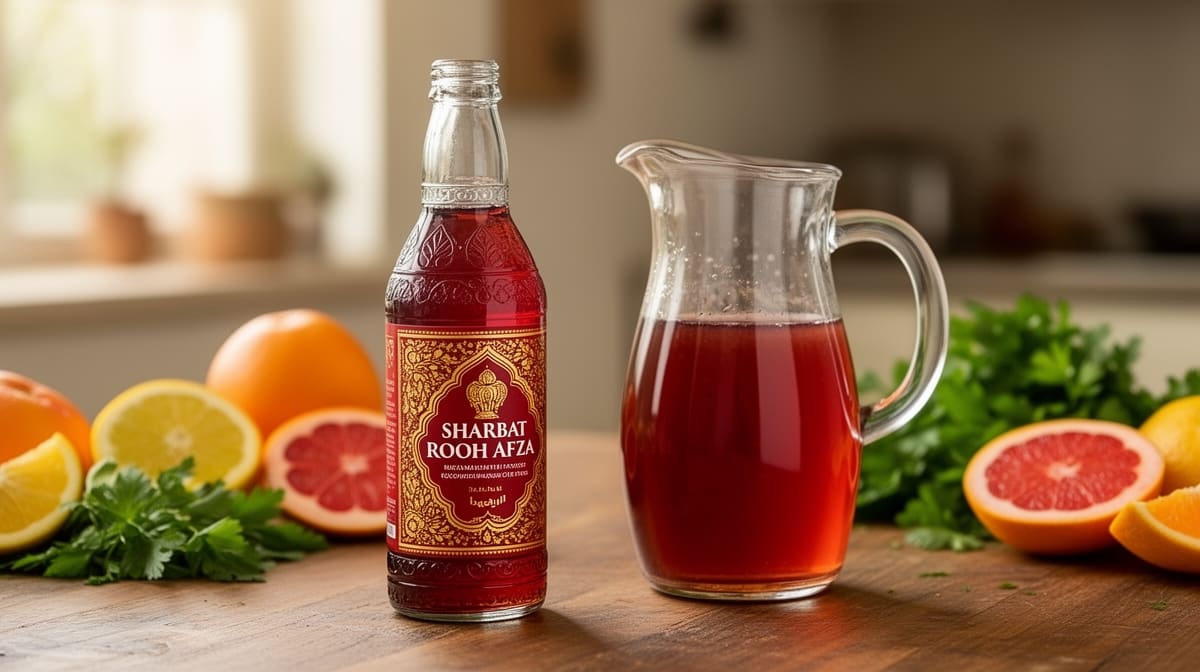
The Supreme Court has clarified that a product containing 10% fruit juice and marketed as a traditional sharbat cannot be classified under a residuary tax entry merely due to regulatory labelling or sugar content. The judgment reasserts that fiscal classification must follow commercial understanding and statutory inclusivity, not technical or licensing definitions.
Background & Facts
The Dispute
The dispute centres on the classification of "Sharbat Rooh Afza", a non-alcoholic sweetened beverage manufactured by M/s Hamdard (Wakf) Laboratories. The product contains 8% pineapple juice, 2% orange juice, 80% invert sugar syrup, and herbal distillates. The appellant paid VAT at 4% under Entry 103 of Schedule II, Part A of the Uttar Pradesh Value Added Tax Act, 2008, treating it as a "fruit drink". The Commercial Tax Authorities reclassified it under the residuary entry in Schedule V, imposing a 12.5% tax rate.
Procedural History
The case progressed through multiple tiers of adjudication:
- 2008 - 2012: Assessment period during which the appellant paid VAT at 4% under protest
- 2012 - 2017: Assessing Authority, Appellate Authority, and Commercial Tax Tribunal all upheld the 12.5% classification
- 2018: Allahabad High Court dismissed revisions, affirming the residuary classification
- 2022: High Court reiterated its position in a connected appeal
- 2026: Supreme Court heard batch appeals arising from SLPs filed between 2019 and 2022
Relief Sought
The appellant sought reclassification of "Sharbat Rooh Afza" under Entry 103 of the UPVAT Act as a "fruit drink", entitling it to the 4% VAT rate. It also sought refund or adjustment of excess tax paid, amounting to Rs. 2.66 crore, along with consequential relief.
The Legal Issue
The central question was whether "Sharbat Rooh Afza" qualifies as a "fruit drink" under Entry 103 of the UPVAT Act, or whether it must be classified under the residuary entry in Schedule V at 12.5%, despite containing 10% fruit juice and being traditionally understood as a fruit-based beverage.
Arguments Presented
For the Appellant
The appellant argued that Entry 103, which covers "processed or preserved vegetables and fruits including fruit jams, jelly, pickle, fruit squash, paste, fruit drink and fruit juice", is inclusive and does not prescribe a minimum fruit juice threshold. It relied on the statutory definition of "sharbat" under Supplementary Note 3 to Chapter 21 of the Central Excise Tariff Act, which recognises beverages with 10% fruit juice. The appellant cited Mauri Yeast India Pvt. Ltd. v. State of Uttar Pradesh to argue that recourse to a residuary entry is impermissible when a specific entry applies. It also highlighted uniform classification as a fruit drink in Delhi, Gujarat, West Bengal, Madhya Pradesh, and Andhra Pradesh.
For the Respondent
The respondent contended that the product is a "non-fruit syrup" under the Fruit Products Order, 1955, which mandates that beverages with less than 25% fruit juice must be labelled as "non-fruit". It relied on the common parlance test from CST v. Jaswant Singh Charan Singh and Indo International Industries v. CST, arguing that consumers perceive the product as a sugar-based concentrate, not a fruit drink. The Revenue asserted that the absence of the word "sharbat" in Entry 103 and the mandatory labelling under FPO precluded classification as a fruit drink.
The Court's Analysis
The Court rejected the Revenue’s reliance on food regulatory classifications, holding that licensing norms under the Fruit Products Order cannot override fiscal interpretation. "Regulatory enactments such as the FPO... operate in a distinct domain namely quality control, safety, and licensing. They are neither determinative nor conclusive for purposes of fiscal classification unless a taxing statute expressly incorporates or adopts such definitions."
The Court reaffirmed the common parlance test as the primary tool for interpreting undefined fiscal entries. It emphasized that commercial understanding, not marketing labels or regulatory nomenclature, determines classification. The Court cited CCE v. Connaught Plaza Restaurant to hold that consumer perception, not technical composition, governs fiscal terms.
Crucially, the Court applied the essential character test, observing that while sugar syrup constitutes 80% by volume, it functions merely as a preservative and sweetening medium. The product’s identity as a beverage derives from its fruit juice and herbal distillates, which impart flavour, aroma, and functional utility. "Classification must follow the component that confers upon the product its essential beverage character."
The Court also invoked the principle that residuary entries are a last resort. Quoting Dunlop India Ltd v. Union of India, it held that goods with a "reasonable claim" to a specific entry cannot be consigned to an "orphanage of the residuary clause." The inclusive language of Entry 103, particularly the word "including", was interpreted expansively to encompass fruit-based concentrates and sharbats intended for dilution.
The Court further noted that the Revenue failed to discharge its burden of proof. Citing Hindustan Ferodo Ltd v. Collector of Central Excise and HPL Chemicals Ltd v. Commissioner of Central Excise, it held that the onus lies squarely on the Department to prove that a product does not fall within a specific entry. "Reliance has been placed primarily on licensing norms... Such material, without more, cannot substitute the evidentiary burden required to displace classification under a specific entry."
"The existence of ambiguity in classification, and the plausibility of the appellant’s contention... is further evidenced by the treatment accorded to the very same product under similarly worded VAT entries in other States."
The uniform classification across five States provided evidentiary weight to the appellant’s interpretation, reinforcing that its view was not artificial but commercially recognised.
The Verdict
The appellant won. The Supreme Court held that "Sharbat Rooh Afza" qualifies as a "fruit drink" under Entry 103 of Schedule II, Part A of the UPVAT Act and is liable to VAT at 4%. The residuary entry at 12.5% was held inapplicable. The impugned judgments were set aside, and the respondent authorities were directed to grant consequential relief, including refund or adjustment of excess tax paid.
What This Means For Similar Cases
Classification Cannot Be Based on Regulatory Labels
- Practitioners must challenge tax classifications grounded solely on FPO, FSSAI, or PFA labelling norms
- Regulatory definitions are irrelevant unless expressly adopted by the taxing statute
- Evidence of commercial perception must override administrative labels
Burden of Proof Rests on the Revenue
- When the Revenue seeks to classify goods under a residuary entry, it must produce objective evidence - trade surveys, market studies, consumer data
- Mere assertion or reliance on licensing conditions is insufficient
- Failure to discharge this burden entitles the assessee to the benefit of the doubt
Inclusive Entries Must Be Interpreted Broadly
- Terms like "including" in tax schedules signal legislative intent to cover a wide range of products
- Absence of a quantitative threshold means courts cannot read one in
- Beverages like sharbats, squashes, and concentrates with fruit content are presumptively covered under "fruit drink" entries
- Practitioners should argue for expansive interpretation where statutory language is inclusive and no exclusions are stated