
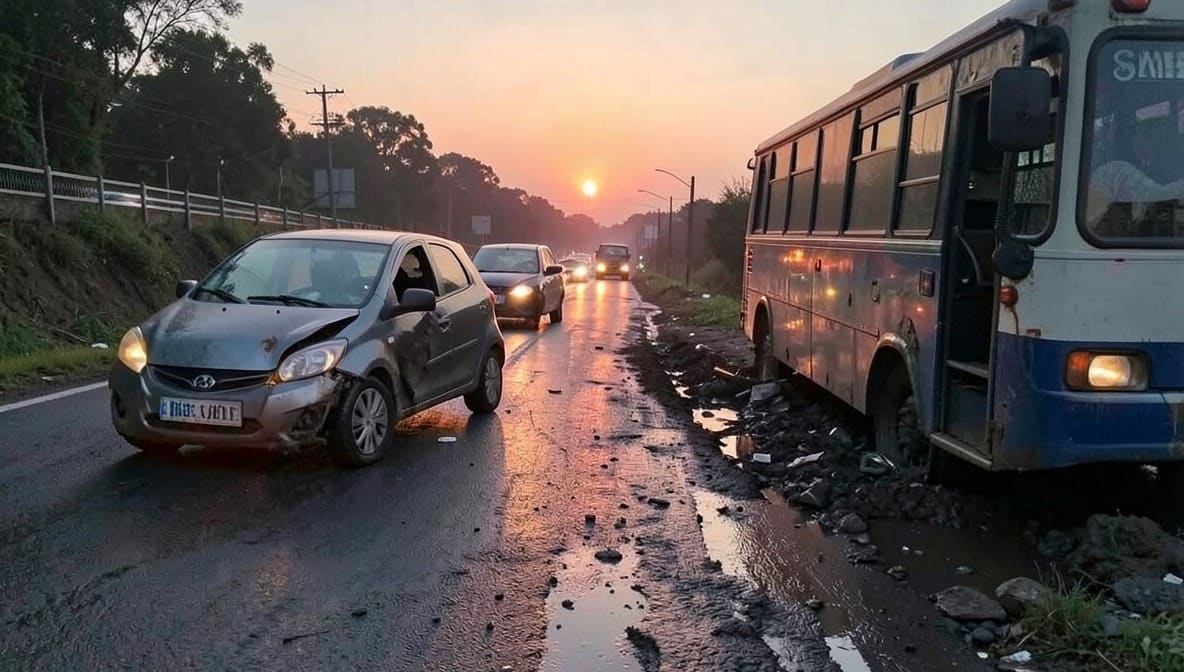
The Supreme Court set aside a High Court award that had reduced compensation on a 50 % contributory negligence basis, holding that the FIR and charge-sheet constitute prima facie evidence of negligence and that a criminal acquittal does not extinguish civil liability under the Motor Vehicles Act.
Background & Facts
The Dispute
The appellant, Reena, a surviving spouse of the deceased Nandan Shet, filed three separate Motor Vehicle Claim (MVC) petitions seeking compensation for the death of her husband, the death of her mother-in-law, and for her own injuries arising from a collision on 14 October 2005.
Key Facts
- 14.10.2005, 01:20 AM: A Hyundai Santro (Reg. KA-04-MB-2073) driven by Nandan Shet collided with a KSRTC heavy passenger bus (Reg. KA-01-F-7846) near Siddeshwara Petrol Bunk, Kunigal, Karnataka.
- The accident caused the deaths of Nandan Shet, his mother-in-law Geetha Shet and a family friend Mahesh; the claimant survived with grievous injuries.
- The claimant was an Associate Manager at Accenture Technologies, Bangalore, earning a notional monthly salary of Rs 20,000.
- FIR No. 275 of 2005 was lodged at Kunigal Police Station; a charge-sheet was filed against the bus driver (RW1).
- The bus driver was acquitted on 03.10.2008 by the Principal Civil Judge, Jr. Dn. & JMFC, Kunigal, on the basis of benefit of doubt.
- The claimant filed:
- MVC No. 7828 of 2005 for death of husband (claim: Rs 1 crore 50 lakhs).
- MVC No. 7829 of 2005 for death of mother-in-law.
- MVC No. 583 of 2006 for personal injuries.
- The Motor Accident Claims Tribunal (MACT) awarded modest sums (Rs 1.5 lakhs for husband’s death, Rs 1.5 lakhs for mother-in-law, Rs 1.67 lakhs for injuries) and did not record liability of the insurer.
- The Karnataka High Court enhanced the award for the husband’s death to Rs 14,35,267 but reduced it by 50 % on a contributory negligence finding, directing payment by KSRTC.
Procedural History
- 14.10.2005 - Accident occurs.
- 2005 - FIR and charge-sheet filed.
- 03.10.2008 - Criminal trial court acquits bus driver.
- 2005-2006 - MVC petitions filed (7828, 7829, 583).
- Date not specified - MACT awards compensation.
- Date not specified - Karnataka High Court judgment (impugned) reduces award by 50 % for contributory negligence.
- 2024 - I.A. No. 1 filed in MFA No. 5074 of 2014.
- 2026 - Civil Appeals Nos. 10755-10758 filed before the Supreme Court.
- 19 August 2026 - Supreme Court delivers judgment.
Parties' Positions
- Appellant (Claimant): Argues that the FIR, charge-sheet and bus conductor’s statement establish the bus driver’s sole negligence; rejects any contributory negligence by the deceased; seeks full compensation as per MACT findings and additional evidence on the deceased’s earnings.
- First Respondent (KSRTC): Claims the bus was driven cautiously; attributes negligence to the Santro driver; relies on the High Court’s 50 % contributory negligence finding.
- Second Respondent (Insurer - New India Assurance): Contends the policy excludes liability because the car was let for “hire and reward”.
- Third Respondent (Vehicle Owner): Notified but absent; set ex parte.
Relief Sought
The appellant seeks:
- Restoration of the MACT award for death of husband and mother-in-law and for personal injuries.
- Determination of compensation on the basis of loss of estate, not loss of dependency, using the additional evidence of the deceased’s income and future prospects.
- Liability to be placed solely on KSRTC, with interest at 6 % per annum from filing of the claim till realisation.
The Legal Issue
Whether the FIR and charge-sheet constitute prima facie evidence of negligence in a motor accident claim, and whether a criminal acquittal of the driver precludes civil liability; additionally, how contributory negligence should be assessed and the quantum of compensation calculated under the Motor Vehicles Act.
Arguments Presented
For the Appellant
- Relied on the FIR, charge-sheet and the bus conductor’s statement as prima facie proof of the bus driver’s rash and negligent driving.
- Cited ICICI Lombard General Insurance Co. Ltd. v. Rajani Sahoo and Mathew Alexander v. Mohd. Shafi for the principle that criminal acquittal does not affect civil liability.
- Submitted additional evidence (salary certificates, invoices, bank records) to establish a realistic monthly income of Rs 70,000 at the time of death, thereby increasing the loss-of-estate calculation.
- Contended that the High Court erred in attributing 50 % contributory negligence to the deceased without proper evidentiary support.
For the Respondents
- Asserted that the bus driver exercised due care and that the Santro driver’s rash driving caused the collision.
- Relied on the High Court’s finding of equal contributory negligence based on the vehicle-sketch and the principle that both parties share fault.
- The insurer argued that the policy excluded liability because the car was used for “hire and reward”.
- Cited Sunita & Ors. v. Rajasthan State Road Transport Corporation for the view that contributory negligence may be apportioned when both vehicles are at fault.
The Court's Analysis
The Court began by reaffirming that Section 166 of the Motor Vehicles Act mandates a pre-ponderance of probability standard in civil motor-accident claims, distinct from the criminal standard of proof beyond reasonable doubt. It observed that the FIR and charge-sheet are statutory investigations that create a prima facie case of negligence and must be given due weight unless convincingly rebutted.
"The High Court erred in ignoring the FIR and chargesheet, which, according to binding precedents supra , demonstrate the preponderance of negligence on one or the other."
The Court noted that the acquittal of the bus driver in the criminal case was based on a benefit-of-doubt principle and could not extinguish civil liability, echoing the reasoning in ICICI Lombard and Mathew Alexander. It further held that Section 162(1) of the CrPC restricts the use of a witness’s statement to contradict the maker, thereby limiting the High Court’s reliance on the bus conductor’s statement against the bus driver.
On contributory negligence, the Court rejected the High Court’s equal apportionment. It emphasized that the site sketch showing the Santro dragged to the left does not, by itself, prove the Santro driver’s rashness. The Court found the bus driver’s statement, corroborated by the FIR and charge-sheet, to be more reliable. Consequently, the Court restored the MACT’s finding of 100 % negligence on the part of the KSRTC bus driver.
The Court then turned to the quantum of compensation. Using the additional evidence, it calculated the deceased’s realistic monthly earnings at Rs 70,000, applied a multiplier of 17 for the age of 30, and arrived at a loss-of-estate figure of Rs 50,10,376. Adding loss of consortium (Rs 52,000) and funeral expenses (Rs 19,500) yielded a total compensation of Rs 50,81,876. The Court ordered 6 % interest per annum from the date of filing of the claim petition till realisation, and placed the entire liability on KSRTC.
The Court also affirmed the awards in the other two appeals (death of mother-in-law and personal injuries) as per the High Court, but modified the apportionment to make KSRTC solely responsible.
The Verdict
The Supreme Court allowed Civil Appeals Nos. 10755 and 10758, awarding the claimant Rs 50,81,876 with interest at 6 % per annum from the filing date till realisation. It restored the MACT’s finding of 100 % negligence on the KSRTC bus driver, rejected the High Court’s 50 % contributory negligence finding, and directed that the entire liability rest with KSRTC. The other two appeals were confirmed with the High Court’s awards, but the apportionment was altered to make KSRTC the sole payer.
What This Means For Similar Cases
FIR and Charge-Sheet as Prima Facie Evidence
- Practitioners must treat the FIR and charge-sheet as strong evidence of negligence in MACT proceedings.
- A criminal acquittal does not automatically negate civil liability; the civil standard remains pre-ponderance of probability.
Contributory Negligence Must Be Evidently Proven
- Courts will not infer contributory negligence from vehicle-sketches alone; direct ocular evidence or reliable statements are required.
- Parties alleging shared fault must substantiate the claim with corroborative material beyond the sketch.
Compensation Calculations Require Realistic Income Evidence
- Claimants should submit detailed income records, future prospect assessments, and professional qualifications to support loss-of-estate calculations.
- Courts will apply appropriate multipliers and inflation adjustments, but will reject inflated monthly income claims unsupported by documentary proof.





