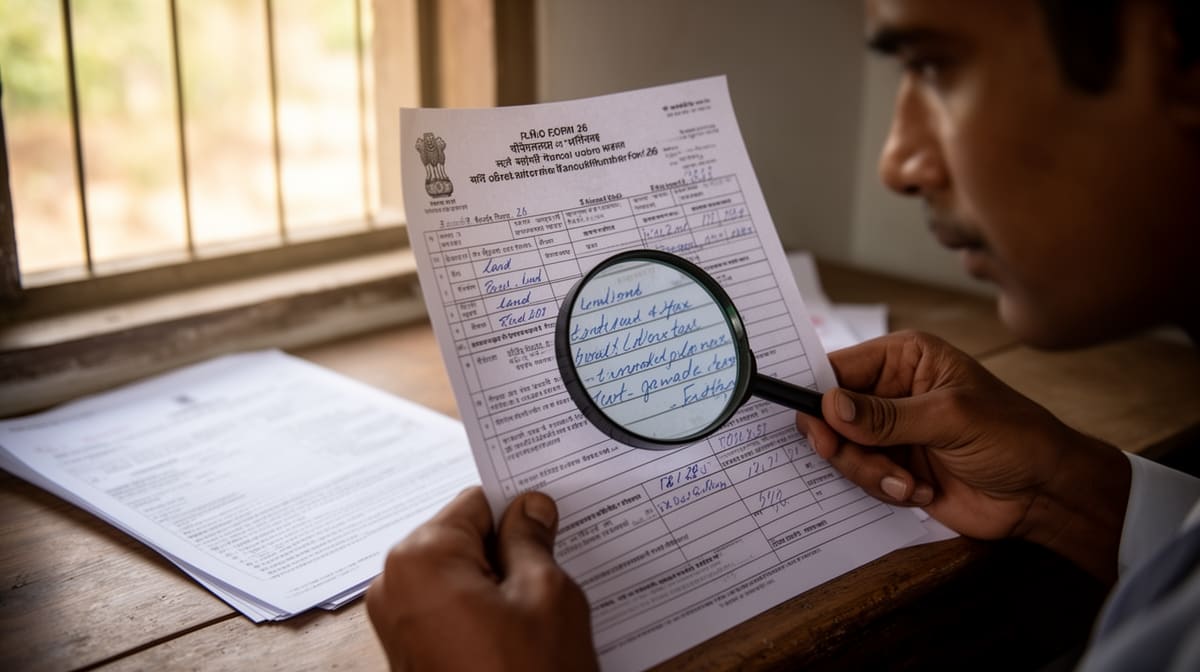
The Karnataka High Court has delivered a landmark ruling affirming that deliberate non-disclosure of assets, false valuation of property, and suppression of statutory dues in a candidate’s Form 26 affidavit constitute corrupt practice under Section 123(2) of the Representation of the People Act, 1951. This judgment reinforces the voter’s fundamental right to information and establishes that material misrepresentations on oath, irrespective of electoral margin, invalidate an election.
Background & Facts
The Dispute
The petitioner, Sri C. Muniraju, contested the 2023 Karnataka Legislative Assembly election from the 140-Bagepalli constituency as a Bharatiya Janata Party candidate. He lost to the incumbent, Sri S.N. Subbareddy of the Indian National Congress, who secured 82,128 votes against the petitioner’s 62,949. The petitioner filed an election petition challenging Subbareddy’s election on grounds of material misrepresentation in his Form 26 affidavit, alleging suppression of business income, undisclosed properties, false classification of land, and non-disclosure of property tax dues.
Procedural History
- 20.04.2023: Respondent No.1 filed his nomination papers along with Form 26 affidavit.
- 10.05.2023: Assembly election held; Respondent No.1 declared elected.
- 24.06.2023: Election petition filed under Sections 80, 81, 100, 101 and 123 of the RP Act, 1951.
- 05.02.2026: Final arguments concluded; judgment reserved.
- 16.02.2026: Judgment pronounced by Justice M.G.S. Kamal.
Relief Sought
The petitioner sought:
- Declaration of Respondent No.1’s election void under Section 100(1)(b) and (d)(iv) of the RP Act, 1951.
- Declaration of himself as duly elected under Section 101(b) of the RP Act, 1951.
The Parties' Positions
Petitioner’s Allegations:
- Non-disclosure of five active business entities and their current account balances.
- Failure to disclose 2 acres 22 guntas of land in Sy.No.21.
- Misclassification of commercial land as agricultural land in Sy.Nos.164, 173, 174, 138/2, 158/2, 172 and 157.
- False declaration of property tax dues as ‘Nil’ despite outstanding liabilities exceeding Rs.1.3 crore.
- Non-disclosure of GST dues and late fees.
Respondent’s Defense:
- All disclosures were substantial and any omissions were inadvertent.
- No requirement under law to disclose current account balances or GST late fees.
- Property tax was paid belatedly due to administrative delay, not malice.
- No evidence of direct interference with electoral rights.
- Election margin of 19,179 votes negates any material impact.
The Legal Issue
The central question was whether non-disclosure of business income, misclassification of land, and false declaration of property tax dues in a Form 26 affidavit constitute corrupt practice under Section 123(2) of the Representation of the People Act, 1951, and whether such conduct, even without proof of voter impact, is sufficient to void an election.
Arguments Presented
For the Petitioner
The petitioner’s counsel relied on Lok Prahari v. Union of India and S. Rukmini Madegowda v. Karnataka State Election Commission to argue that false declarations on oath regarding assets and liabilities inherently amount to undue influence under Section 123(2). She contended that:
- Disclosure of sources of income is mandatory under Rule 4A of the Conduct of Elections Rules, 1961.
- Failure to disclose current account balances of business entities concealed the true source of income.
- Misclassifying commercial land as agricultural land artificially depressed valuation, constituting fraud.
- Declaration of property tax dues as ‘Nil’ when statutory liability existed amounted to perjury and deceit.
- The Supreme Court in Lok Prahari held that such non-disclosure is a corrupt practice irrespective of its impact on the election result.
For the Respondent
The respondent’s counsel argued that:
- The Supreme Court in Ajmera Shyam v. Kovalaxmi requires that defects be of substantial character to invalidate an election.
- Non-disclosure of current accounts is not mandated by Form 26, which only requires savings and investment details.
- GST late fees and property tax dues are not ‘liabilities’ until formally demanded by authorities.
- Any errors were technical or inadvertent, not malicious.
- The electoral margin of nearly 20,000 votes negates any claim of material effect.
- Section 101 relief is inapplicable where more than two candidates contest, as per Vishwanatha Reddy v. Konappa Rudrappa Nadgouda and Prakash Khandre v. Vijay Kumar Khandre.
The Court's Analysis
The Court undertook a rigorous doctrinal analysis of the statutory framework under the RP Act, 1951, and the constitutional right to information under Article 19(1)(a). It rejected the respondent’s contention that omissions were merely technical, holding instead that the cumulative effect of the misrepresentations crossed the threshold of substantiality.
"False statement or a false declaration, that too made on oath, inherently carries with it corrupt, deceitful, dishonest and fraudulent intent, which once proved, neither requires further probe of its innocence nor the need of testing the same through the lens of substantiality."
The Court distinguished Ajmera Shyam, where non-disclosure of income tax returns for four years was deemed inconsequential, by emphasizing that the present case involved active concealment of business income, deliberate misclassification of land, and false oath on statutory dues - all of which directly undermined the integrity of the disclosure regime.
The Court held that the requirement to disclose assets and liabilities under Rule 4A is not a mere formality but a constitutional imperative. The Supreme Court in People’s Union for Civil Liberties v. Union of India had affirmed that voters have a right to know the financial antecedents of candidates to assess potential for misuse of public office. The Court found that the respondent’s failure to disclose:
- The five business entities and their current account balances, which were the primary source of income;
- The 2 acres 22 guntas of land in Sy.No.21, despite its inclusion in the same sale deed as disclosed land;
- The commercial nature of six properties, thereby undervaluing them by over Rs.64 lakh;
- Property tax dues of over Rs.1.3 crore, declared as ‘Nil’ on oath;
…constituted a pattern of systemic non-compliance that could not be excused as oversight.
The Court further held that the absence of a demand notice for property tax or GST late fees did not absolve the candidate of the statutory obligation to disclose liabilities. Under Section 144(8) of the BBMP Act, 2020, property tax is payable by the owner irrespective of demand. The Court cited Srikanth Kashinath Jituri v. Corporation of City at Belgaum to underscore that municipal taxes are the lifeblood of public infrastructure and their suppression is not a trivial omission.
The Court also rejected the respondent’s reliance on Vishwanatha Reddy and Prakash Khandre to bar Section 101 relief, noting that while those cases barred automatic declaration of the runner-up in multi-candidate contests, they did not preclude the possibility where the petitioner’s claim was substantiated by evidence. However, the Court found the petitioner’s prayer under Section 101(b) unproven due to lack of evidence on voter behavior.
The Verdict
The petitioner won on the core issue. The Court held that the respondent’s conduct constituted corrupt practice under Section 123(2) of the RP Act, 1951, and declared his election void under Section 100(1)(b). However, the Court declined to declare the petitioner as duly elected under Section 101(b), citing the absence of evidence to prove that but for the corrupt practices, the petitioner would have secured a majority. The seat shall be filled by a fresh election.
What This Means For Similar Cases
False Declarations on Oath Are Per Se Corrupt Practices
- Practitioners must now treat any material misstatement in Form 26 affidavits - especially regarding income sources, land classification, or statutory dues - as grounds for election petitions.
- Courts will no longer accept ‘oversight’ as a defense where multiple omissions are systemic and involve sworn declarations.
- Evidence of non-disclosure of business accounts, even if not explicitly mandated, becomes relevant if those accounts are the primary source of income.
Property Tax Dues Are Not Optional Disclosures
- Candidates must disclose all statutory dues, including property tax, GST late fees, and income tax liabilities, even if no demand notice has been issued.
- The absence of a notice does not extinguish liability; the obligation to disclose arises from statutory duty, not enforcement action.
- Petitioners should obtain RTI responses and BBMP/CGST records to substantiate claims of non-disclosure.
Land Classification Errors Are Not Technical
- Misclassifying commercial or converted land as agricultural land to reduce valuation is fraudulent, not inadvertent.
- Courts will compare declared values with government guidelines and RTC records to assess intent.
- Practitioners should cross-verify land classification with the latest revenue records and conversion orders before filing election petitions.
Election Petitions Must Be Plead with Precision
- While Section 101 relief remains difficult to obtain in multi-candidate contests, the threshold for voiding an election under Section 100(1)(b) has been lowered.
- Petitioners need not prove voter impact if the corrupt practice is established through documented falsehoods.
- The burden shifts to the candidate to prove that omissions were not intentional or material.
No Automatic Declaration of Runner-Up
- Even where corruption is proven, Section 101 relief requires proof that the petitioner would have won but for the tainted votes.
- In multi-candidate elections, the Court will not guess voter preferences; a fresh election remains the default remedy.
- Practitioners should focus on securing voidance of the election rather than seeking automatic declaration of victory.
Key Takeaways for Practitioners
- Always verify Form 26 affidavits against GST portal, BBMP records, and RTC extracts.
- File RTI applications for property tax and GST compliance before filing election petitions.
- Argue that false declarations on oath are per se corrupt practices under Lok Prahari and Rukmini Madegowda.
- Do not rely on electoral margin as a shield - courts now prioritize integrity over numbers.
- For Section 101 claims, plead and prove with specific voter behavior evidence, not speculation.
Key Legal Principles Established
- False declaration on oath in Form 26 affidavit = Corrupt practice under Section 123(2)
- Non-disclosure of statutory dues = Material misrepresentation, not technicality
- Misclassification of land to undervalue = Fraudulent intent
- Section 101 relief requires proof of voter impact, not mere corruption
- Fresh election is the default remedy in multi-candidate contests