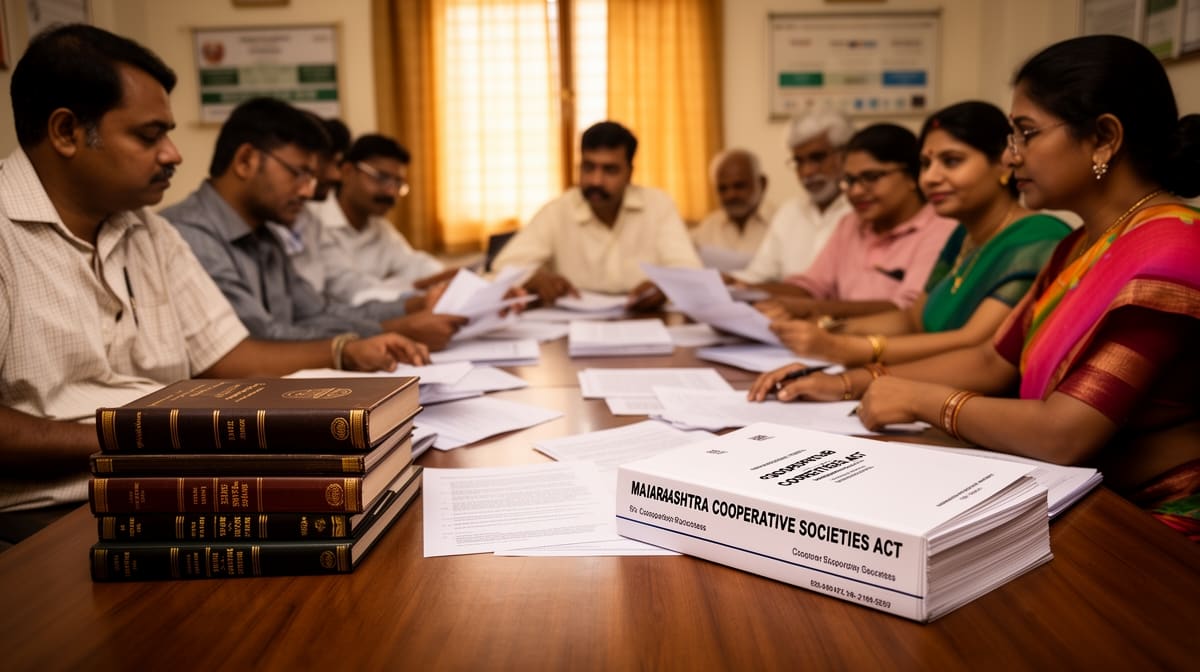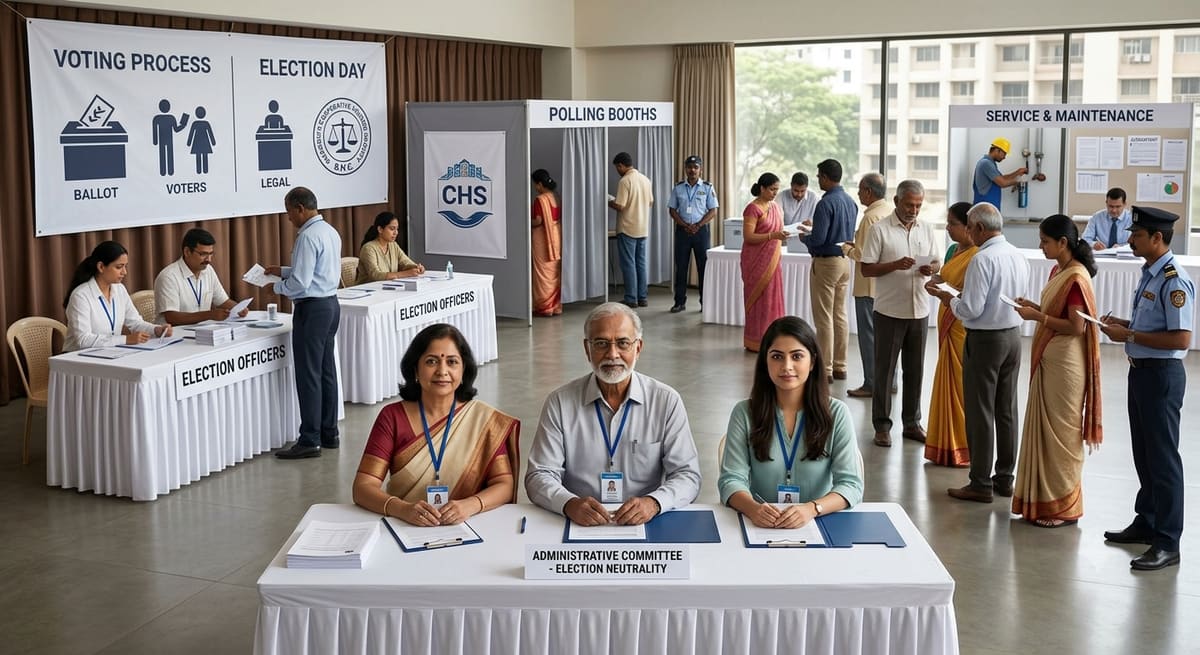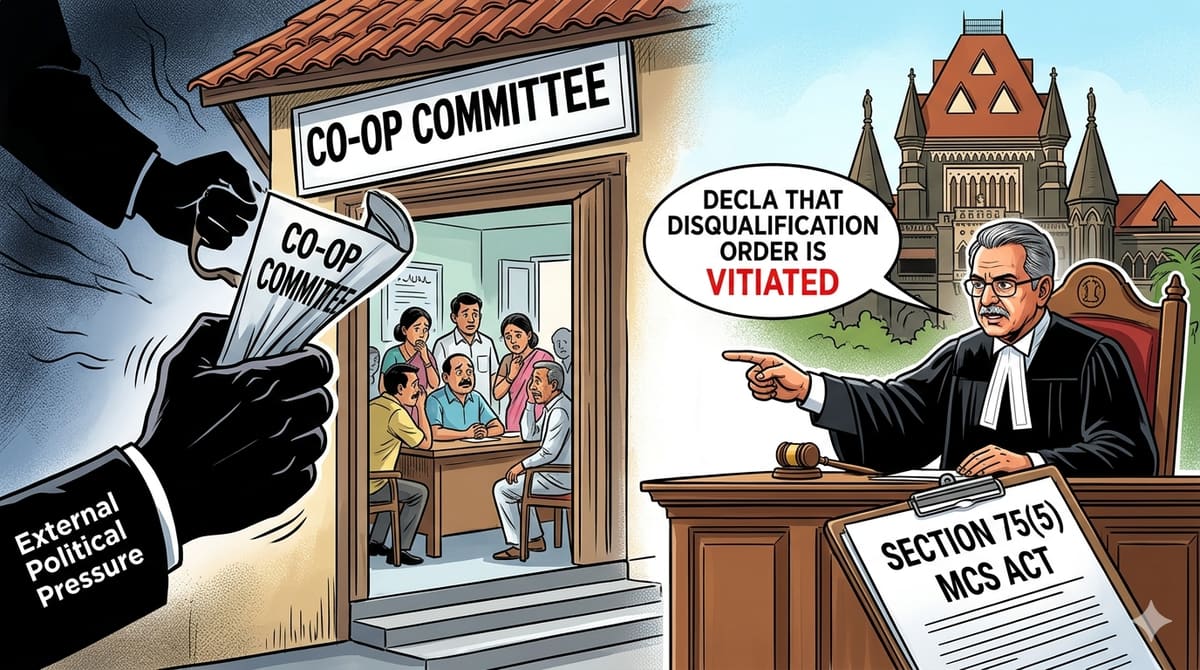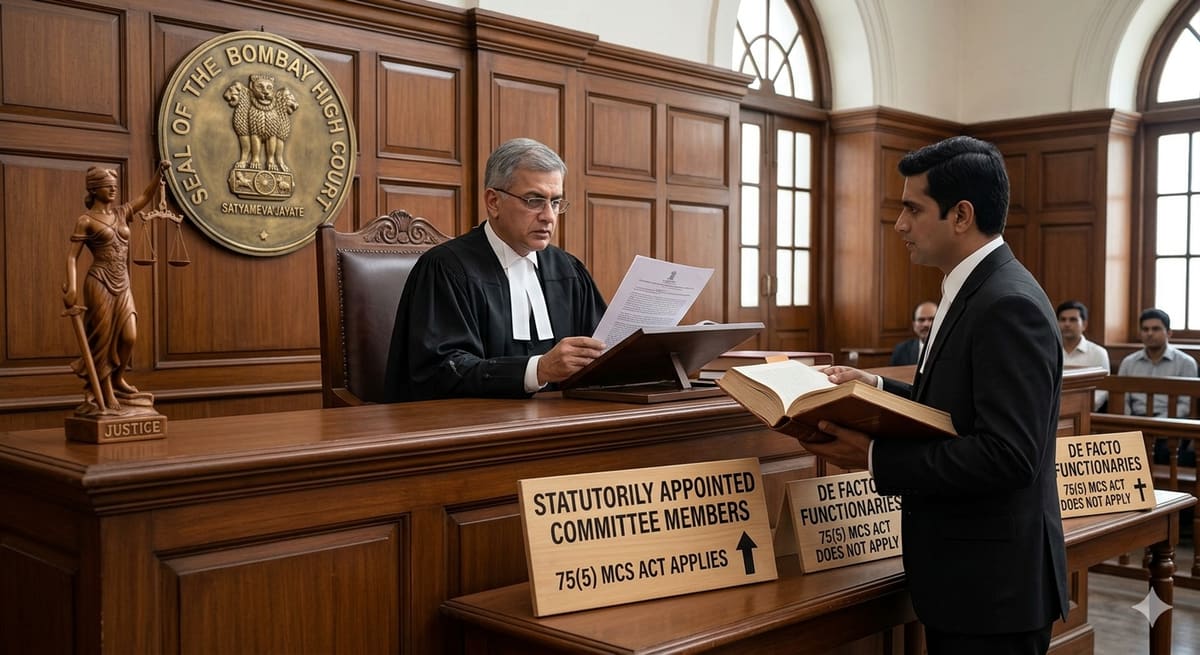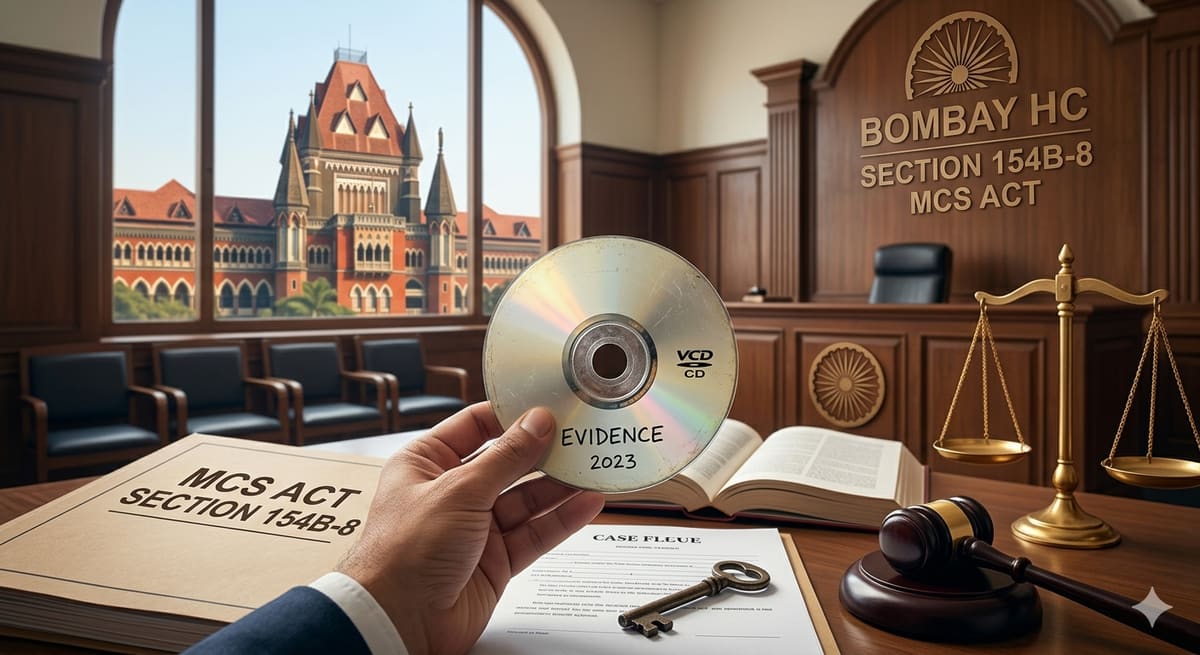
The Bombay High Court has clarified that demanding video recordings or translations of minutes from a co-operative housing society does not constitute a valid statutory request under the Maharashtra Co-operative Societies Act, 1960, and cannot form the basis for disqualifying elected committee members. This judgment reinforces the narrow scope of Section 154B-8 and the high threshold required to invoke disqualification under Section 154B-23.
Background & Facts
The Dispute
The dispute arose between Petitioner Mahesh Madhukar Bhartiya, a member and former Managing Committee member of Lok Nisarg Co-operative Housing Society Limited, Mulund, and Respondent Nos. 3 to 5 - the Chairman, Secretary, and Treasurer of the same Society - who were elected for the term 2023 - 2028. The Petitioner, dissatisfied with the functioning of the new Managing Committee, initiated a series of demands for documents related to the Special General Body Meeting (SGM) held in May 2023 and the Annual General Body Meeting (AGM) held on 10 September 2023.
Key Facts
The Society has 281 members, including 11 commercial units, and operates under the Maharashtra Co-operative Societies Act, 1960 (MCS Act)
The Petitioner was a member of the previous Managing Committee (2015 - 2023) and remained a member of the current Committee until August 2025
The Society adopted a paperless policy and communicated minutes via WhatsApp and email
The Petitioner repeatedly demanded: (i) CDs containing video recordings of SGM and AGM; (ii) Marathi translations of English minutes; (iii) minutes of Management Committee meetings; (iv) audit reports; and (v) agendas of future meetings
On 27 January 2024, the Petitioner and four other members sent a complaint to the Deputy Registrar alleging non-supply of CDs for SGM and AGM
On 16 April 2025, the Petitioner filed another complaint with the Deputy Registrar, again demanding video CDs and translations
On 28 August 2023 and 21 September 2024, the Petitioner sent separate letters to the Society demanding minutes of Management Committee meetings and documents for the upcoming AGM
The Society provided WhatsApp messages containing the minutes of the SGM and AGM, which the Petitioner acknowledged receiving
The Petitioner refused to accept physical copies of documents offered by the Society on 18 June 2025, citing non-payment of copying charges and insisting on video recordings
The Deputy Registrar, on 18 August 2025, disqualified Respondent Nos. 3 to 5 under Section 154B-23(1)(iii) for non-supply of documents, and appointed an Authorized Officer under Section 77A(b-1)
On the same day, the Petitioner and three other Committee members resigned
The Divisional Joint Registrar, on 20 November 2025, set aside the disqualification order, holding that the Petitioner’s demands were not statutorily valid
Procedural History
27 January 2024: Complaint filed by Petitioner and four members with Deputy Registrar regarding non-supply of SGM and AGM CDs
16 April 2025: Second complaint by Petitioner to Deputy Registrar demanding video CDs and translations
15 May 2025: Deputy Registrar directed Society to supply documents upon payment of copying fees
7 June 2025: Petitioner served advocate notice for non-compliance
7 July 2025: Hearing fixed by Deputy Registrar
18 June 2025: Society deposited documents; Petitioner refused acceptance
7 August 2025: Show cause hearing conducted under Section 154B-23(1)(iii)
18 August 2025: Deputy Registrar issued two orders: (i) disqualification of Chairman, Secretary, and Treasurer for five years; (ii) appointment of Authorized Officer
18 August 2025: Petitioner and three other members resigned
20 November 2025: Divisional Joint Registrar set aside both orders
9 December 2025: Bombay HC admitted the Writ Petition
15 May 2026: Supreme Court dismissed SLP and directed expeditious disposal
18 June 2026: Final hearing held
25 June 2026: Judgment pronounced
Relief Sought
The Petitioner sought quashing of the Divisional Joint Registrar’s order dated 20 November 2025, restoration of the Deputy Registrar’s disqualification order dated 18 August 2025, and a direction to enforce compliance with statutory document supply obligations.
The Legal Issue
The central question was whether demanding video recordings of meetings or translations of minutes constitutes a valid request under Section 154B-8(2) of the Maharashtra Co-operative Societies Act, 1960, and whether such a demand, if unfulfilled, can trigger disqualification under Section 154B-23(1)(iii).
Arguments Presented
For the Petitioner
Mr. Mandar Limaye argued that the Society’s failure to supply minutes of the SGM and AGM amounted to a breach of Section 154B-8(2), which mandates furnishing documents within 45 days of payment of fees. He contended that the Deputy Registrar correctly interpreted the law in disqualifying the Chairman, Secretary, and Treasurer. He relied on Smt. Nair Pushpa Sureshkumar v. State of Maharashtra and Shahid Tamboli v. Divisional Joint Registrar to assert that non-supply of statutory documents justifies disqualification. He further argued that the Divisional Joint Registrar erred in setting aside the order merely because copying charges were not paid, and that the Society’s paperless policy cannot override statutory obligations.
For the Respondent/State
Ms. Seema Chopda and Ms. Mamta Shrivastava countered that the Petitioner’s demands were not for statutory documents but for video recordings and translations, which are not enumerated under Section 154B-8(1). They emphasized that the Petitioner, as a former and current Committee member, had access to all records and was privy to the WhatsApp communications containing the minutes. They argued that the disqualification order was based on a misreading of the law and that the Petitioner’s conduct - including immediate resignation after disqualification - revealed a mala fide intent to destabilize the Committee. They relied on Jijau Coop. Housing Society Ltd. v. State of Maharashtra to argue that disqualification must be strictly construed and not used as a tool for factional control.
The Court's Analysis
The Court undertook a meticulous textual analysis of Section 154B-8 and Section 154B-23. It held that Section 154B-8(1) explicitly lists the documents a member may inspect, including minutes of general and committee meetings, but does not include video recordings, audio files, or translations. The Court observed:
"Sub-section (1) of Section 154B-8 does not include video recording of a meeting in the list of documents enumerated therein. Therefore for both the reasons of letter not being a request made to the society in writing as well as demanding something not envisaged under Section 154B-8, the letter dated 27 January 2024 is irrelevant for deciding the issue of disqualification of members of the committee."
The Court further noted that the Petitioner’s letters dated 27 January 2024 and 16 April 2025 were complaints addressed to the Deputy Registrar, not written requests to the Society as required under Section 154B-8(2). Even the later letters dated 28 August 2023 and 21 September 2024 sought documents outside the statutory scope - such as agendas of future meetings and audit reports - and did not constitute a valid demand for minutes.
The Court rejected the Deputy Registrar’s reliance on a non-existent letter dated 21 January 2024, calling it a clear case of non-application of mind. It emphasized that disqualification under Section 154B-23(1)(iii) is a severe penalty that imposes a stigma and must be triggered only by unambiguous, statutory non-compliance. The Court cited Smt. Nair Pushpa and Shahid Tamboli to affirm that substantial compliance and good faith must be considered, and that disqualification cannot be used to settle internal disputes.
The Court also noted the timing of the Petitioner’s resignation - immediately after the disqualification order - and the resulting collapse of the Managing Committee, which led to the appointment of an external Administrator. This, the Court held, demonstrated that the Petitioner’s conduct was not about transparency but about gaining control of the Society.
Finally, the Court reiterated the limited nature of Article 227 jurisdiction, citing Garment Craft v. Prakash Chand Goel, and held that it would not interfere merely to correct an error of fact or law where the final outcome - setting aside an improperly grounded disqualification - was legally sound.
The Verdict
The Writ Petition was dismissed with no order as to costs. The Divisional Joint Registrar’s order dated 20 November 2025, setting aside the disqualification of Respondent Nos. 3 to 5, was upheld. The appointment of the Authorized Officer remains in effect. The Court held that no statutory breach occurred under Section 154B-8, and therefore no disqualification under Section 154B-23 was warranted. The Petitioner’s demands for video recordings and translations were found to be outside the statutory framework.
What This Means For Similar Cases
Statutory Demands Must Be Precise and Within Scope
Practitioners must ensure that requests for documents under Section 154B-8 strictly reference only the enumerated items: minutes, balance sheets, registers, bye-laws, etc.
Demands for video recordings, translations, agendas, or audit reports cannot be treated as statutory requests under Section 154B-8(2)
Any disqualification proceeding based on such extraneous demands is legally unsustainable
Disqualification Is Not a Tool for Internal Power Struggles
Courts will scrutinize the timing and context of disqualification petitions - especially when followed by mass resignations
A member who is already privy to records (e.g., a former or current Committee member) cannot claim ignorance to justify a disqualification petition
Repeated, overlapping, or shifting demands may be viewed as mala fide and used to destabilize governance
Paperless Communication Does Not Violate Statutory Rights
Electronic delivery of minutes via WhatsApp or email satisfies statutory obligations if the content matches the required documents
Societies are not obligated to provide physical copies if electronic access is provided and acknowledged
The burden shifts to the member to prove non-receipt or non-acceptance of electronic documents, not to the Society to prove delivery