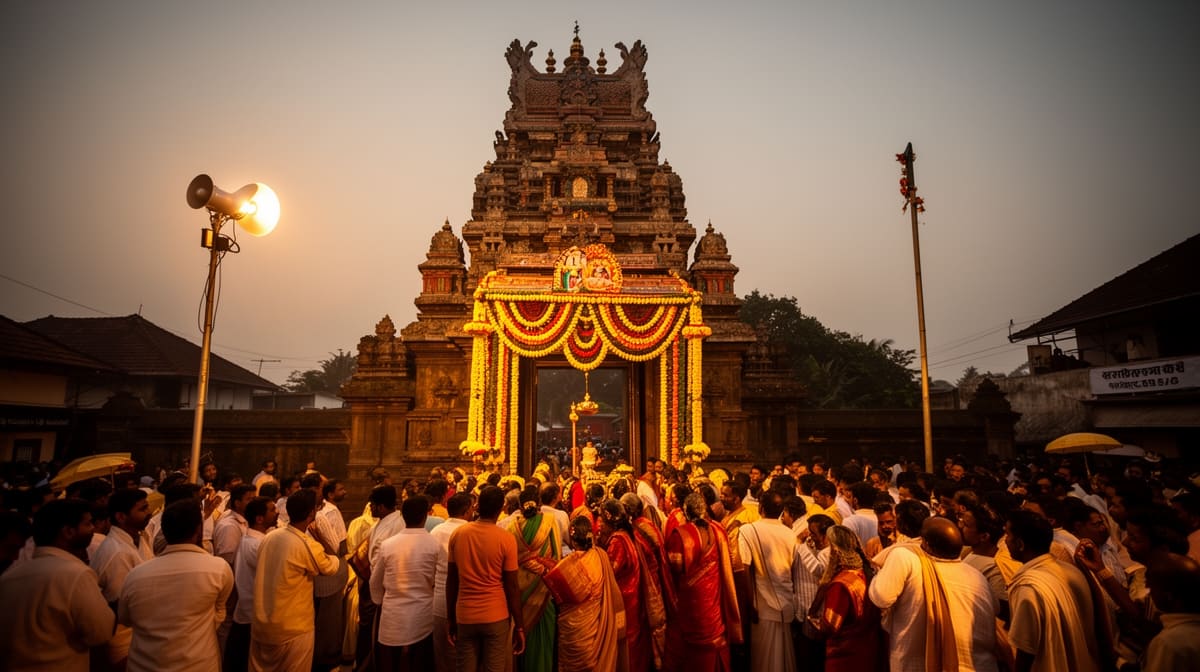
The Kerala High Court has affirmed that religious traditions involving elephants in temple festivals may continue, provided they are conducted without cruelty or excessive fatigue. This judgment strikes a critical balance between the right to practice religion and the constitutional obligation to protect animal life, setting a precedent for similar cultural-religious practices across India.
Background & Facts
The Dispute
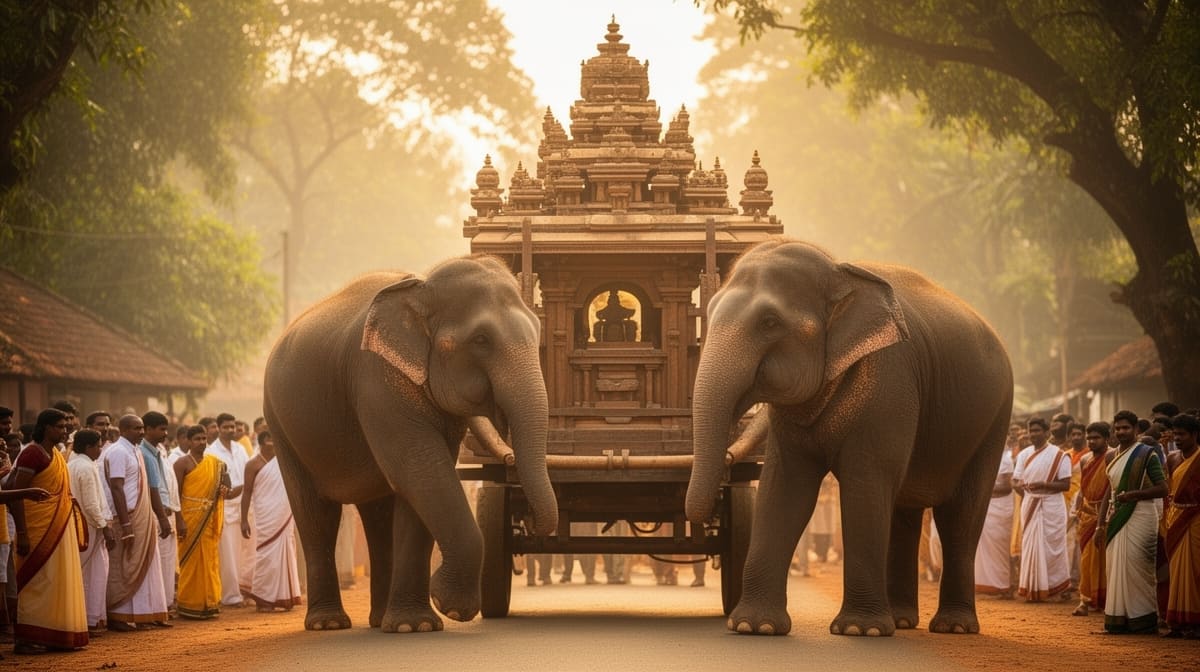
The petitioners, three temple festival committees from Perinkulam Village in Palakkad, seek permission to use elephants to push chariots during their annual Car Festival (രഥോത്സവം). The festival, held over two days in March, involves pulling chariots by hundreds of devotees, with elephants deployed solely to assist in navigating sharp curves. The second respondent, the Assistant Conservator of Forests, denied permission for this year’s event, despite prior judicial approvals in similar cases.
Procedural History
- 2023: In W.P.(C) No. 6289/2023, the Court observed that elephants were used only for pushing, not pulling, and permitted their use under conditions.
- 2024: In W.P.(C) No. 44136/24, the Court reiterated the same position, relying on the 2023 order.
- 2025: Similar permissions were granted in W.P.(C) No. 8434/2025 and W.P.(C) No. 44196/2025.
- February 2026: The District Committee denied permission, prompting this writ petition.
Relief Sought
The petitioners sought a writ of mandamus directing the respondents to grant permission for using elephants to push chariots during the March 2026 festival, citing precedent and the non-injurious nature of the practice.
The Legal Issue
The central question was whether the use of elephants to push chariots during a religious festival constitutes an unlawful act under the Prevention of Cruelty to Animals Act, 1960, or whether such use, when strictly limited and non-exploitative, falls within the protective ambit of Article 25 of the Constitution.
Arguments Presented
For the Petitioner
The petitioners relied on W.P.(C) No. 6289/2023 and W.P.(C) No. 44136/24, arguing that prior judicial orders had already established that elephants are used only to assist in negotiating curves, not to bear the full weight of the chariot. They emphasized the cultural and religious significance of the practice, citing Article 25 and the principle of continuity of established customs. They submitted that the elephants were well-trained, supervised, and never subjected to physical harm.
For the Respondent
The State, through the Special Government Pleader, contended that any use of elephants in public processions risks violation of Section 11(1)(a) and Section 11(1)(e) of the Prevention of Cruelty to Animals Act, which prohibit causing unnecessary pain or suffering. They argued that judicial precedent cannot override statutory prohibitions and that the State has a duty to enforce animal welfare laws uniformly.
The Court's Analysis
The Court examined the nature of elephant use in the festival, distinguishing it from exploitation. It noted that the elephants are not pulling the chariot but merely assisting in turning, as confirmed by prior judgments and photographic evidence. The Court emphasized that the practice is not new, has been consistently permitted under conditions, and involves no evidence of physical abuse.
"The elephants are used only for pushing the chariots in order to negotiate curves easily, and not to bear the entire weight of the chariot at any point in time."
The Court held that Article 25 protects the right to practice religion, including culturally embedded rituals, provided they do not involve cruelty. It rejected the argument that precedent alone cannot override statutory law, noting that statutory interpretation must harmonize with constitutional rights. The Court further observed that the State’s duty under Article 48 and the Prevention of Cruelty to Animals Act is not to ban the practice outright, but to regulate it to prevent harm.
The Court also reviewed the exhibits (P4, P6, P9) demonstrating consistent judicial recognition of the practice over three years, reinforcing the principle of legitimate expectation and procedural fairness.
The Verdict
The petitioners succeeded. The Court held that the use of elephants to push chariots during religious festivals is permissible, provided it is strictly limited to assisting in navigation and does not involve cruelty or excessive fatigue. The Court directed the respondents to grant permission for two elephants, subject to enforceable safeguards against torture or overexertion.
What This Means For Similar Cases
Permission Is Conditional, Not Absolute
- Practitioners must now demonstrate that animal use in religious processions is non-exploitative, limited in scope, and historically established.
- Applications for permission should include evidence of past judicial approvals and veterinary supervision plans.
- Courts will not permit blanket bans on religious practices without proof of actual harm.
Animal Welfare Conditions Are Enforceable
- Any permission granted must include specific, measurable conditions - e.g., maximum duration of work, rest intervals, prohibition of sticks or hooks.
- District authorities must issue written orders with conditions, not mere denials.
- Violations can be challenged under Article 226 as contempt of court order.
Precedent Creates Legitimate Expectation
- Repeated judicial permissions create a legitimate expectation for religious bodies to continue the practice.
- Authorities cannot arbitrarily withdraw permissions without new, evidence-based grounds of cruelty.
- Future petitions should cite prior orders (like P4, P6, P9) to establish continuity and reduce litigation risk.