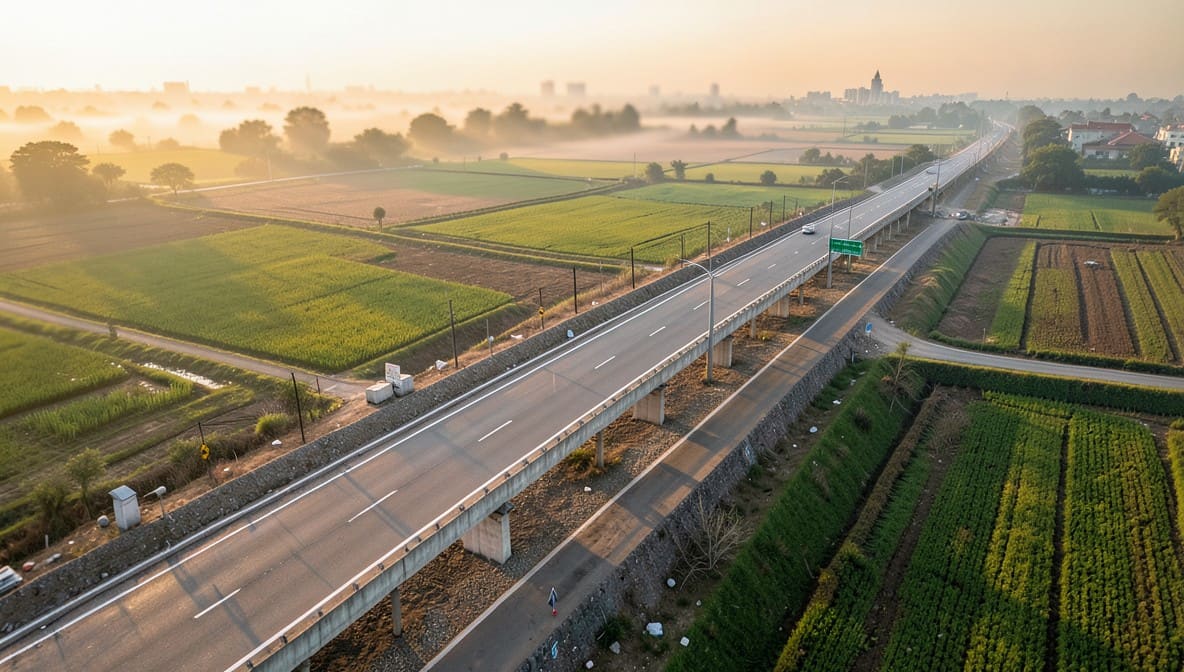
The Bombay High Court has reaffirmed the limited scope of judicial intervention in arbitration awards, upholding an arbitrator’s decision to enhance compensation for land acquired for highway expansion where the land was already being used commercially. The judgment clarifies that compensation for loss of easementary rights is not automatically precluded when ownership is acquired, provided the adjacent landholder suffers a direct impact.
Background & Facts
The Dispute
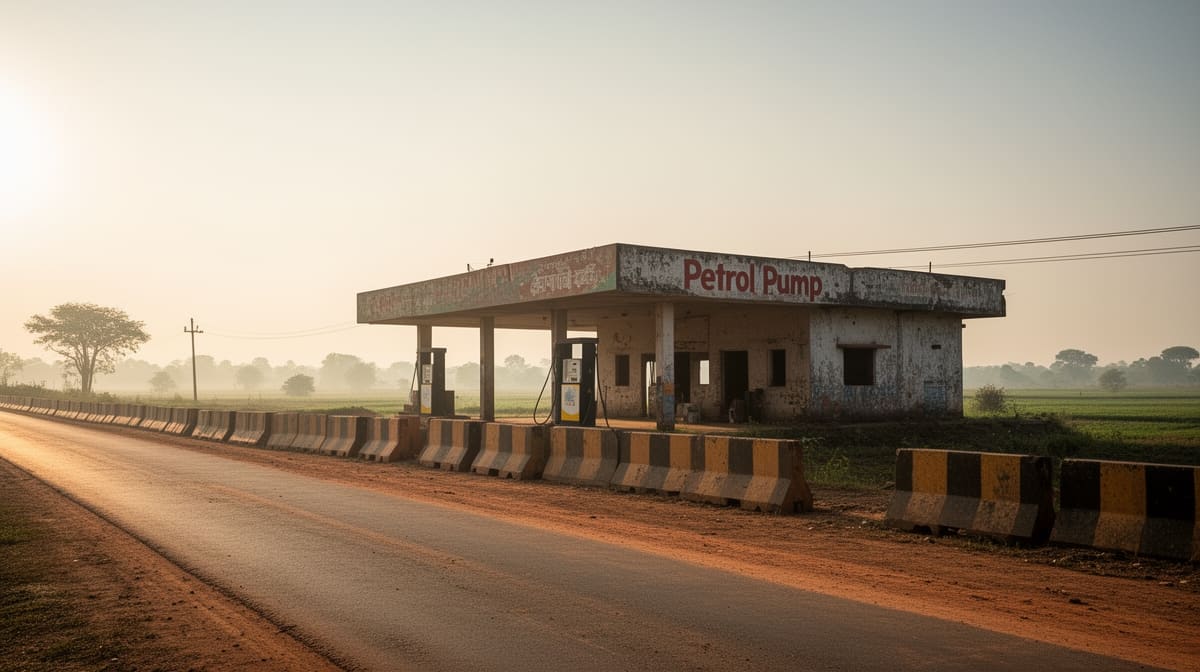
The National Highways Authority of India (NHAI) acquired 2542 square metres of land belonging to Kerman Sam Amroliwala, a farmer and petrol pump operator, located at Gat No. 213, Village Pimpri Sekam, Taluka Bhusawal, District Jalgaon. The land was being used for a commercial petrol pump at the time of acquisition. The Competent Authority for Land Acquisition (CALA) determined compensation under Section 3-G(1) of the National Highways Act, 1956, awarding Rs. 15,12,498 for the land at Rs. 595 per square metre, Rs. 1,51,250 for constructed area, Rs. 1,50,510 for a water tank, Rs. 3,722 for forest trees, and Rs. 1,51,249 as easementary rights (10% of land value), totaling Rs. 19,69,229.
Key Facts
- The acquired land was not agricultural but had been actively used for a petrol pump business.
- The claimant challenged the compensation as inadequate, contending the land’s commercial use warranted higher valuation.
- The claimant submitted sale instances of Rs. 11,951 per square metre from Bhusawal town, but CALA rejected them as non-comparable due to urban location and smaller plot size.
- The arbitrator, under Section 3-G(5) of the National Highways Act, enhanced the land compensation to Rs. 1,190 per square metre, doubling the original rate.
- The arbitrator also awarded Rs. 1,10,000 as compensation for loss of business income and 10% of the enhanced land value as compensation for loss of easementary rights.
- Interest at 9% per annum was directed from the date of notification under Section 3-D until actual payment.
Procedural History
- 15.03.2011: CALA issued compensation order No. LAQ/SR/8/2011 awarding Rs. 19,69,229.
- 12.02.2015: Arbitrator issued award enhancing compensation to Rs. 1,190 per sq. mtr., adding Rs. 1,10,000 for business loss and 10% for easementary rights.
- 17.03.2015: Arbitrator issued corrigendum order confirming the award.
- 2015: Both NHAI and the claimant filed applications under Section 34 of the Arbitration and Conciliation Act, 1996, challenging the award before the Principal District Judge, Jalgaon.
- 13.04.2016: District Judge dismissed both Section 34 applications, upholding the arbitral award.
- 14.02.2016: NHAI filed Arbitration Appeal No. 14 of 2016 under Section 37.
- 04.01.2024: Claimant filed Arbitration Appeal No. 4 of 2024 under Section 37.
- 16.03.2026: Judgment delivered by the Bombay High Court (Aurangabad Bench).
The Parties' Positions
For NHAI
- Argued that the enhancement from Rs. 595 to Rs. 1,190 per sq. mtr. lacked evidentiary basis.
- Contended that 10% compensation for business loss was unjustified due to absence of income statements post-notification.
- Asserted that easementary rights compensation was impermissible once ownership was acquired, citing Tarsem Singh.
For the Claimant
- Maintained that the land’s commercial use justified higher valuation.
- Argued that the arbitrator’s award was consistent with CALA’s own recognition of business loss and easementary rights.
- Stated that the 10% easementary compensation was not double payment, as the claimant retained adjacent land affected by highway expansion.
Relief Sought
- NHAI sought setting aside of the arbitral award.
- The claimant sought enhancement of compensation beyond Rs. 1,190 per sq. mtr. and inclusion of solatium under Tarsem Singh.
The Legal Issue
The central question was whether an arbitral award enhancing land compensation for commercial use and granting 10% each for business loss and easementary rights can be set aside under Section 34 of the Arbitration and Conciliation Act, 1996, on grounds of patent illegality or lack of evidence, and whether such compensation constitutes double payment in light of Tarsem Singh v. Union of India.
Arguments Presented
For the Appellant (NHAI)
NHAI contended that the arbitrator’s enhancement of land value from Rs. 595 to Rs. 1,190 per sq. mtr. was unsupported by evidence, as the claimant’s sale instances were from an urban municipal area and not comparable to the rural acquired land. It further argued that the 10% compensation for business loss was arbitrary without post-notification income records, and that easementary rights compensation was barred under Tarsem Singh since ownership had been transferred. NHAI relied on PSA Sical Terminals to argue that the award was perverse and vitiated by patent illegality.
For the Respondent (Claimant)
The claimant countered that the arbitrator correctly recognized the land’s commercial use, distinguishing it from agricultural or N.A. potential land. He submitted that CALA had already acknowledged business loss and easementary rights, and the arbitrator merely adjusted these components proportionately with the enhanced land value. He relied on Tarsem Singh to argue that easementary rights compensation applies to adjacent landholders whose use is impaired, not just third-party easement holders.
The Court's Analysis
The Court emphasized that under Section 34 and Section 37 of the Arbitration and Conciliation Act, judicial interference is strictly circumscribed. The Court cannot reappreciate evidence or substitute its view for that of the arbitrator, unless the award is vitiated by patent illegality or contravenes the fundamental policy of Indian law.
"An award would be set aside on the ground of patent illegality appearing on the face of the award and as such, which goes to the roots of the matter. However, an illegality with regard to a mere erroneous application of law would not be a ground for interference."
The Court found that the arbitrator’s enhancement of land value was not arbitrary. The land was demonstrably used for a petrol pump, a commercial activity, and CALA had treated it as N.A. potential land - a classification inconsistent with its actual use. The arbitrator’s doubling of the rate was a reasonable adjustment to reflect market reality, even if the claimant’s sale instances were rejected for being non-comparable.
Regarding the 10% compensation for business loss, the Court noted that CALA had already recognized this head of compensation, and the arbitrator merely scaled it proportionately with the enhanced land value. The absence of detailed income statements did not render the award perverse, as the loss was evident from the nature of the business and the physical disruption caused by highway expansion.
On the issue of easementary rights, the Court distinguished Tarsem Singh. While that case held that easementary rights are subsumed in ownership when the owner is compensated, it did not preclude compensation to the owner when the acquisition adversely affects the usability of retained land. Here, the frontal portion was acquired, and the remaining land - where the petrol pump operated - suffered diminished access and customer flow. The Court held:
"The claimant being also the adjacent land holder where he runs his petrol pump has suffered the loss of easementary right. Thus, granting 10% of loss of easementary right does not travel beyond the law as laid in the case of Tarsem Singh supra."
The Court concluded that the award did not shock the conscience, nor did it violate public policy. It was not perverse, as it was based on the nature of the land use and the impact of acquisition - factors within the arbitrator’s domain.
The Verdict
The appeal filed by NHAI (Arbitration Appeal No. 14 of 2016) was dismissed. The appeal filed by the claimant (Arbitration Appeal No. 4 of 2024) was disposed of with the direction that the arbitrator shall compute and award statutory solatium under Tarsem Singh within four months of this order, after hearing both parties. The existing award of Rs. 1,190 per sq. mtr. for land, Rs. 1,10,000 for business loss, 10% for easementary rights, and 9% interest from the date of Section 3-D notification remains intact.
What This Means For Similar Cases
Easementary Rights Compensation Applies to Adjacent Landowners
- Practitioners must now argue that compensation for impaired access or usability of retained land is distinct from third-party easements.
- The Tarsem Singh principle does not bar compensation to the owner when acquisition directly affects the functionality of their remaining property.
Commercial Use Justifies Higher Valuation Even Without Comparable Sales
- Arbitrators may enhance land compensation based on actual use, even if formal sale instances are inadmissible.
- Rejection of sale instances does not preclude valuation adjustments grounded in the nature of land use - a critical point for petrol pumps, factories, or commercial establishments.
Patent Illegality Requires More Than Mere Disagreement
-
An award cannot be set aside merely because the court would have decided differently.
-
Absence of income records does not equate to no evidence; contextual and circumstantial proof of business loss suffices.
-
Courts must resist reappreciating evidence under the guise of patent illegality.
-
Always distinguish between erroneous application of law and patent illegality.
-
In commercial land acquisition cases, document the nature of use, proximity to infrastructure, and impact on operations - these are decisive factors for arbitrators.
-
When challenging awards, focus on procedural defects or manifest irrationality, not valuation disagreements.