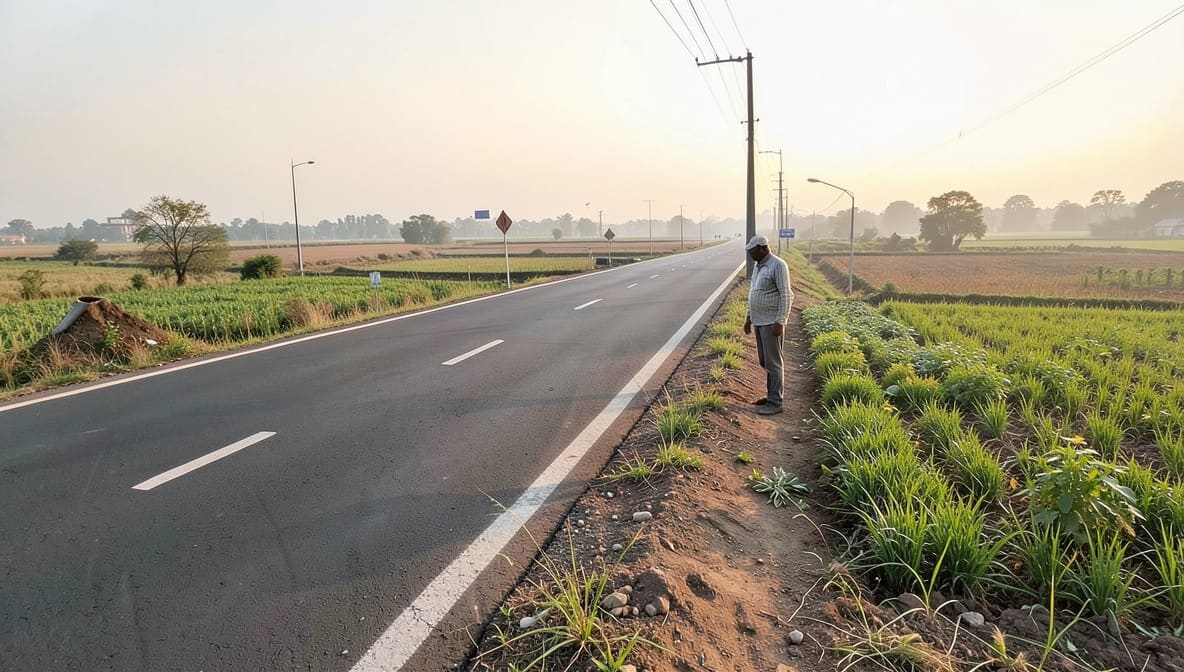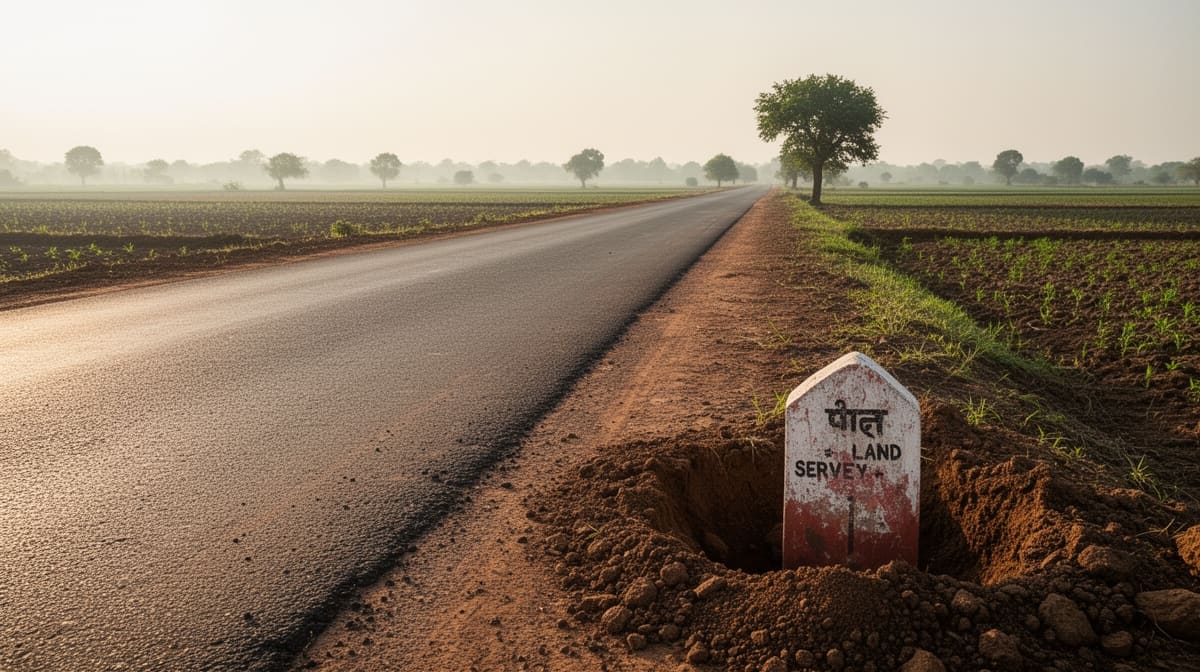
The Bombay High Court has affirmed that landowners are entitled to compensation for excess land acquired beyond the area specified in the final award, where state authorities themselves confirm the additional utilization through documented joint measurement. This ruling clarifies that post-award discovery of unauthorized acquisition does not bar relief, especially when the state’s own officers validate the claim.
Background & Facts
The Dispute
The petitioners, Zumbarabai Hari Avhad and another, are agriculturists and landowners in Gat Nos. 46/2 and 46/3 of Village Dodi Khurd, Tal. Sinnar, Dist. Nashik. Their land was partially acquired for the construction of the Khed Sinnar section of National Highway No. 50 (NH 50). A final award dated 30.10.2013 granted compensation only for 900 sq. mtrs. of their land. However, the petitioners contended that an additional 3000 sq. mtrs. of their land was also used for the highway, without any compensation.
Key Facts
- The petitioners’ land in Gat No. 46/2 and Gat No. 46/3 was subject to acquisition under the National Highways Act, 1956.
- Final award dated 30.10.2013 recognized compensation for 900 sq. mtrs. only.
- On 26.12.2013, petitioner No. 1 submitted a representation challenging the clarity of land utilization.
- On 14.02.2014, the Deputy Superintendent of Land Records responded, proposing a joint measurement to determine actual land used.
- Joint measurement was conducted and confirmed by a communication dated 31.08.2015.
- Exhibit 'F' - a map prepared by the Deputy Superintendent of Land Records - recorded that 0.25 Are (2500 sq. mtrs.) from Gat No. 46/2 and 0.14 Are (1400 sq. mtrs.) from Gat No. 46/3 were utilized, totaling 3900 sq. mtrs.
- The map at Exhibit 'F' was prepared pursuant to an order dated 12.07.2016 by the Deputy Collector (Land Acquisition) and signed by a representative of the Land Acquisition Department.
- Exhibit 'G' - a letter dated 27.09.2018 from the Deputy Superintendent of Land Records to the Competent Authority - explicitly stated that 0.39 Are (3900 sq. mtrs.) of land in Survey No. 46 was utilized for NH 50.
- Representations were made by the petitioners on 21.02.2023 seeking compensation for the excess 3000 sq. mtrs., but no response was received.
Procedural History
- 30.10.2013: Final award passed for 900 sq. mtrs. only.
- 26.12.2013: First representation by petitioner No. 1.
- 14.02.2014: Deputy Superintendent of Land Records initiates joint measurement.
- 31.08.2015: Communication confirming measurement process.
- 12.07.2016: Order by Deputy Collector (Land Acquisition) authorizing joint measurement.
- 27.09.2018: Official confirmation of 3900 sq. mtrs. utilization sent to Competent Authority.
- 21.02.2023: Final representation by petitioners seeking compensation for excess land.
- 2023: Writ Petition No. 14155 of 2023 filed before Bombay High Court.
- 10.03.2026: Court indicated intent to allow petition but deferred final order due to non-service of Exhibit 'F' to NHAI.
- 26.03.2026: Hearing concluded; NHAI submitted scanned additional affidavit; original to be filed within one week.
The Parties' Positions
For the Petitioners: Relied on Exhibit 'F' and Exhibit 'G' to establish that state authorities, through their own officers, confirmed the utilization of 3900 sq. mtrs. of land. Argued that the final award was incomplete and that the excess land was acquired without due process or compensation.
For the Respondents (State & NHAI): Contended that the final award dated 30.10.2013 was conclusive and that petitioners had ample opportunity to raise objections under the National Highways Act, 1956. NHAI denied the claim, asserting that only 900 sq. mtrs. was acquired and compensated, and dismissed the joint measurement documents as non-binding.
Relief Sought
The petitioners sought: (a) A declaration that acquisition of the excess 3000 sq. mtrs. of land without due process was illegal; (b) A direction to pass a fresh award for the additional land in accordance with the National Highways Act, 1956.
The Legal Issue
The central question was whether a landowner is entitled to compensation for excess land acquired beyond the final award, where the state’s own officers have documented and confirmed the additional utilization through joint measurement, even if the claim arises post-award.
Arguments Presented
For the Petitioner
The petitioners relied on the official documents generated by the state’s Land Records Department - including the signed map at Exhibit 'F' and the letter at Exhibit 'G' - to establish that the excess land was not merely alleged but officially verified. They argued that the National Highways Act, 1956, does not bar claims arising from post-award discovery of unauthorized acquisition, especially when the state itself initiates and confirms the measurement. They cited the principle of ubi jus ibi remedium - where there is a right, there is a remedy - and emphasized that the petitioners acted promptly and in good faith.
For the Respondent
The State and NHAI contended that the final award under Section 11 of the National Highways Act, 1956, is conclusive and binding. They argued that the petitioners had the opportunity to raise objections during the acquisition process and that post-award representations cannot override a final award. NHAI dismissed the joint measurement documents as internal administrative records without legal effect, asserting that only the award determines compensation liability.
The Court's Analysis
The Court rejected the respondents’ contention that the final award was an absolute bar to further claims. It emphasized that the award is not a static document immune to correction when new, authoritative evidence emerges from the state’s own machinery.
"It is relevant to note that the corrected joint measurement report at Exhibit 'F' along with the map bears the signature of the officer of the Land Acquisition Department and as a matter of fact, exercise of joint measurement was undertaken by the Deputy Superintendent of Land Records on the basis of an order dated 12th July 2016 passed by the Deputy Collector (Land Acquisition)."
The Court found that the documents at Exhibits 'F' and 'G' were not mere representations but official records generated by the state’s competent authorities - the Deputy Superintendent of Land Records and the Deputy Collector - acting within their statutory domain. The fact that these officers signed and confirmed the measurement rendered the claim credible and beyond mere assertion.
The Court further held that the petitioners could not have raised the issue of excess acquisition before the award, as the extent of land used was not known until the state initiated the joint measurement. The respondents’ argument that the petitioners had ample opportunity to object was therefore legally untenable.
"The nature of objections raised by the petitioners could have been raised only after the award was rendered, for the reason that utilization beyond 900 sq. mtrs. came to light only after the exercise of joint measurement undertaken by the officers of the State itself..."
The Court also criticized NHAI’s reliance on bald denials without addressing the documentary evidence. It held that the respondents could not disown the official records generated by their own departments.
The Verdict
The writ petition was allowed. The Court declared that the acquisition of the additional 3000 sq. mtrs. of land without due process was illegal. It directed the respondents to pass a fresh award for the excess land in accordance with the National Highways Act, 1956. The respondents were ordered to complete the acquisition process for the additional 3000 sq. mtrs. of land within one year from the date of judgment. Pending applications were disposed of.
What This Means For Similar Cases
Joint Measurement Documents Are Legally Significant
- Practitioners must treat official maps and reports signed by Land Records or Land Acquisition officers as prima facie evidence of land utilization.
- Even if such documents are not part of the formal award process, their origin from state authorities gives them evidentiary weight.
- Denials by NHAI or other agencies without rebutting these documents will not suffice.
Post-Award Claims Are Not Barred by Statute
- The National Highways Act, 1956, does not preclude compensation claims arising from post-award discovery of excess land use.
- Where the state’s own officers confirm additional acquisition, the final award cannot be used as a shield to deny justice.
- Landowners must act promptly upon discovering discrepancies - timely representation strengthens the claim.
State Cannot Disown Its Own Records
- Government departments cannot selectively accept or reject documents generated by their subordinate officers.
- If a Deputy Superintendent or Deputy Collector issues a signed report confirming land use, the state is estopped from denying it in litigation.
- This principle reinforces accountability and prevents administrative arbitrariness in land acquisition.