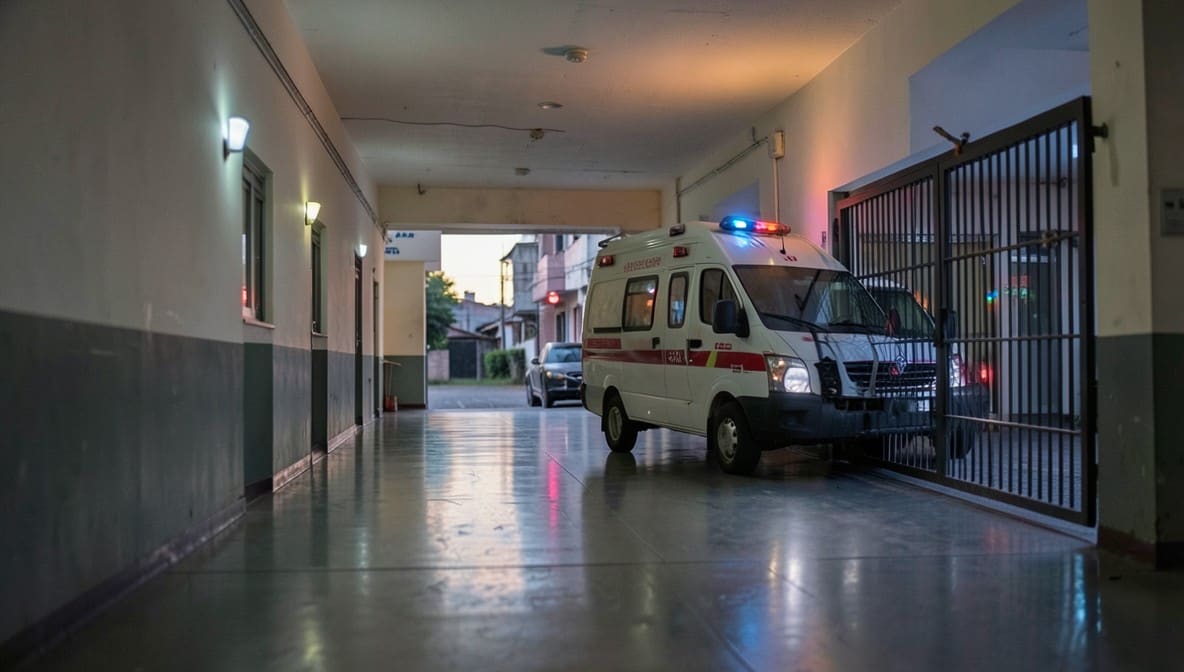
The West Bengal State Consumer Disputes Redressal Commission has established a critical precedent: a hospital’s failure to arrange timely transfer of a critically ill patient due to absence of a critical care ambulance constitutes a clear deficiency in service under the Consumer Protection Act, even where medical treatment itself adheres to professional standards. This ruling redefines institutional accountability in emergency care.
Background & Facts
The Dispute
The complainant, Sri Sanat Kumar Bhattacharya, filed a consumer complaint alleging gross deficiency in medical service by I.L.S. Hospital and its attending doctors, which directly led to the death of his wife, Smt. Susmita Bhattacharya, aged 43, on 20.11.2015. The complainant contended that despite being admitted in critical condition, the hospital failed to provide timely transfer to a facility equipped for advanced thoracic surgery, resulting in preventable loss of life.
Key Facts
- Smt. Susmita Bhattacharya was admitted to I.L.S. Hospital, Dum Dum, at approximately 04.00 A.M. on 20.11.2015, suffering from acute abdominal pain, vomiting, anuria, and respiratory distress.
- She was initially treated by Dr. Sushil Kr. Saha on 19.11.2015 at 04.00 P.M. and 07.00 P.M., who administered medication and injections without improvement.
- Upon admission, the patient was conscious but in shock, with suspected acute intestinal obstruction and possible perforation.
- Dr. Devraj Roy (Opposite Party No.2) and Dr. Arvind Ojha (Opposite Party No.3) examined the patient at 08.00 A.M. and diagnosed severe metabolic acidosis, hypotension (BP 80/40), and possible intestinal perforation.
- The patient was shifted to ITU; vasopressors (Noradrenaline and Vasopressin) were initiated; blood transfusions and electrolyte corrections were administered.
- A CT Scan of the thorax conducted at approximately 12.30 P.M. revealed massive oesophageal dilation, indicating end-stage achalasia cardia with complications requiring thoracotomy.
- At 12.30 P.M., Dr. Devraj Roy advised immediate transfer to a tertiary care center with cardio-thoracic facilities, as I.L.S. Hospital lacked such infrastructure.
- Despite this medical advice, the patient remained at the hospital until 16.40 P.M. - a delay of over four hours - before being discharged.
- I.L.S. Hospital had no critical care ambulance (CCA) available.
- The complainant arranged private transport; the patient died en route to Apollo Hospital.
- The complainant paid Rs.70,000 for investigations and was asked to deposit Rs.2 lakhs for surgery and Rs.5-10 lakhs for overall treatment.
- The hospital did not attempt to arrange ambulance from any other source, nor sought police or emergency services assistance.
Procedural History
- 20.11.2015: Patient admitted at 04.00 A.M., died during transfer at approximately 17.00 P.M.
- 19.11.2015: Initial treatment by Dr. Sushil Kr. Saha.
- 12.06.2017: Consumer Complaint No. SC/19/CC/320/2017 filed before State Consumer Disputes Redressal Commission, West Bengal.
- 06.05.2026: Final order passed by the Commission.
The Parties' Positions
For the Complainant
- Argued that the hospital’s failure to provide a critical care ambulance, despite clear medical advice for urgent transfer, amounted to deficiency in service.
- Contended that the four-hour delay was not due to medical reasons but administrative failure.
- Relied on Smt. Savita Garg v. National Heart Institute and Master Abhishek Ahluwalia v. Dr. Sanay Saluja to establish that hospitals are liable for systemic failures even if doctors follow protocols.
- Asserted that Article 21 imposes a constitutional duty on hospitals to ensure timely access to higher care.
For the Respondents (Hospital and Doctors)
- Denied negligence, asserting that all medical interventions were in line with international protocols.
- Claimed that the diagnosis of achalasia cardia with thoracic complications was rare and complex, requiring specialist care beyond their capacity.
- Stated that the decision to refer was made promptly at 12.30 P.M. and that the delay was due to logistical challenges, not malice or omission.
- Relied on medical literature on achalasia cardia and the Bolam Test to defend the doctors’ clinical judgment.
- Argued that the hospital’s lack of CTVS department is not negligence but a limitation of infrastructure.
Relief Sought
The complainant sought:
- Refund of all hospital charges, investigation costs, and doctor fees totaling Rs.25,00,000
- Compensation for mental agony, loss of spouse, and loss of mother to the daughter: Rs.20,00,000
- Interest at 18% per annum on the above amounts
- Additional Rs.5,00,000 for loss of life partner and maternal loss
The Legal Issue
The central question was whether a hospital’s failure to arrange timely transfer of a critically ill patient - despite medical advice to do so - due to absence of a critical care ambulance, constitutes a deficiency in service under the Consumer Protection Act, even when the attending doctors followed accepted medical standards.
Arguments Presented
For the Appellant/Petitioner
The complainant’s counsel, Mr. Swapan Kr. Pal (later represented by Mr. Hiranmoy Brahmachari), argued that the hospital’s duty extends beyond clinical treatment to ensuring the patient’s safe and timely transition to a higher facility. The absence of a critical care ambulance was not merely an operational gap but a systemic failure. The hospital had no contingency plan, made no effort to requisition external transport, and allowed the patient to remain in a deteriorating state for over four hours after the CT Scan confirmed the need for thoracic intervention. Reliance was placed on Smt. Savita Garg, where the Supreme Court held that hospitals are liable for institutional failures, and on Article 21, which imposes a positive obligation to preserve life.
For the Respondent/State
The hospital’s counsel, Ms. Binota Roy and Ms. Moushumi Sarkar, contended that the attending physicians acted diligently and in accordance with the Bolam Test. The diagnosis was complex, the referral decision was timely, and the delay was attributable to logistical constraints, not negligence. They emphasized that the hospital was not equipped for thoracic surgery and that advising transfer was the appropriate course. The absence of a CCA was a resource limitation, not a legal breach, and the doctors could not be held liable for institutional shortcomings.
The Court's Analysis
The Commission undertook a two-tier analysis: first, whether the doctors were negligent; second, whether the hospital was liable for systemic failure.
The Court found that the attending physicians, Dr. Devraj Roy and Dr. Arvind Ojha, had correctly diagnosed the condition, initiated appropriate resuscitation, ordered necessary investigations, and advised transfer at 12.30 P.M. - actions consistent with the standard of care. The Bolam Test was satisfied, and no medical negligence was established against them.
However, the Court turned to the hospital’s institutional responsibility. It held:
"A hospital cannot simply 'wash its hands' of a patient by advising them to leave. If the three-hour delay was due to administrative hurdles (e.g. waiting for billing clearance, lack of pre-arranged ambulance, or staff unavailability), it is, in our opinion, a deficiency in service."
The Commission emphasized that hospitals are institutional providers bound by the Consumer Protection Act, and their duty under Article 21 includes ensuring access to timely care - not just treatment. The absence of a critical care ambulance was not an isolated incident but a known institutional deficiency. The hospital made no effort to procure transport from external sources, contact emergency services, or coordinate with nearby facilities.
The Court distinguished between medical negligence (which requires deviation from professional standards) and deficiency in service (which includes systemic failures in infrastructure, logistics, and patient management). It held:
"A three-hour delay in shifting a critical cardiac patient - specially after a scan has confirmed a complication - is a significant window of time, we are of the view, for medical negligence or deficiency of service."
The Commission further noted that the complainant had paid Rs.70,000 for investigations and was subjected to repeated financial demands, adding to the trauma. The failure to provide a CCA, in the context of a known life-threatening condition, was a direct and proximate cause of the patient’s death during transit.
The Verdict
The complainant succeeded against I.L.S. Hospital (Opposite Party No.1). The Commission dismissed all claims against Dr. Devraj Roy and Dr. Arvind Ojha, holding them not liable for medical negligence. The hospital was held solely liable for deficiency in service. The Commission ordered I.L.S. Hospital to pay Rs.15,00,000 as compensation to the complainant. This amount shall carry interest at 9% per annum, accruing from the date of filing of the complaint (12.06.2017). If payment is not made within eight weeks, the interest rate shall increase to 12% per annum. The hospital must comply fully within the stipulated period.
What This Means For Similar Cases
Hospital Infrastructure Gaps Are Not Excuses
- Practitioners must now argue that lack of equipment or transport is not a defense under consumer law - hospitals are expected to have contingency plans.
- Failure to arrange critical care transport, even if the patient is referred, constitutes a standalone deficiency in service.
- Hospitals must document proactive steps taken to secure external transport (e.g., calls to other hospitals, police, or ambulance services).
The Bolam Test Does Not Shield Institutional Negligence
- A doctor may follow the Bolam Test and still be exonerated, but the hospital remains liable for systemic failures.
- Consumer forums will examine the entire care continuum - from admission to discharge - not just clinical decisions.
- Financial demands during critical care, especially without transparency, may be viewed as exploitation and aggravate liability.
Article 21 Imposes Positive Obligations on Private Hospitals
-
Private hospitals are now clearly bound by the constitutional duty to preserve life under Article 21, especially in emergencies.
-
This judgment reinforces that consumer protection law operates alongside constitutional rights, creating a dual accountability framework.
-
Legal notices and complaints should now explicitly invoke Article 21 and the duty to ensure timely transfer in critical cases.
-
Always demand proof of ambulance availability in hospital brochures or admission forms
-
File complaints against hospitals for lack of CCA, even if doctors are not at fault
-
Seek compensation for delays between medical advice and actual transfer
-
Use this judgment to challenge hospitals that outsource care but retain financial control