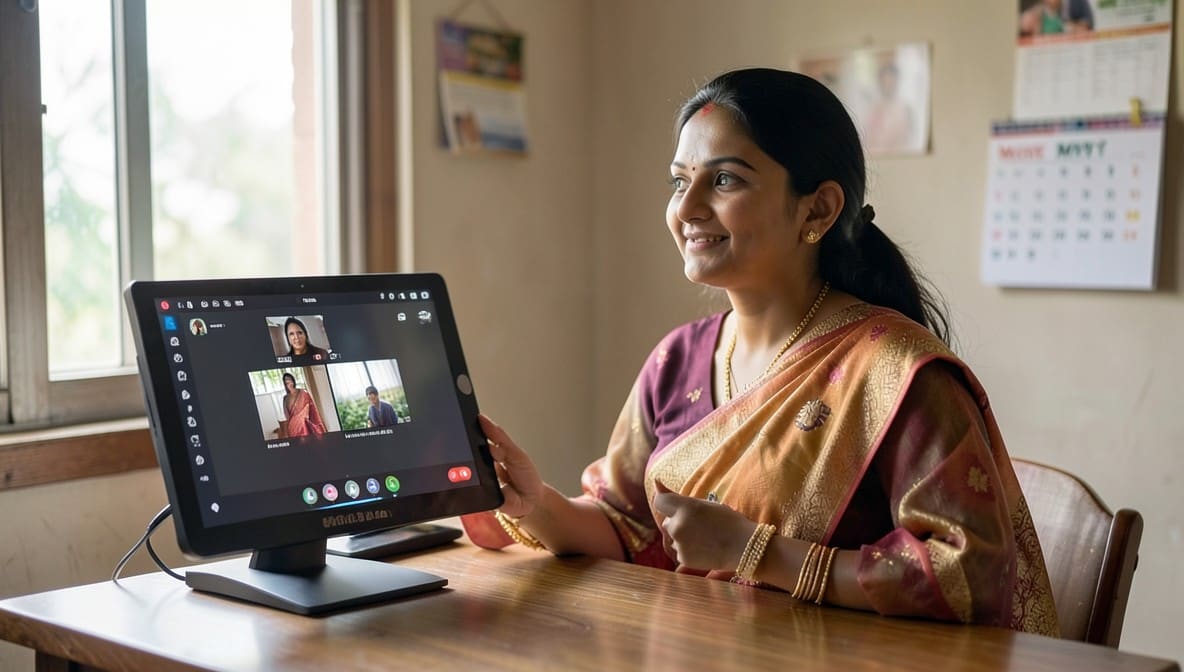
The Madhya Pradesh High Court has affirmed the procedural flexibility available under Section 24 of the Code of Civil Procedure to ensure equitable access to justice in family disputes, particularly where physical presence poses hardship. In a significant procedural ruling, the Court directed that virtual appearance, evidence recording, and electronic filing be permitted in pending matrimonial proceedings, reinforcing the principle that justice must not be denied due to logistical constraints.
Background & Facts
The Dispute
The petition was filed under Section 24 of the Code of Civil Procedure seeking transfer of RCSHM No. 29/2025, a matrimonial dispute pending before the District Judge, Baihar, District Balaghat, to the Family Court, Jabalpur. The petitioner, Smt. Shilpa Namdev @ Pandya, is the wife and respondent in the underlying suit. The husband, Shri Devendra @ Pappu Pandya, is the petitioner in the original proceeding.
Key Facts
- The matrimonial dispute involves allegations of cruelty and divorce under the Hindu Marriage Act, 1955
- The petitioner-wife resides in Jabalpur while the proceedings are pending in Balaghat, approximately 300 kilometers away
- The petitioner has no independent means to travel frequently to Balaghat for court appearances
- The petitioner is employed and faces significant professional and financial hardship in attending physical hearings
- No allegations of misuse of process or delay were raised by the respondent
Procedural History
- RCSHM No. 29/2025: Filed in District Court, Baihar, District Balaghat (date not specified in judgment)
- 05.04.2026: Misc. Civil Case No. 1534 of 2026 filed before the High Court at Jabalpur seeking transfer and virtual access
- 12.05.2026: Hearing conducted before Justice Maninder S. Bhatti
- 12.05.2026: Order passed disposing of the petition with directions
Relief Sought
The petitioner sought:
- Transfer of the matrimonial case from District Court, Baihar to Family Court, Jabalpur
- Permission to appear through video conferencing in all future hearings
- Permission to file documents through the Electronic Filing System
- Permission to adduce evidence and cross-examine witnesses via video conferencing
- Coordination between Family Courts of Baihar and Jabalpur to facilitate virtual participation
The Parties' Positions
The petitioner contended that physical attendance in Balaghat was impractical and discriminatory, especially given the absence of any prejudice to the respondent. The respondent did not oppose the petition, and no counter-affidavit was filed.
The Legal Issue
The central question was whether Section 24 of the Code of Civil Procedure permits a High Court to direct a subordinate court to allow virtual appearance, electronic filing, and remote evidence recording in a pending matrimonial proceeding, even in the absence of a formal transfer request being granted.
Arguments Presented
For the Petitioner
Learned counsel for the petitioner relied on the evolving jurisprudence on access to justice, citing Shyam Narayan Chouksey v. Union of India and State of Maharashtra v. Dr. Prafulla B. Desai, to argue that the right to access courts includes the right to participate meaningfully without undue hardship. He emphasized that Section 24 empowers the High Court to transfer cases in the interest of justice and that procedural flexibility under this provision must extend to modern modes of participation. He further cited the Supreme Court’s directives in Smt. Sunita Devi v. State of NCT of Delhi regarding the use of video conferencing in family matters.
For the Respondent
The respondent did not file any opposition or appear before the Court. No counter-arguments were presented.
The Court's Analysis
The Court observed that Section 24 of the CPC is a residuary provision designed to ensure that justice is not only done but is seen to be done with fairness and practicality. The Court noted that while the petition for transfer was not granted, the relief sought regarding virtual participation was both reasonable and necessary.
"The Court is not merely a forum for adjudication but an institution that must adapt to the realities of modern life. Denying a litigant the ability to participate meaningfully due to geographical distance, without any prejudice to the other party, defeats the very purpose of access to justice."
The Court held that the power to regulate procedure under Section 24 includes the authority to permit virtual appearances, electronic filing, and remote evidence recording where such measures are conducive to the ends of justice. The Court further emphasized that the trial court retains discretion to require physical presence if the circumstances of a particular hearing demand it, such as for identification, demeanor assessment, or complex testimony.
The Court also directed coordination between the Family Courts of Baihar and Jabalpur to ensure seamless technological support for the petitioner’s virtual participation, recognizing that procedural harmonization is essential for effective implementation.
The Verdict
The petition was disposed of with the following directions:
- The District Court at Baihar, District Balaghat, shall permit the petitioner to appear through video conferencing in all future hearings in RCSHM No. 29/2025
- The proceedings conducted via video conferencing shall be held in camera and not in open court
- The petitioner shall be permitted to adduce evidence and cross-examine witnesses through video conferencing
- The Court shall accept documents filed through the Electronic Filing System
- The Family Courts of Baihar and Jabalpur shall coordinate to ensure uninterrupted virtual access on hearing dates
- The trial court retains the discretion to require physical appearance if deemed necessary on any specific date
What This Means For Similar Cases
Virtual Appearance Is a Procedural Right, Not a Privilege
- Practitioners may now invoke Section 24 CPC to seek virtual participation in any civil proceeding where physical attendance imposes undue hardship
- Courts must evaluate requests for virtual appearance on a case-by-case basis, balancing convenience with the need for fair trial
- No formal transfer of case is required to obtain virtual access under this provision
Electronic Filing Must Be Accepted Without Hindrance
- Courts cannot refuse documents filed electronically merely because they are not physically submitted
- The burden is on the court to ensure the E-Filing system is functional and accessible to litigants
- Refusal to accept e-filings without valid reason may constitute procedural denial of justice
Coordination Between Courts Is Mandatory for Effective Implementation
- When litigants move between jurisdictions, courts must proactively coordinate technological and procedural support
- Failure to coordinate may result in delays and prejudice, attracting appellate scrutiny
- Family courts, in particular, must adopt digital infrastructure as standard practice